

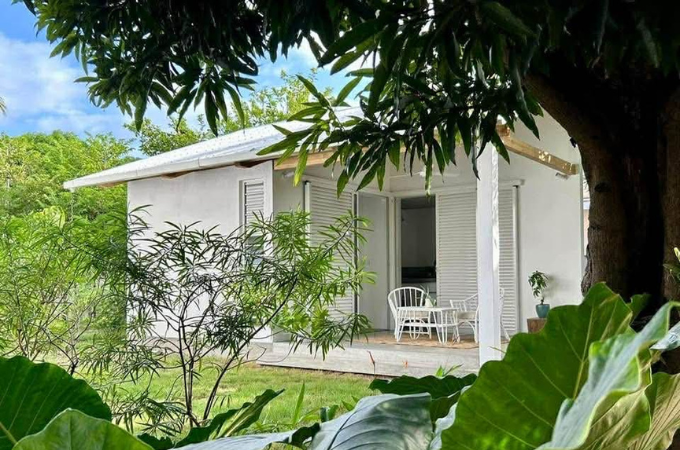
I created a writer’s residency on the island of Mauritius within six weeks. It was the craziest, and probably the best thing, I’ve ever done.
In 2024, I was selected, along with 31 other writers from around the world, for the University of Iowa’s International Writing Program (IWP) Fall Residency (sponsored by the U.S. Dept of State, Bureau of Educational and Cultural Affairs) which takes place in a UNESCO City of Literature. Despite the program’s legacy of nurturing the world’s most prestigious awards, including three Nobel Prize laureates to date, the U.S. administration terminated its grant in 2025, and the program has since been funded by private donations, NGOs, the University of Iowa and foreign ministries of culture.
Over the course of my residency, the IWP organised several cultural trips, including visits to Chicago, Washington D.C. and New York City. I also visited the Bridges of Madison County and Oklahoma City for The Neustadt Literary Festival, during which the prolific Mauritian author Ananda Devi was awarded the 2024 Neustadt International Prize for Literature (often referred to as the “American Nobel”).
After spending almost three months in Iowa, I returned to Mauritius with my suitcases full of books, my newly finished second manuscript, Tamarin, and a distant dream. As much as I loved being back on the island, I felt that something was lacking. I missed the feeling of Gemütlichkeit that we had in Iowa, where we were immersed in literary and cultural activities. I longed for culture around every corner.
In October 2025, our tenant informed us that she would be moving out of our studio in mid-December to a location closer to her place of work. That’s when it struck me that I could use this space to fulfil my dream of bringing literature to the vibrant coastal village of Tamarin, and to create more literary spaces on the island. It did not take me long to turn the idea into a plan. I used whatever resources I could get my hands on to organise a free one-week residency for writers. Thanks to friends, I managed to secure another two beach studios near Tamarin Bay.
“A writing residency?” an acquaintance of mine said. “Is there such a thing in Mauritius?”
“Precisely,” I replied, beaming my most performative smile, somewhat trepidatiously.
For a small island lost in the middle of the Indian Ocean, Mauritius has a long and rich literary tradition. It dates back to Bernardin de Saint Pierre’s eighteenth-century novel, Paul et Virginie which was the inspiration for Henry de Vere Stacpoole’s novel, The Blue Lagoon, which was later adapted for Hollywood starring Brooke Shields. In 2024, The Guardian named Ananda Devi’s novel Eve out of Her Ruins — translated by Jeffrey Zuckerman and published by Deep Vellum — among the hundred best contemporary novels in translation by women writers.
In November 2025, the Mauritian novelist Nathacha Appanah, won the prestigious Prix Femina, Prix Goncourt des Lycéens and was shortlisted for other major literary prizes for her searing novel on gender-based violence, La Nuit au Coeur (to be published in English by Linden Editions). And although Mauritian writers – especially its women writers – are garnering critical acclaim internationally, Mauritius has yet to make room for the full force of its literature.
But why did I want to create a writing residency? The thing that I kept going back to is how in my darkest moments, it is always writing that I turn to. Through writing, I try to make sense of the deeply fragmented world we live in and explore what it is to be human. The possibility offered by a blank page, to write our own narratives, in our own language and space, as a form of resistance, becomes a necessity. We do not need permission to write, to question and to challenge institutional power and literary exclusion.
Virginia Woolf wrote that “a woman must have money and a room of one’s own if she is to write.” Woolf was not only writing about women being unable to reach their full literary potential; she was also using the metaphor of a room of one’s own to represent freedom and independence from patriarchy. This brings me to another reason why I decided to create a residency on the island: as an alternative to the old-guard culture and male dominated networks in Mauritius that dictate who gets to curate, who gets published and who gets invited to literary events.
“That’s sounds pretty cool,” said my sixteen-year-old son.
“If anyone can create and curate a residency programme on the island, it’s you!” chipped in my nineteen-year-old daughter.
“You’ve always wanted to create more inclusive literary spaces,” added my husband.
With the help of my family and friends, I created a new logo for the residency, a new email account, a new Instagram page, spreadsheets, lists of potential sponsors and venues for a literary event, a budget, consulted a lawyer for legal advice, and on it went. The days leading up to the residency, I could barely sleep. Too many thoughts kept me awake at night, including the fear of failing.
I reached out to the former IWP Director Christopher Merrill, the program’s newly appointed Director Cate Dicharry, and a few of my IWP alumni peers, who all encouraged me and said the same thing: that the cultural, social and literary value of residencies cannot be overestimated, especially in these difficult times.
And just like that, the Tamarin Writing Residency was launched as a free, one-week residency that offers emerging and established authors quiet time in a private beach studio, to write, reflect and be inspired by the unique topography of Tamarin Bay. As I issued the call for applications on social media, there was a quiet, unspoken excitement followed by a buzz as word quickly got around.
Applications and queries started to pour in, just as an older male acquaintance approached me to mansplain the concept of a writing residency before warning me that my unprecedented literary endeavour would fail without ‘proper’ backing.
A few days before the deadline for applications, my nascent writing residency could barely keep up with the interest it was generating both locally and abroad, so I turned to a fellow writer friend, Ari Gautier, to help me draw up the shortlist. Judging the applications was no easy task due to the quality of applications received from around the globe, but we were in unanimity regarding the three selected writers: Vashish Jaunky, who was shortlisted for the 2024 Commonwealth Prize and for the Prix du Jeune Écrivain, Dr Sabyn Javeri, a novelist and Professor of Literature and Creative Writing at the University of Oxford and New York University (Abu Dhabi), and Clémence Soupe, a talented actress and emerging playwright whose writing in French seeks to resist inherited theatrical conventions. Their projects demonstrated not only intellectual and literary ambition but also cultural depth.
A week before the start of the residency, I still didn’t have a venue for our literary event. I requested a meeting with Javier Olivas, who after studying French Literature at Sorbonnes University moved to Mauritius as a lecturer, documentary-maker and manager of La Pointe Tamarin Cultural Centre, a local NGO dedicated to arts and education founded by the musician and social worker Jean-Jacques Arjoon. La Pointe Tamarin is currently under the patronage of Naomi Linehan, award-winning journalist, documentary-maker and bestselling author of Overcoming (Sunday Times Memoir of the Year 2019) and Nowhere’s Child published by Hachette. Halfway through my pitch, Javier reassured me: “You have our full support. We are hundred percent behind you and this new literary initiative.” These are words I wish I could hear more often in the Mauritian literary scene.
On the 16th of December 2025, a new chapter began as our three writers-in-residence packed their suitcases – and manuscripts – for the shores of Tamarin, where our days were filled with early morning walks, writing and reading in-between swims, yoga sessions and picnics on the beach, where we gathered at sunset to discuss our work.
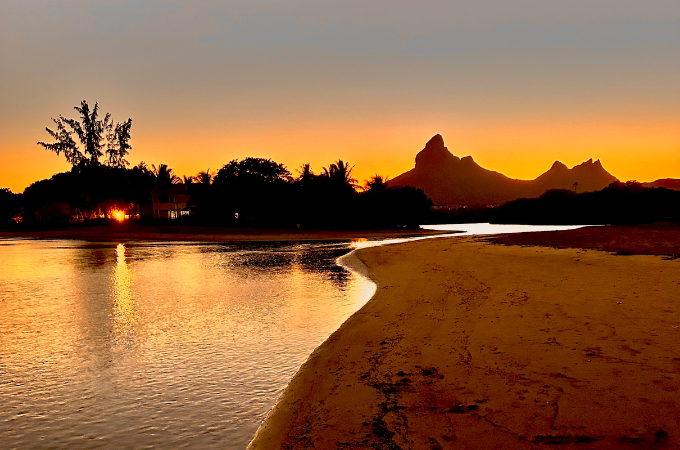
The weekend before Christmas, La Pointe Tamarin generously hosted and sponsored a literary soirée to mark the end of our first residency. Attendees included academics, translators, aspiring young writers, artists, the acclaimed novelist Lindsey Collen, a multiple Commonwealth Writers’ Prize winner, and her husband Ram Seegobin, a veteran activist who sadly passed away a couple of weeks later.
During the bilingual event, moderated by Senior Lecturer Dr Sachita Samboo, the three writers-in-residence read excerpts of their work in English and French infused with Creole words reflecting the linguistic diversity of our island where language still bears the marks of violence. The reading was followed by a thought-provoking discussion on languages, art and writing as a form of resistance. By the end of the evening, there was an overwhelming sense that this literary space was much needed on the island.
The following day, I was pleasantly surprised to receive an Instagram message from Nathacha Appanah, who after seeing videos of the residency on social media, inquired how she could offer her support to nourish my new literary initiative. We arranged to have a phone call during which we explored ways of bringing this project forward.
In a literary culture where writing is not valued and recognition feels remote unless we are able to get published abroad, the Tamarin Writing Residency is an act of inner permission, where the waves carry our stories. It provides a dynamic space for intellectual and artistic exploration, where our stories are represented and acknowledged – where our words flow to the rhythm of the sea that surrounds us, while our bodies and memories bear the stories of our past, present and future.
To quote Sabyn Javeri: “We are all made up of stories. The stories we tell others, the stories we tell ourselves, and most importantly, the stories we hide. Deep inside.’’
The words of Sabyn Javeri, Vashish Jaunky and Clémence Soupe continue to echo on the shores of Tamarin and beyond, cutting through the cacophony. Their nuanced characters, full of layers and depth, stand strong against the tide. Fierce and unrelentless, they seem to dive into the bay of Tamarin, into an ocean of possibility, where the sea holds a quiet restorative power.
*Author photo taken by Karl Ahnee






COMMENTS -
Reader Interactions