
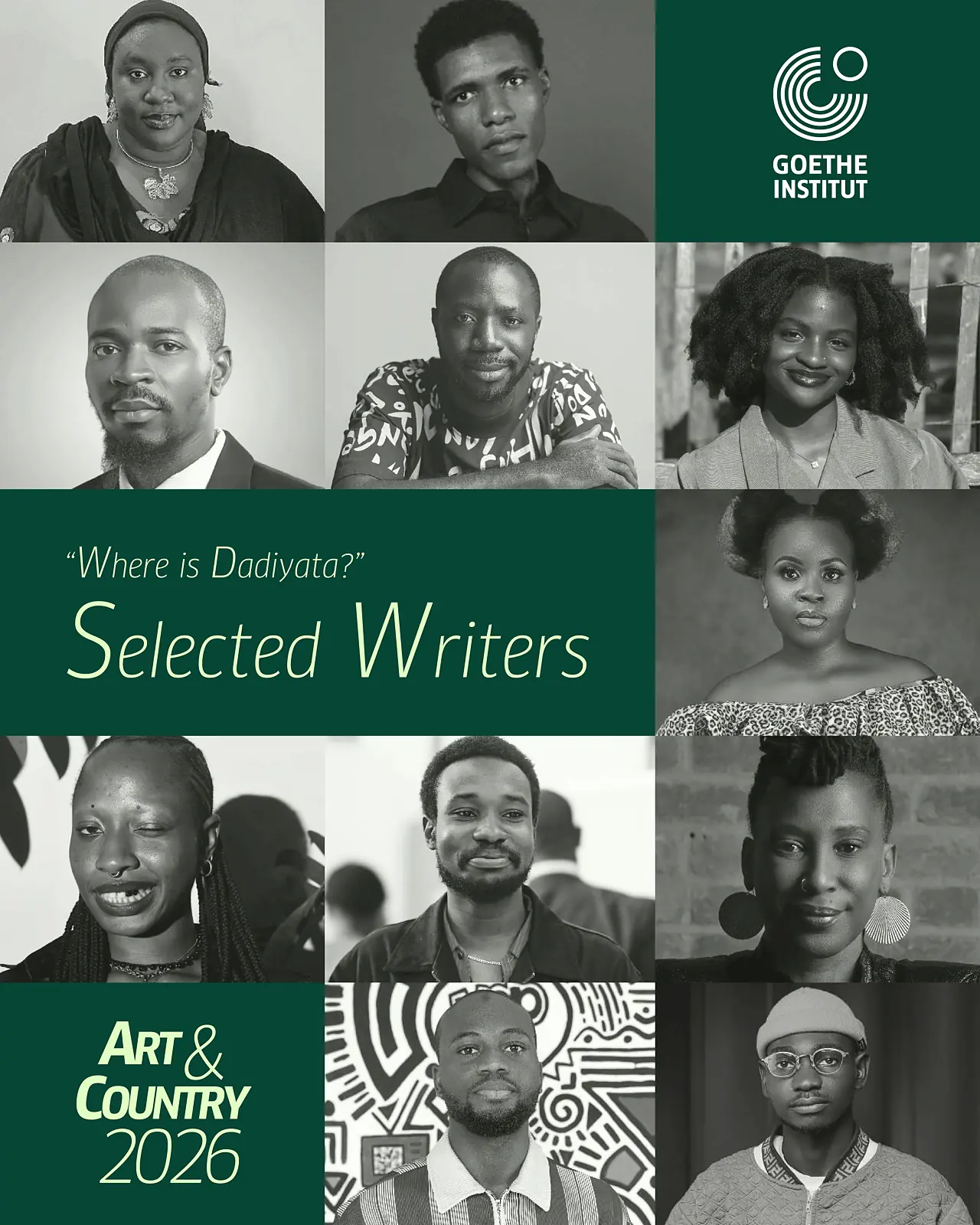
The Goethe-Institut Nigeria has announced the eleven selected writers for Where Is Dadiyata?, an artistic intervention developed under its Art & Country initiative that responds to one of Nigeria’s most urgent unresolved cases of political disappearance. Abubakar Idris, popularly known as Dadiyata, a political critic, social media commentator, and university lecturer, was abducted by armed men at the entrance of his home in Barnawa, Kaduna State on August 2, 2019, and has not been seen since. A movement dubbed “Where is Dadiyata?” has continued to demand answers from the Nigerian government in the nearly seven years since his disappearance, and it is this insistence, the refusal to let a name dissolve into silence, that the project takes as its creative and civic mandate.
The selected writers, drawn from an open call that closed in March 2026, will work across poetry, essay, experimental text, research, and public intervention to engage themes of disappearance, memory, and the politics of silence. Framed by the provocation that “a question repeated becomes a memory, and a memory repeated becomes resistance,” the project positions text as a form of civic pressure. The works produced will be presented across multiple formats, including standalone publications, performative readings, digital outputs, and text integrated into wearable and public art pieces, with a portion of proceeds directed toward supporting the education of Dadiyata’s daughter.
The eleven writers selected are: Aisha Kabiru Mohammed, whose work The Voices That Remain draws from real conversations to hold space for what is known and unresolved; Ogochukwu Umeadi, a writer and filmmaker whose satirical piece 66 Ways to Completely Erase a Man examines how absence is constructed and sustained; Amarachika Emele-Ralph, a writer and cultural practitioner who will use repetition of the titular question as a method to probe disappearance as both political and social condition; Seyi Lasisi, a film critic and culture journalist whose research-driven essay The Political Economy of Erasure reframes Dadiyata’s disappearance through Marxist analysis as a systemic tool of power; and Jacob Akoji James (Jason Cypher), a spoken word artist and community developer who proposes a participatory mural intervention in Kaduna that turns public space into living text and collective demand.
Also selected are Feyisayo Aluko, whose poems drawn from oral history interviews with Nigerians in exile will extend into a visual installation of etched plexiglass panels; Sulaiman A.M., a writer and lawyer whose experimental essay The Pattern That Eats Its Own draws a line between the attempted abduction of Umaru Dikko in 1984 and Dadiyata’s disappearance in 2019, tracing a recurring pattern of silencing in Nigerian political history; U-Meleni Mhlaba-Adebo, a Zimbabwean-American poet whose series In Plain Sight explores disappearance as an everyday civic condition traced through observations of urban life; BEKINWARI (B.), a Nigerian writer whose cyclical, fragmentary text will move through accumulation, names dissolving into numbers, loss becoming routine; Chidera Udochukwu-Nduka, an award-winning Nigerian-Igbo writer whose recursive lyric essay The Question That Echoes Throughout the Countryreturns repeatedly to the central question, refusing closure in a way that mirrors the unresolved reality; and Al Amin Al Hassan, a poet and artist whose interdisciplinary work Silence as Language uses poetry, performance, and participatory engagement to examine silence as both suppression and resistance.
Together, the eleven constitute a remarkable cross-section of Nigerian and diasporic literary practice; poets, essayists, journalists, researchers, and conceptual artists who approach a single unbearable question from eleven different directions, in eleven different forms.
The project’s deeper urgency is hard to ignore: if Dadiyata is not found by August 2026, he will be declared dead by Nigerian law, which makes the act of artistic insistence feel like more than culture. More information on the project is available at goethe.de/nigeria.


COMMENTS -
Reader Interactions