

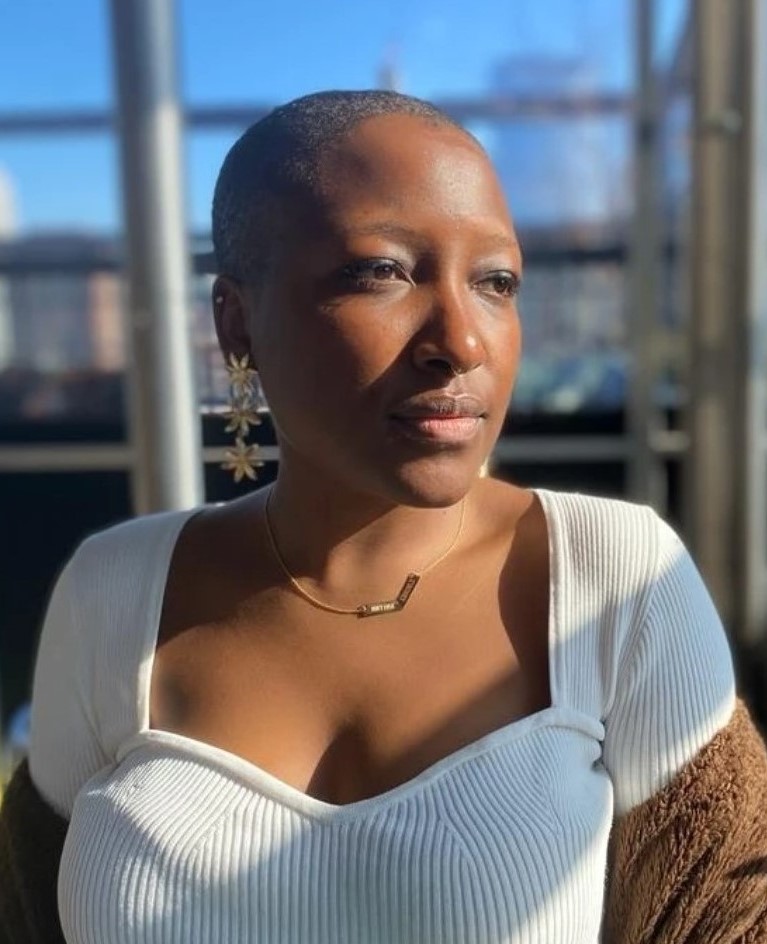
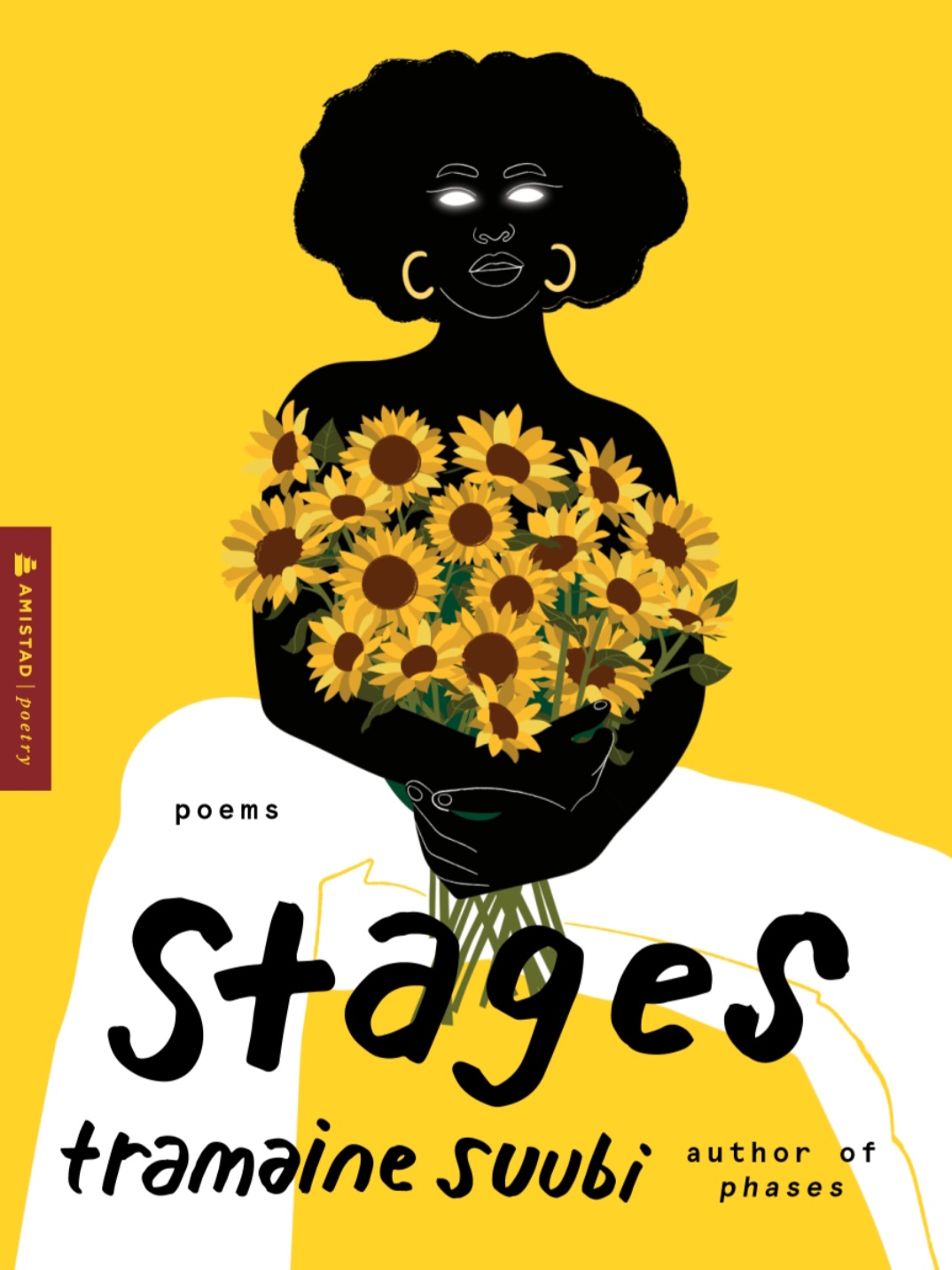
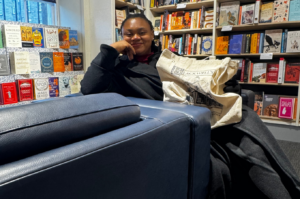
Tramaine Suubi is an Ugandan-American poet, editor, and multidisciplinary writer whose debut collection phases and sophomore collection stages, have announced her as one of the most urgent voices in contemporary African poetry. Quadrilingual in English, French, Luganda, and Runyankore, she is a former managing editor of the Kampala-based Pan-African literary initiative Writivism, an assistant editor at The Weganda Review, and a guest editor whose thematic framing of kitalo, a Luganda word for grief, shaped an entire issue of Yellow Arrow Journal. She is currently writing both a novel and a play.
Born in Uganda and living between it and the United States, Suubi’s work sits at the crossroads of the personal and the political, the celestial and the deeply earthbound. Her poems have been shaped by MFA training, chronic illness, mental and physical therapy, and a commitment to collective liberation that refuses the myth of the solitary poet. She has spoken candidly about the fraught politics of African literary prizes, the theft embedded in artificial intelligence, and the way diaspora both fractures and gifts a writer’s voice. She loves June Jordan above all others.
We talked to Suubi about what it means to love Uganda without conflating its people with its institutions, how she maps the landscape of Ugandan poetry from Okot p’Bitek to a forthcoming debut that may make history, and why she is giving her next collection ten years to breathe in silence before it meets the world.
Brittle Paper
You’ve described Uganda as a country whose literature is “fighting to survive,” where freedom of speech, press, and assembly are under erosion. Yet you were born there, and it is clearly the emotional and political core of your identity as a writer. How do you hold that tension of the love for a place whose current climate makes honest literary expression dangerous?
Tramaine Suubi
My framework of love is most influenced by bells hooks’ all about love, 1 Corinthians 13, and my older sister. I find all three sources errant and fallible, but deeply inspired. Based on this framework, I learned to less so hold the tension of love for this place and more so “live in the tension,” as phrased by a former professor of mine. Existing between the many contradictions of so-called Uganda and the so-called United States means I was born fighting to survive, just as their respective literatures are fighting for survival today. For me, the people define a place and I love my people, while practicing accountability with my people. I am able to love my birthplace because I do not conflate individuals with institutions, I can accept multiple truths at same time, and I love people in this place—many of whom are fighting for free speech, press, and assembly. Our literature has and will outlive the despot of the day, and their support from white christofascism.
Brittle Paper
Ugandan poetry has a rich lineage, from Okot p’Bitek’s Song of Lawino to the more recent work of poets like Ber Anena, Mildred Barya, and Arao Ameny, many of whom you’ve cited as voices worth celebrating. For readers who may be coming to Ugandan poetry for the first time through your work, how would you map the landscape? Who are the essential names, and what threads connect them across generations?
Tramaine Suubi
I actually have Song of Lawino & Song of Ocol, A Nation in Labour, and The Price of Memory resting in my personal bookcase. I am hoping for Arao Ameny to release her debut poetry collection someday, but I have taught “Home is a Woman” in multiple creative writing workshops and classes. When traveling across the landscape of our poetry, note the ethnic and linguistic diversity of our grafted nation. I would actually recommend reading from the present towards the past. I would begin with Jedidiah Mugarura’s forthcoming Nyamuteza. They may be the first Ugandan to win the African Poetry Book Fund’s first book prize. Next, the explosive poetry of Stella Nyanzi in Exiled for My Mouth is worth visiting—and “Museveni Birth Date a Wasted Day,” which launched her exile. Afterwards, I would stop by Hope Wabuke’s The Body Family. I would also recommend all the poets you have previously mentioned. I must highlight other FEMRITE poets, who include Beverly Nambozo. I would recommend ending an introductory survey with the archived folk songs of the Karamoja, Acholi, Toro, Nkore, and Buganda kingdoms. After all, we began with a rich tradition of oral poetics.
Brittle Paper
You’ve spoken about the silver linings of being Ugandan poets in the diaspora. Is there something specific that diaspora does to a poet’s voice? How has living between Uganda and the United States shaped the kind of poet you are?
Tramaine Suubi
There are infinite combinations of specific things that diaspora does to a poet’s voice. That analysis is a whole book of its own. Based on my experience and observation, these specificities include liminality, dexterity, expansion, and an inescapable tinge of grief. There are also wildly different stakes depending on whether the poet enters the diaspora, voluntarily or involuntarily, as an asylee, a refugee, an international student, or an international worker. There is a sort of fracture in the diaspora poet’s voice that can lead to verses anywhere from ‘mango diaspora poetry’ to Transition Magazine. This cultural fossilization and my experiences with cultural diffusion have significantly shaped my poetry. I was robbed of true belonging and gifted a kaleidoscopic gaze. Living between two neocolonial states has made me a hypervigilant and hypersensitive poet. I cannot not pay attention, for better and for worse. Then again, attention can be a potent form of love.
Brittle Paper
You are a quadrilingual writer (English, French, Luganda, Runyankore) and multilingualism moves through your poems not just as texture but as a structural choice. The theme you chose as guest editor of a Yellow Arrow Journal issue was kitalo, which comes directly from Luganda. Can you talk about some of the Ugandan and African poets you love who also work across languages, and what that multiplicity of tongue does to poetry as a form?
Tramaine Suubi
I appreciate you noting that my multilingualism is both a certain texture and a structural choice. I was proud of that Yellow Arrow Journal issue and I explained it fully here. One African multilingual poet whom I personally know and love is Karwitha Kirimi. The ones who live on my bookshelves include Adedayo Agarau, Yalie Saweda Kamara, I.S. Jones, Manthipe Moila, Yrsa Daley-Ward, Warsan Shire, and Ijeoma Umebinyuo. Among many things, the multiplicity of tongue can make poetry more empathetic, more chaotic, and more dense. It makes the form more malleable and absorbent. There is the risk of becoming less legible and accessible in an increasingly illiterate and distracted world. However, I believe the benefits of multilingual poetics outweigh the costs.
Brittle Paper
Beyond Uganda, you’ve expressed deep admiration for poets across the continent and its diaspora. If you were putting together a Pan-African poetry syllabus, the books you’d want every serious reader of African poetry to sit with, what would be on it, and why?
Tramaine Suubi
What a fantastic challenge! With no repeating and no hesitating, these are my ten recommendations for a Pan-African Poetry syllabus. I would start with Complete Writings by Phillis Wheatley because she was the first African to publish a poetry collection in English. I break continuity here to highlight Zong! by M. NourbeSe Philip, for its historical significance and its groundbreaking found poetry. I suggest The Collected Poems of Langston Hughes because he is arguably the most influential poet of the Harlem Renaissance. This movement gave birth to Négritude, so I am including two of its cofounders through The Complete Poetry of Aimé Césaire: Bilingual Edition and The Collected Poetry of Léopold Sédar Senghor. After the global freedom struggles of the sixties, I recommend Ntozake Shange’s revolutionary choreopoem for colored girls who have considered suicide / when the rainbow is enuf. I am compelled to include my favorite poet of all time: Directed by Desire: The Collected Poems of June Jordan. I would round out my syllabus with three poet laureates. First, Africa’s first poet laureate Mazisi Kunene and his collection, Echoes from the Mountain. Then, Thomas and Beulah by Rita Dove, which offers critical insight into the Great Migration and familial dynamics that echo across the African diaspora. And finally, a poet who has significantly shaped the whole diaspora’s poetry and its future: Sturge Town by Kwame Dawes. I painstakingly curated this syllabus to include as many intersections and identities, within the Pan-African community, as possible.
Brittle Paper
Your debut, phases, drew on the moon’s cycles as a framework for exploring healing, heartbreak, and transformation. stages, your second collection, turns to the life cycle of the sun and expands outward from the personal to the political. What does the shift from moon to sun mean for you thematically, and how did it change the kinds of poems you wrote?
Tramaine Suubi
I think the main thematic shifts were maturity, breadth, and doubt. Across many cultures, spiritualities, and astrologies, human beings project traditional femininity onto the moon. These projections are inherently flawed, but I subconsciously and consciously leaned into them. The poems in phases are more internal, more focused, and more structured. All those poems were written before I ever took a creative writing class, joined a writing workshop, or began my MFA program. I maintain compassion for my younger self and some of those poems truly saved my life. Yet, those poems are laced with a certain naivety and I hardly recognize the person who wrote them. On the other hand, many cultures, spiritualities, and astrologies project masculinity onto the sun. This concept is even more flawed and I consciously interrogated it. Throughout stages, the poems became more ambitious in their scope, their forms, and their skepticism. All those poems were written during and after my MFA program. They also became paradoxically more precise and more opaque. I played more, too. I wanted to live beyond binaries and explore multiplicity. I did not want to revolve around one entity anymore, so I re-centered myself, clarified my priorities, and dedicated most of my time to scrutinizing all that the light touches and shining light wherever I wanted more.
Brittle Paper
The advance praise for stages is striking in how most of those writers are themselves poets of colour working at the intersection of the personal and the political. Adedayo Agarau in particular writes about what your work does for the question of “what African poetry can do, what it will do.” What do you think African poetry, and Ugandan poetry specifically, can do that other forms cannot? What is the unique political and emotional work it’s capable of?
Tramaine Suubi
I am eternally grateful for the generous blurbs from such admirable writers! Adedayo is a rising champion of African poetry and his words left me stunned. I am a child of the earth and I was raised to harness the power of words. African poetry wields the power of witness, longevity, and shapeshifting in ways that other forms have yet to do. We are a continent shaped by over two thousand languages and ethnicities. Our poetry feels more embodied to me. Ugandan poetry feels uniquely direct and unpretentious. Our forms do a lot of elegiac work and preservation of lineage. They bring to mind the role of the wailers I would observe as a child during funeral processions. Our poems often transmute the rage, the chaos, the mourning that is silenced within us and others.
Brittle Paper
You served as the managing editor of Writivism, a Pan-African literary prize initiative founded in Kampala, and you’ve spoken candidly about the fraught politics of literary prizes in Africa, how the most prestigious ones are often named after, funded by, and initially judged by white Europeans. Are there up-and-coming African poets and writers, especially from Uganda or East Africa, that you feel the broader literary world is sleeping on, people whose work Writivism has introduced you to, or that you think deserve far more attention?
Tramaine Suubi
I stand by those words, and in fact, I think the whole literary prize industrial complex is plagued by fraught politics. Funding was the largest obstacle for Writivism and unfortunately, it has placed our work on an indefinite hiatus. The prize introduced me to three rising stars whose work has lingered with me, even after three years: Davina Philomena Kawuma, Maryhilda Obasiota Ibe, and Sanni Omodolapo. Their work with subversion was wonderful, and I hope to hold their books in my hands someday.
Brittle Paper
You came to poetry in your early twenties “from a place of humility and curiosity,” you’ve said, and you’ve described it as the space where you didn’t have to hedge or explain yourself. Now you have two full-length collections published by a major imprint, you’re an assistant editor at The Weganda Review, and you’re writing a novel and a play simultaneously. The stakes feel very different from that early freedom. How do you protect the honesty that you’ve called the “truest purpose of poetry” as your public profile grows?
Tramaine Suubi
Brittle Paper
You’ve said you believe “individualism will not save us” and that you work toward “the total liberation of all oppressed people.” Poetry, by its nature, is often a solitary and interior art. How do you square that? How does a poem, a deeply personal object, become a collective act? And for the young poets in Uganda and across the continent reading this, what do you want them to know about surviving, and thriving, in this literary moment?
Tramaine Suubi
Amen and amen! I think poetry often starts as an interior art, but I do not think it is meant to be truly solitary. I view this ideal as a European-American myth of the owning class. There is a certain type of poet who has historically taken money, time, and space to write in solitude. Outsourcing the labor required for food, clothing, and shelter makes the life of a poet more accessible. Most human beings do not have the privileges required for a solitary artistic practice. Poets such as Lucille Clifton explicitly address these challenges. As a result, our oldest surviving epic poems were built on communal storytelling and are still accessible today because of collectivism. Before the printing press, we had the griots. Spoken word poetry and slam poetry have a unique staying power that written poetry is still building.
I believe anything can be(come) poetry and I believe that no poem is truly original. We invent new ways to say the same old things. So, I believe poetry begins as a collective act that is uniquely channeled by an individual in a way that may be personal to them. I think that all poems are in conversation with the ones that came before. That interconnectedness feels like collectivism to me. In a more tangible way, poetry becomes even more collective when we share it with one another, and not necessarily through publication. I really enjoy reading and writing after poems. My favorite poem that I have ever written was written in conjunction with a poet I love who I have yet to meet in person.
To all the young poets across the continent, I want you to know that poetry may not put food on your table, clothes on your back, or a roof over your head, but it can save your life. I believe that poetry is an embodied practice and you can find ways to integrate it into your life, especially as the prison poets have shown us. The internet is fighting viciously for your attention and the billionaires have designs on your art. Please protect your art and your poetry practice. For the love of God, please do not engage with so-called artificial intelligence. It is being weaponized for theft and it steals from us in every way.
Finally, to become a good poet, you need to be a good listener and a good reader. Read our poetic ancestors and read them critically. Pay attention and record these perpetually unprecedented times. There is no true arrival and ideally there is no peaking. Strive for lifelong improvement. I would hope that we keep trying to grow as poets until our bodies return to the earth.

Marshal May 19, 2026 15:14
I found this interview powerful because it highlights poetry, diaspora, and survival with honesty and emotional depth. It was deeply meaningful to read. https://www.wordlelimericks.com/