

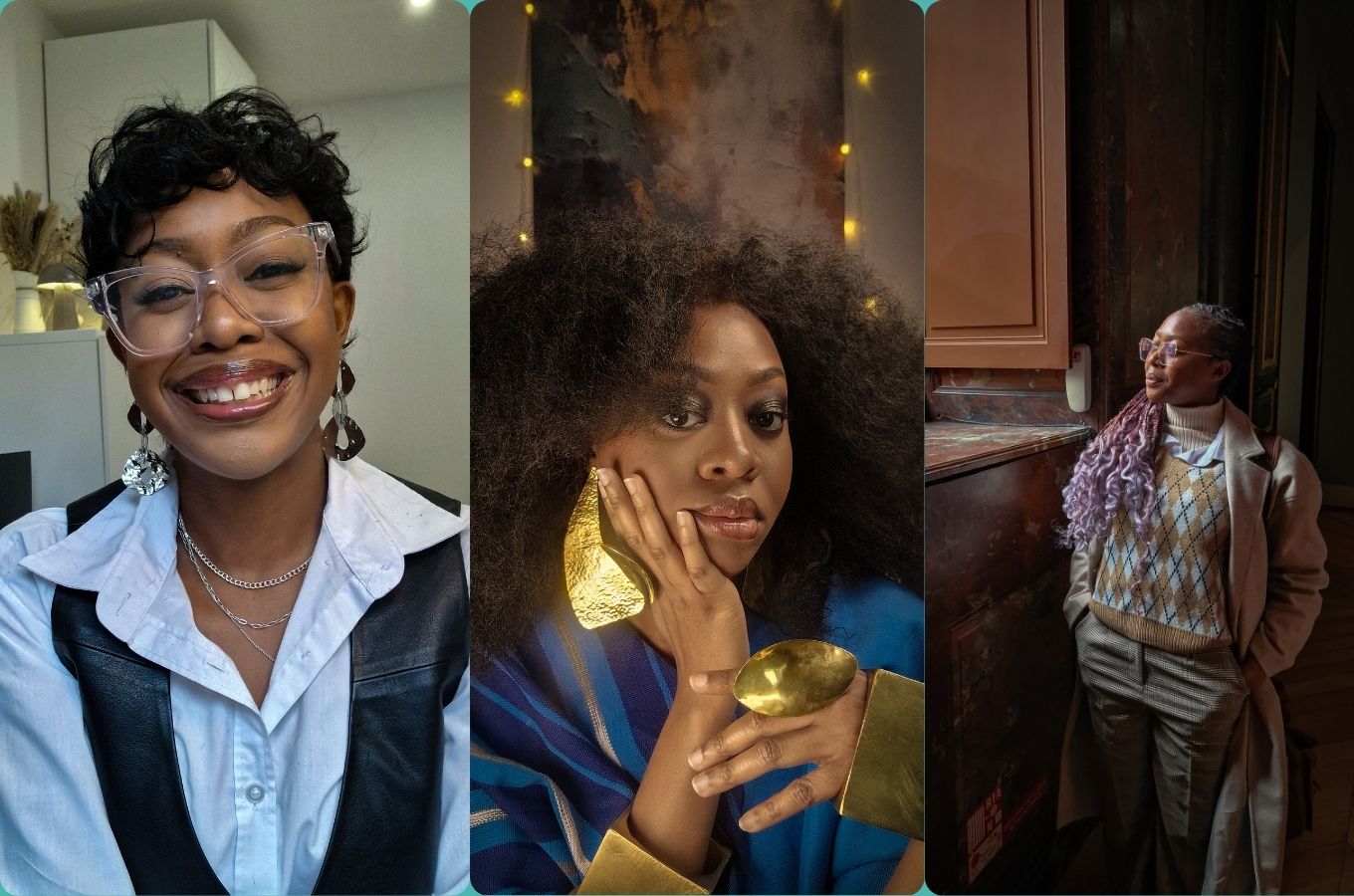
Huwa doesn’t just write poetry, she engineers entire worlds around it. A PhD student in Civil Engineering by day and a spoken word poet whose Instagram reels have surpassed 100,000 views, Huwa represents a new generation of Nigerian artists refusing the false binary between STEM and the arts. Since discovering spoken word at a crowded University of Benin auditorium in 2016, she has built a formidable presence on digital platforms, creating short-form poetry that tackles everything from in-law politics to domestic violence to the joys of friendship. Her work has become many people’s introduction to spoken word, a craft she stumbled upon almost by accident but has championed with missionary zeal.
What makes Huwa’s practice distinctive is her understanding of how poetry functions differently across platforms. She writes for the page, performs for the stage, and creates engaging content on social media. Her poems are mirrors held up to everyday Nigerian life, exploring what she calls “the human condition, especially about women,” while refusing to reduce her art to stereotypical narratives of pain and suffering. In this conversation, she talks about the labor behind what looks effortless, the infrastructure the Nigerian arts scene desperately needs, and why going back to STEM freed her to write better poetry. She also shares her Fast Five favorites, including why Avatar: The Last Airbender is the superior Avatar and why amala wins every time.
Brittle Paper
Hello Huwa, thanks for taking the time to chat with us. The objective of the interview is to learn more about your work as a spoken word poet, as well as your perspective as someone who uses social media to get out your message and deliver your craft. Please provide us with as much information as you can.
Let’s start with you. For people meeting you for the first time, how do you usually introduce yourself? Where did you grow up, and what parts of that upbringing still inform how you exist in the world today?
Huwa Okoyomoh
Just Huwa, it’s short for a much longer name that nobody calls me by. I would immediately follow that with a conversation about my love of animé and how I simply adore cartoons; this is to gauge how the rest of the conversation would go. Awkward silence or debates on the better Avatar (it’s Avatar Aang).
I grew up in Lagos and I think my closeness with my family, my brothers, still affects how I see community and friendship today.
Brittle Paper
You write fiction as well? We have your story published on Brittle Paper. Outside of being a poet, what other hats do you wear?
Huwa Okoyomoh
I am currently a PhD student in the department of Civil Engineering. I have a desire to study and reintroduce earthen materials as primary construction materials in place of concrete and cement.
I crochet in my spare time, I’m trying to make myself something fun for the summer. I used to dance, then I don’t know… old age 😅? But I’m trying to connect to the little and big things that gave us joy as children.
Brittle Paper
Take us back a bit to the beginning and talk about what drew you to poetry in the first place. What were the key moments or influences that defined this path for you?
Huwa Okoyomoh
Now that I think about it, it was quite adventurous. Although I read children’s books growing up, the sentiment that literature was for leisure in the Nigerian community really stuck with me. I liked stories but I never allowed myself to imagine becoming a writer. The most prominent writer at the time was Chimamanda and growing up she just seemed so out of reach.
I was a decent science student so I focused on my mission of becoming an engineer. Ironically, it was in that department that I was introduced to fiction, properly, by my friends and classmates. I remember reading all seven Harry Potter books during the exam period in my second year and I could not get enough of fiction. I passed the exams by the way, it was worth the added stress and anxiety.
Eventually, my neighbour who noticed how much I enjoyed stories informed me about a play at the auditorium. The play was fine, I think, but I’d be honest here, I do not remember what the plot was let alone the name of the characters. The auditorium was also packed full and if you have been in a crowded space filled with uninterested students, you’d know of the drama that ensued that had nothing to do with the kind on stage.
They called for an intermission, and here the opportunity for the up and coming artists of the great Uniben sprung. There were rappers, singers, dancers… the usual. But there was one person who managed to get the auditorium quiet. For the first time since the program started, the audience gave the act on stage their rapt attention. When he was done, I found myself and almost everyone else on our row at the edge of our seats.
For the rest of the play, I zoned out. Replayed not just what I thought the previous performer said but recounting that there was something so mesmerizing about his cadence. When I had the chance, I asked my friend whom I had watched the play with for the name of what he did. It was not a speech or debate, a monologue maybe, but it had a rhyme scheme. She said it was ‘spoken word’. That was the first time I had ever heard that in my life. At an auditorium between 2016/2017 and that moment changed everything for me.
I think what drew me to it the most was how underappreciated it was. How could nobody celebrate this art form? Well, I did not know at the time that it was a well-known craft but for a science student delving into the world of literature, I knew of fiction and non-fiction, plays, poems and even movies but spoken word, I had never heard of it. I thought it was a wrong that needed to be made right and I decided, out of sheer boredom or a desperate need for a quest, that I would be the one to make people fall in love with spoken word.
Brittle Paper
What is poetry to you?
Huwa Okoyomoh
A while back, I said that “Spoken Word is truth from broken pieces of our hearts that bleed from pen to paper.” on my podcast. Now I was probably what? 19 or 20, when I wrote that. A broke student with a broken heart so at that point, it was poignant. I’m 28 now, I haven’t seen it all but I will say that it is important to see beauty and happiness wherever I can find it.
Poetry is that anchor that keeps me grounded. Writing these poems I realise that I’m not alone and there is hardly a unique experience.
Brittle Paper
For someone like you who performs, writes, and creates content for digital platforms, we wonder whether you experience poetry the same across these different mediums.
Huwa Okoyomoh
Written poetry and performed poetry are the same but different. They both tell their stories but I guess it’s a little like watching a play and reading a book. That’s the best way I can describe it.
Brittle Paper
From the outside, a lot of what you do looks effortless. What’s the hardest part that people don’t usually see?
Huwa Okoyomoh
All of it. Well, maybe not the writing. Now that I don’t write for sustenance it’s easy to observe the world and write what naturally comes to me. But everything else takes a bit more effort and consideration that eventually hinders the release dates of my poems.
Memorising the poems, conceptualising the visuals, reaching out for collaborations, the setups, make up, audio and video editing, even down to getting over the imposter syndrome. I have a number of poems I have written, perhaps even shot and edited that I will never post. Getting over that hurdle and sharing it with the world takes an extra layer of mental strength and after that, we have the obsession over analytics and filtering comments.
Everything takes an amount of effort and time and I enjoy every bit of the process. It’s always worth it when I hear that someone shared my video or used my poem to audition for a role or part in a play because it says that all my work means something.
Brittle Paper
Your work on social media is stunning. Your look, your vibe. How did social media become such an important part of how you share your poetry?
Huwa Okoyomoh
I appreciate the compliment. Thank you. I’ve been writing and performing since 2017 but it wasn’t until late 2020 and early 2021 that I got popular on Tiktok and Instagram, before then, I’d been putting out content on YouTube and on my podcast channel.
I had all these little poems that ran for less than a minute but I couldn’t really perform them on stage because for those kinds of performances, you are engaging with your audience. People are enamoured by your presence and they can accommodate longer content. Digital media with the introduction of vines and reels has conditioned its viewers to short content and with a diminished attention span, a 30 second piece would do wonders. I had so many of them and soon it was easy to stay consistent and grow my platform. At the time there weren’t a lot of Nigerian spoken word artists on social media so I’d hear people say I was their introduction to the craft. It was very satisfying. It reminded me of why I started performing in the first place.
Brittle Paper
One of your Instagram reels, “diss-respectfully,” has crossed 100,000 views. We watched it several times, and the way it tackled in-law politics really resonated. Can you tell us the story behind that piece? How did it come together, and were you surprised by how strongly people responded to it?
Huwa Okoyomoh
Like most of my poems, it is derived from real life conversations and debates. Some are happening on social media and others yelled at a salon, or are whispered in the office. I try to make my poems as relatable as possible and though I am surprised sometimes about how well a poem that took me 5 minutes to write and film does over one that took me 2 weeks, I have developed an understanding of my audience and what they prefer. They gravitate towards stories that hold a mirror to their lives and speak on the human condition, especially about women. My best performing poem till date is “Dem Go Still Talk” about unplanned pregnancies followed by “You Dey Mind Dem?” which speaks on domestic violence.
As a feminist, I try to tell stories about women and the challenges we face but I don’t want to focus only on that because then I become the stereotypical artist. Drawing inspiration from pain and suffering. So I branch out and explore themes like nostalgia, (unsuccessful) dating, friendships and crazy best friends. Because life doesn’t need to be painful first to be relatable or beautiful and art, my art, should show that too.
Brittle Paper
Tell us about the Nigeria poetry scene. Is it thriving? Are there areas where it needs support or infrastructure?
Huwa Okoyomoh
The art, not just poetry, scene in Nigeria needs a lot of support. And I mean from the very basic level. We don’t encourage children to read, write, paint, dance, sing, learn a musical instrument, sew, design, speak (debate), play a sport, cook for fun, or act enough and I think that this is crucial to develop empathy, creativity, innovation and an all-round healthy society.
At the time I was in secondary school, the science students outnumbered the art students by 5:1 (rough estimate) with even fewer students in the economics/commercial and you would see students struggle with these subjects but stay put because society will think less of them for wanting to be writers or artists. Brilliant students with distinctions in their results are pressured to study medicine or engineering because of the false belief that intelligence only exists in codes and hard science. But innovation is born from creativity and that part of ours is being suppressed if we do not appreciate the contributions the arts make.
The artists are the historians and storytellers. They are also the ones that strive for originality and we don’t think that any of that is important. But after a long day of being a successful surgeon inventing novel treatments, would you go home and carry out more operations?
We work to live, that is the point of earning a living; and when we think about living, we dream of eating out at restaurants, watching a movie at the cinema, or a football match at the stadium. We don’t dream about work, and until we acknowledge that they are just as important, I worry about the art scene still.
Thankfully, with the introduction of digital media, anyone with access to the internet and a phone can break the noise and connect with those who share their interests.
To answer your question, compared to a decade ago when I was first introduced to spoken word, there is a growing community for poets but this is spearheaded by private communities. We need to do more. More colleges and institutions for fashion designers, chefs and the culinary arts, athletes, gamers and many many more.
It is impossible to talk about the literary scene in Nigeria without addressing the absence of support that the arts have as a whole.
Brittle Paper
What about your own experience in the poetry community? Have there been particular moments that have stayed with you?
Huwa Okoyomoh
I am blessed to have such a supportive community. When I started performing, I was introduced to the community in Benin and the yearly events by the organizers at SIO (Say It Out). It was on that stage that I conquered stage freight and grew my confidence to speak and share my poems. I am grateful for all the poets and performers that listened and cheered, even the ones that weren’t very good.
Brittle Paper
There’s often an unspoken hierarchy in literary spaces that places published poets above performance poets. Have you encountered that in your own career, and how do you navigate or push back against it?
Huwa Okoyomoh
I haven’t encountered it. I know of it but then again from the moment I tried being a poet, there was a lot of push-back. They did not compare me to a published poet but rather a rapper and a common question was why not rap instead. I would supposedly receive a lot more respect for it and at that time, spoken word poets were the punchline to a joke. I didn’t care enough about that to stop.
Brittle Paper
Let’s talk honestly about money. Poetry has always had a complicated relationship with sustainability, even though it’s real labor. Do you feel that relationship is changing at all, especially with digital platforms?
Huwa Okoyomoh
As I said at the start, writing, at the time, was not a lucrative business. Like most art forms in Nigeria, it is not treated with the respect it deserves. And it was easier for me to pursue a literary and creative career as an engineering graduate. Quite strenuous but enjoyable. I did not have the pressure a lot of new artists feel to be successful right off the bat and that worked for me quite nicely.
To be honest, I find that the moments I write my best is when I don’t expect any monetary compensation. I worked in the creative space for a while and what I noticed was I had longer periods with writer’s block and originality was always one station ahead no matter how many rides I took. Going back to STEM, which I absolutely love, gave me the freedom to write because I loved it and not because a deadline was looming.
Let’s talk about sustenance. When I first tried writing, getting paid for it was not on the table and unless you were an established novelist, the opportunities were not looking good. I went into content editing and digital advertising in order to tap into the lucrative market but again we were writing for others and I have always felt so strange when something subjective and deeply personal is now flattened to two or three lines built to run its course as a hashtag. It was never enough, influencer and content marketing is a drug and people always want more and that’s a good thing, if you’re fine with adrenaline but I wanted to create something that lasted longer, a piece of poetry like ‘Dem Go Still Talk’. But this is the reality of writing for the digital space. No matter what form of content you make, you have to write your story first and it will never be enough.
The digital space shone a spotlight on different kinds of storytelling and it is encouraging small and indie writers that there is hope for us afterall.
Brittle Paper
If someone discovers your work through this conversation and wants to explore more African poets working in spoken word and performance, who are five people you’d tell them to check out?
Huwa Okoyomoh
Philip Asaya, he started the program Say It Out where I had the chance to perform in front of an audience who loved poetry. Then Havfy, one of the powerful spoken word poets that speaks on social justice. You cannot speak on the spoken word scene in Nigeria without mentioning Wana Udobang, Lola Shoneyin and IBQuake.
Brittle Paper
To close our conversation, we have five questions requiring only single answer responses. Here goes the Fast Five:
Who is your favorite poet of all time?
Huwa Okoyomoh
Sophia Thakur
Brittle Paper
What is one book you can’t wait to read in 2026?
Huwa Okoyomoh
A broken people’s playlist, Chimeka Garricks
Brittle Paper
Amala, pounded yam, or neither?
Huwa Okoyomoh
Amala
Brittle Paper
Do you write first or perform first?
Huwa Okoyomoh
Write
Brittle Paper
A word you love?
Huwa Okoyomoh
Poignant
Brittle Paper
Thank you, Huwa, for chatting with us. Keep in touch. Keep us updated on what is going on in your world. We wish you all the best!


COMMENTS -
Reader Interactions