

I ate the bones of my father
We should have been a normal family in a tiny house with an orange door. We could have been known for brewing buckets of sorghum beer and cooking delicious goat stews for local funerals. Instead, we were the reason those funerals were happening.
The problem arose because I look like my father; therefore, people assumed I was him. They were looking for him.
Maybe I had been him all along.
Father did something, and mother was aware of it.
An angry voice interrupted my thoughts, echoing in the woods. Behind the searching community, my house was on fire, as if the flames belonged on that plot of land; it glowed beautifully, as if the sun had fallen onto the roof.
The light flickered between the trees and under the shrubs.
The searchers passed through the forest, through bushes that finally brought them closer to where I was hiding. They still couldn’t see me, but I saw them. I smelled them.
Something inside me didn’t come from this body. Mother knew and kept quiet.
I kept hearing my parents’ conversation again, and it settled in my head as my joints tightened inside my skin and my veins snaked through from my toes to my head.
There were several reasons why mother was quiet, and one of them was that father had the gift of disappearing; nights often fell on the roof without him. Mother and the steaming brown gravy pot she had prepared both waited for him. But Mother dismissed Father’s activity as a passing pleasure, an activity he did at night. “Men are built differently,” she would say.
Father fixed cars in the community: if someone had a flat tyre, they called him; if they needed petrol, they called him; if they got stuck on the highway, they called him. Many people would visit and ask for advice or for a cup of sugar, or bring their broken cars, broken televisions, broken heaters and broken two-plate stoves for fixing. My parents were helpful and kind, always willing to hold the fort for the next guy.
However, nine days ago, things changed when Zakhona, the township beauty-pageant queen, disappeared. She was last seen bringing an empty Tupperware back to our house.
There had been many girls before. The local radio listed the missing girls, their names and ages, like a shopping list. This one was Zakhona, Mr Mngomezulu’s daughter.
I heard voices in the night from the dining room, as if the walls had stepped aside: my parents were at each other’s throats. I touched the doorknob, and the door opened. Mother hadn’t locked it. She used to, every night. She said it was because of my sleepwalking.
I tiptoed down the stairs from my bedroom to the kitchen. There was a wall dividing the kitchen and the dining room, and I stood quietly behind the wall to eavesdrop on my parents.
Mother’s breath arrived late at her lips. I could hear the chair scoot.
“Gaja! We cannot live like this,” she said.
“You know very well that if I do not do this, they will come for her,” Father said.
“She sees them at night. She cannot sleep.”
“It’s only night terrors.”
“She is a child. She should sleep. She should have good dreams.”
“Come on. She’ll be eighteen soon.”
“And you are not worried?”
Father didn’t say anything. I could hear my own breathing.
“Listen to the radio, Gaja. For the sky beyond the stars! It’s getting out of hand.”
“What do you suggest I do?”
There was silence again, and I heard Mother’s breathing become frantic.
“I will get more goats, chickens for you,” she said.
“Don’t insult me.” Father clicked his tongue. “Insulting me will not ease your guilty conscience.”
“At least I hold my guilt, wholeheartedly. What about you?”
I heard Father clear his throat, the sound of his feet renegotiating the floor.
“It is my nature, Rabe. I cannot run away from it.”
“Girls are missing, Gaja! People will find out.”
“We have been careful. We have a system.”
“It’s not working!”
“We will be fine.”
“We are not fine.” Mother paused. Her voice softer, she said, “This Zakhona thing has brought too much attention, and it’s going to end badly.”
The last words held a tremor.
“Rabe, of course, none of this is normal for them, but for us, it is.” I could hear the frustration in my father’s voice. I had no idea what they were talking about.
There was a long silence.
“You enjoy this?” Mother said at last.
“Enjoy? That word has never lived near me. Do you know how it feels to be unwanted? To be incomplete? To not be part of the pack?” Father whispered.
“I’m your pack. I’ve been part of your pack for twenty-five years.”
“People come here to our little house for our help all the time. Rabe, it’s a great setup. We help them… and they help us.”
“And those who help us end up on the morning news… Yeah, it’s a great setup.”
Pressed against the wall, I slid my head around the corner so I could see them. I saw a goat crouching near them, tethered by a rope.
Father moved closer to Mother. His hand touched her face and she looked away.
“I have been careful. No one can trace this back to us.”
He was speaking a different language, which sounded like waves raging in a storm, and yet somehow I understood every word, as if his tongue had once been mine too.
“I’m scared, Gaja,” Mother said.
Father cupped her face gently.
“Now, now. Calm yourself. Human emotion is not our way of doing things, Rabe.”
“Everything about me is human, Gaja. You seem to forget that.”
Mother pulled back. They looked at each other.
Father kissed her forehead, then turned to the kitchen door. On his way out, he pulled the goat behind him on a rope.
Mother was left standing alone, silent.
My feet were cramping up, so I stood up and snuck back to my bedroom and hid under the blanket. Enveloped in its warmth, I heard a goat bleat as I drifted off, and the door click. Mother had locked me in again.
Over the following two days, Mother was not the same; she was often quiet. For dinner, Father would eat his raw meat, while we ate cooked meat with vegetables on the side.
What I didn’t tell Mother was that whenever I was near my father, something in me went still, as though life had switched off. It only resumed when he left the room.
Seven days remained before my eighteenth birthday, and part of me was excited about the possibility of leaving the house. Another part was worried that I knew little about the world outside my house. What if I really was a child, as Mother had said?
In those same seven days, the community’s searchers burned down my house. Out of desperation, they cut branches and trampled on rare plants, searching desperately, and they held night vigils for the missing girls and sang for their Jesus.
I looked up into the starry nights, exhaled, and thought how they were wasting their time because Jesus had never heard my mother’s prayers.
They sang struggle songs and searched around the forest. They kept going, spread out, pulled forward by the same goal: to find me. They didn’t give up until exhaustion and nightfall chased them back to their houses. There, they closed their eyes, tossed and turned and wished for a better world, then the sun came up, and they continued where they had left off.
Even the priest came out in his robes, carrying his holy water, blessing the soil and their feet. They prayed louder and called out Jesus’s name seven times, as Mother used to.
I was seven years old when Mother’s prayer woke me up in the middle of the night. She was in my bedroom, her hands raised in the air as if giving a high five to the wind. ‘Lord, only you know. Cast it out! Cast it out in the name –’
‘Mama?’
I slid to the edge of the bed as she offered me her hand. ‘Come, Mandlakhe. Close your eyes and call on the merciful Lord.’ There was loss in her voice, and I thought it was me. I thought my night terrors, sleepwalking, had made Jesus upset, and now Mother was calling on Jesus to spank me.
I sat there on the edge of the bed, thinking about how to make my apology sincere so that Jesus could hear me.
Mother pulled me by my pyjamas. ‘Kneel and repeat after me,’ she said.
Then Father barged in. One of his hands was bloodied, and a piece of meat dangled from it.
Must be one of the goats, I thought.
‘Rabe, stop what you are doing and come help me this side,’ he said, indicating with his head for Mother to follow him.
Mother looked at me, and the prayer ended without an amen. She got up, brushed down her dress, wiped her knees, went out and closed the door behind her. I heard a click. I was locked in again. Alone, finally, with Jesus.
‘Hello, Mr Jesus in the clouds,’ I said. ‘Jesus in the clouds, my sorry today is bigger than yesterday. I am sorry. So sorry and very sorry. Amen and goodnight, Jesus in the clouds.’
As a child, I’d said many sorries to Jesus in the clouds. But Mother’s face had remained sullen. She had lost weight, and silence had become something she cherished.
The voices in the forest were getting closer, cutting through the trees. They were after me as if I were a beast. They were guided by holy water, fervent prayers and dogs barking.
My thighs tightened, muscles preparing to run, but I couldn’t. I should stay small, disappear into the leaves and the dirt.
Their voices grew louder and closer. I could taste the sweet salt of their sweat, and I smelled their blood oozing from their thorny wounds.
If I let them see me, it would take only a few seconds for every river to become a raging sea in a storm; it would take seconds for the terror Father had inflicted on every mother and child to return. There would be no more braai visits, no more stokvel meetings, no dipping the dumpling in the chakalaka.
I must stay hidden, because my father’s peculiarity, his otherness, was hidden inside me.
It should have remained there, but slowly it had demanded to come to the surface, not to hide any more; his otherness was mine too. Mother had seen it; she had heard it, and knew it was in me. But mothers were not taught to protect their children.
Zakhona, the township beauty, was missing.
I had a deep crush on her. She wore a tight, short, purple uniform that flattered her curves. She had brought back the red Tupperware that Mother so loved. I remembered seeing her come in, but I didn’t see her leave.
A few hours later, Zakhona’s mother had knocked on the door. She was not alone; Mr Mngomezulu was also there.
Father had opened the kitchen door and invited them in. He had dusted off the sofa and asked the visitors if they wanted something to drink, but they had refused. I had been sent to my room, as usual, but I had peeped out the window facing the main gate entrance, and after a while, I had seen Father shaking hands with Mr Mngomezulu, waving goodbye to Zakhona’s mother and him as they left the house, their concern leading them away from the remains of their child to look elsewhere.
Father had waved with a smile on his face. He had not been protecting us, but carefully leading us to our deaths.
Mother swung open my bedroom door, marched in, opened my wardrobe, and began tossing out clothes.
‘Mother?’ I said.
‘We are going to leave. Do not tell your father, okay?
‘Where are we going?’
‘Just pack a few things. Tomorrow, your aunt will be here.’
‘Mother, what’s going on?’
‘I should have done this a long time ago, to protect you.’
‘Protect me from what?’
‘Just pack.’
Mother didn’t answer. She simply walking out of my bedroom and pulled the door closed behind her, leaving me silent and confused.
—
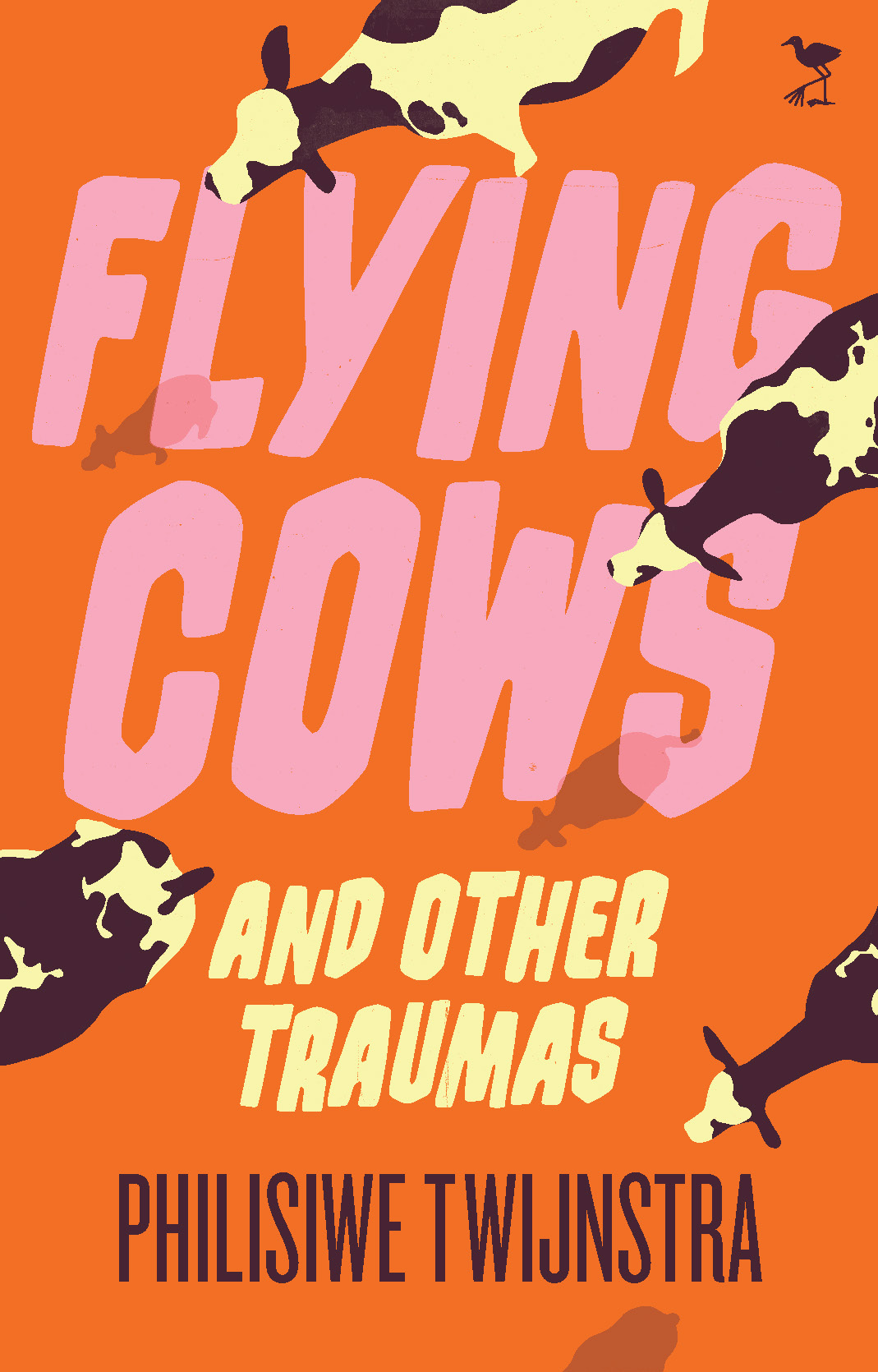
Excerpt from Flying Cows and Other Traumas published by Jacana Media. Copyright © 2026 by Philisiwe Twijnstra.
Order a copy of the book here!



COMMENTS -
Reader Interactions