

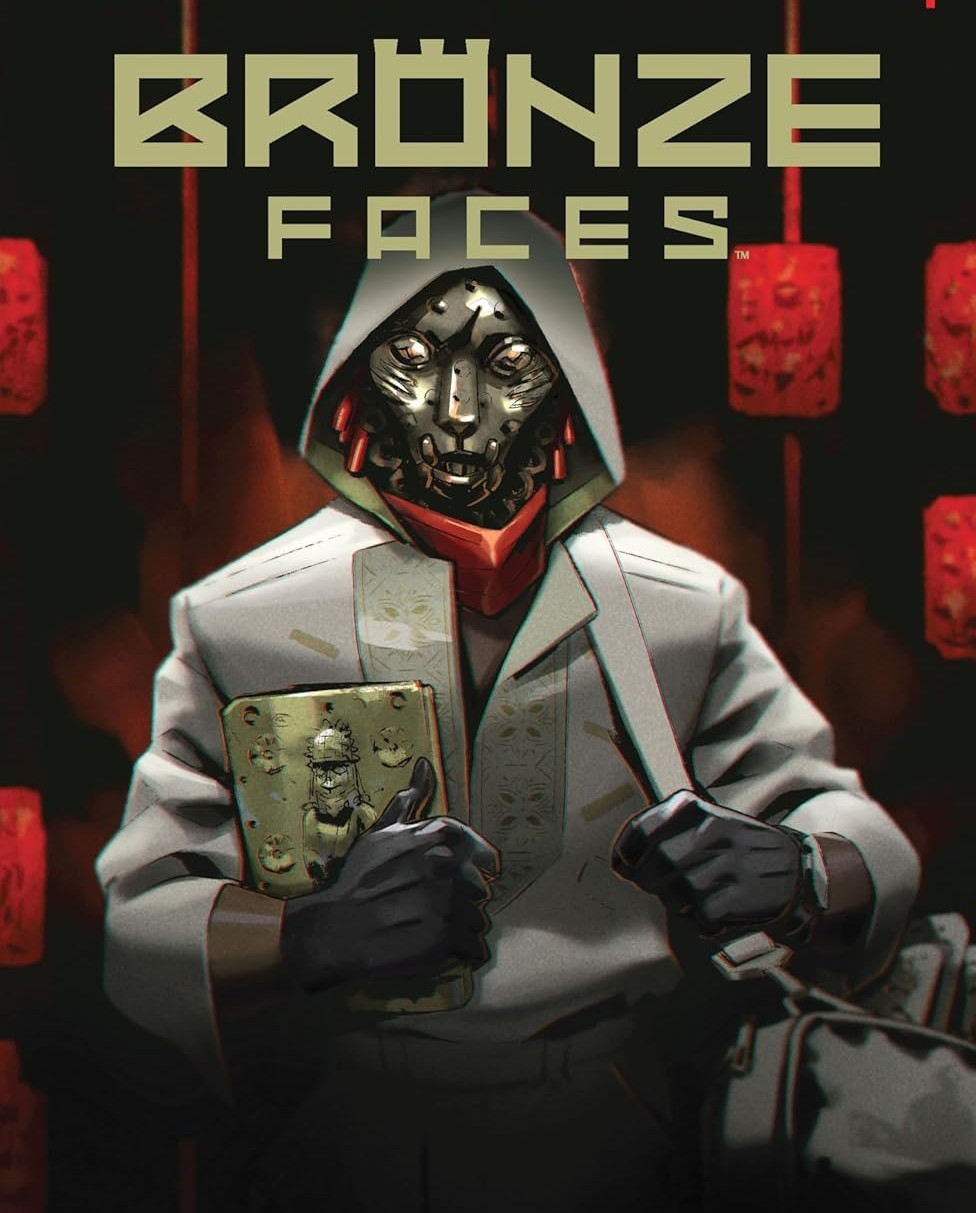
To what length would you go to recover a family―and by extension cultural and national―patrimony?
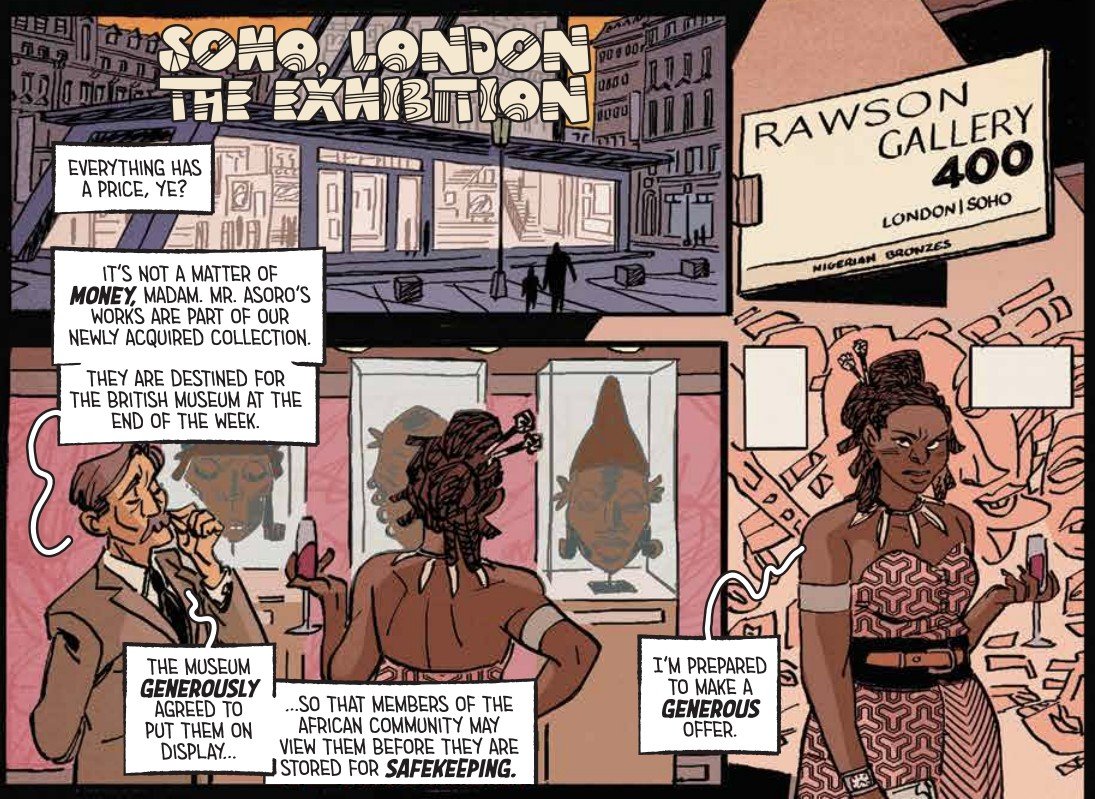
In Bronze Faces, Sango, Timi, and Gbonka embark on an audacious mission: to steal back the Benin Bronzes from the British Museum. For these chums, the global call for the return of African cultural artifacts is not an abstract political demand; instead, it is an intimate, deeply personal imperative. The authors, Shofela Coker and Shobo Coker, deliver a fresh offering in African comics with this “part heist, part homecoming, and part myth” story which has been nominated for Eisner Awards. Shof and Shobo weave a crime story into a mythic structure in complex family, national, and racial entanglements.
The story never sits still. As unwitting accomplices, we follow the characters through London and Brussels, a Buka(restaurant) in Brixton, the Noailles quarters in Marseille, on the coasts of Dakar, the Mambila Plateau and the new Benin museum in Nigeria, or as they sail off the coast of Cape Verde. As one turns the pages of the comic book, there are echoes and flashes of real and fictional events. Sango, Timi, and Gbonka’s covert plots flip the operations of the group of activists who, in the summer of 2020, stormed the Quai Branly Museum in Paris to forcefully remove African art objects held in museums across Europe. Bronze Faces joins films like Mati Diop’s Dahomey and Nii Kwate Owoo’s You Hide Me and the game Relooted in a growing body of transnational creative and artistic works that restage urgent conversations about Africa’s cultural patrimonies and colonial wounds.
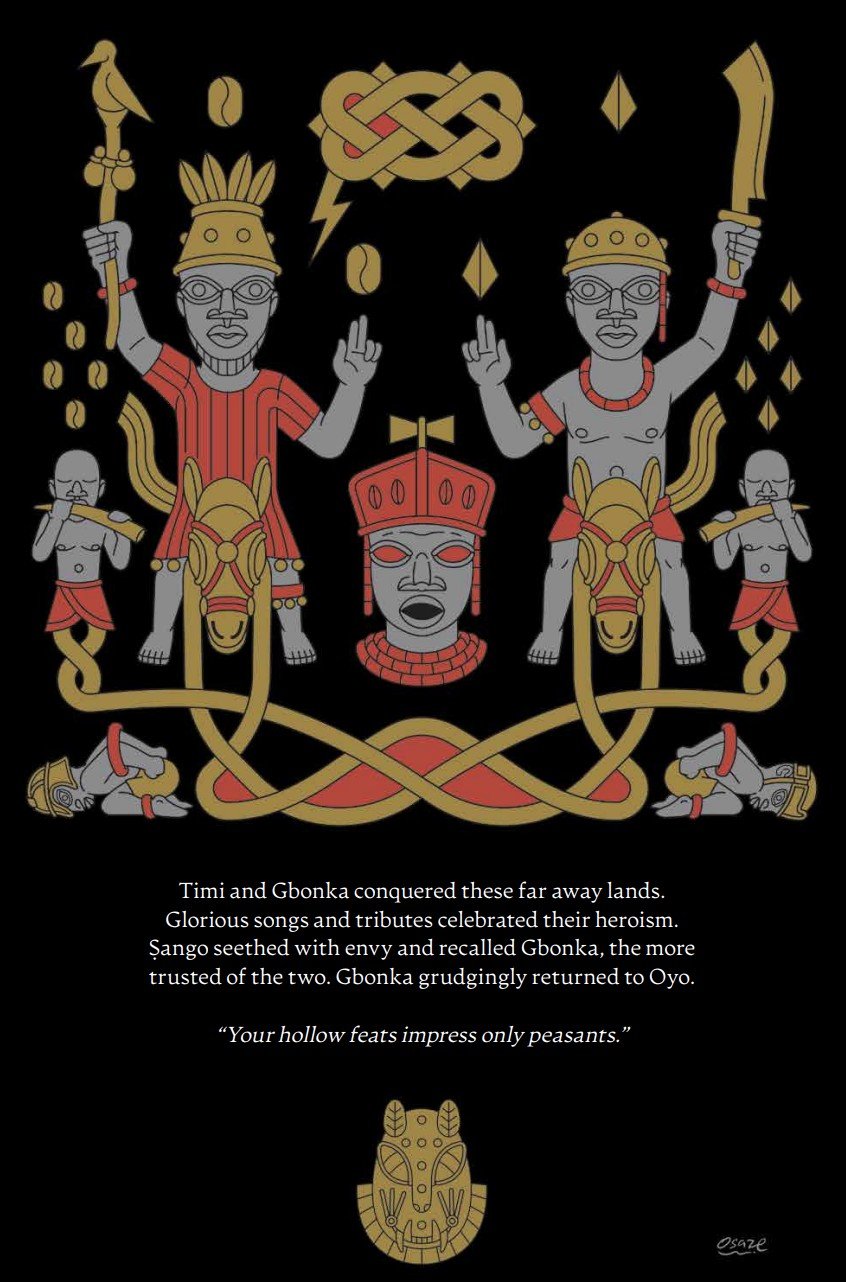
At the end of each chapter, the book incorporates one-page illustrations by the Nigerian artist Osaze Adamasun whose artworks provide a mythic meta-narrative on the relationship between the protagonists while grounding the translational tale in a distinctly Nigerian cosmology.
In the interview below, I ask Shof and Shobo to share the motivation behind Bronze Faces and reflect on the unique affordances of comics as a medium of telling the story.
***
Michael Oshindoro
This thrilling story follows three friends committed to reclaiming a collective heritage. Let’s start with some context. Can you provide some insights into how this story came to be? How did you both come to tell this story?
Shobo
The first germ of an idea came when I was reading Barnaby Phillips’ remarkable book Loot: Britain and the Benin Bronzes. I was captivated by the story, and initially envisioned a sweeping historical epic, something cinematic in scope, which allowed an inside look at the thought processes of the Oba and his court in the weeks and months leading up to what they knew must be the end of their empire.
That idea changed in 2023, when I moved from the West Coast to Atlanta to live with Shof for a little while. It was an unexpected creative incubation period, during which a few projects we’d been poking at finally crystallized. Bronze Faceswas a beneficiary, and the story shed its original skin, becoming a globe-trotting spy adventure about a team repatriating lost artifacts before eventually settling into what you can read today. It was Shof who had the idea of layering in the ancient Yoruba story of Sango and his two companions into the heist framework.
That mythological layer is what gave the story its real weight and urgency. It seems almost impossible now to imagine the book without it. It took something that could have been a fun caper and gave it an epic backbone and thematic resonance. It was the spice that made the stew spicy and added some much-needed body.
Shof
We workshopped the story back and forth until it took the shape you see today. Considered time gave the story the heft you experience, and along the way, music became an important component of the narrative. All of the chapters of the book reference famous Nigerian musical milestones as tentpoles for the thematic subtext in that section of the narrative.
Michael Oshindoro
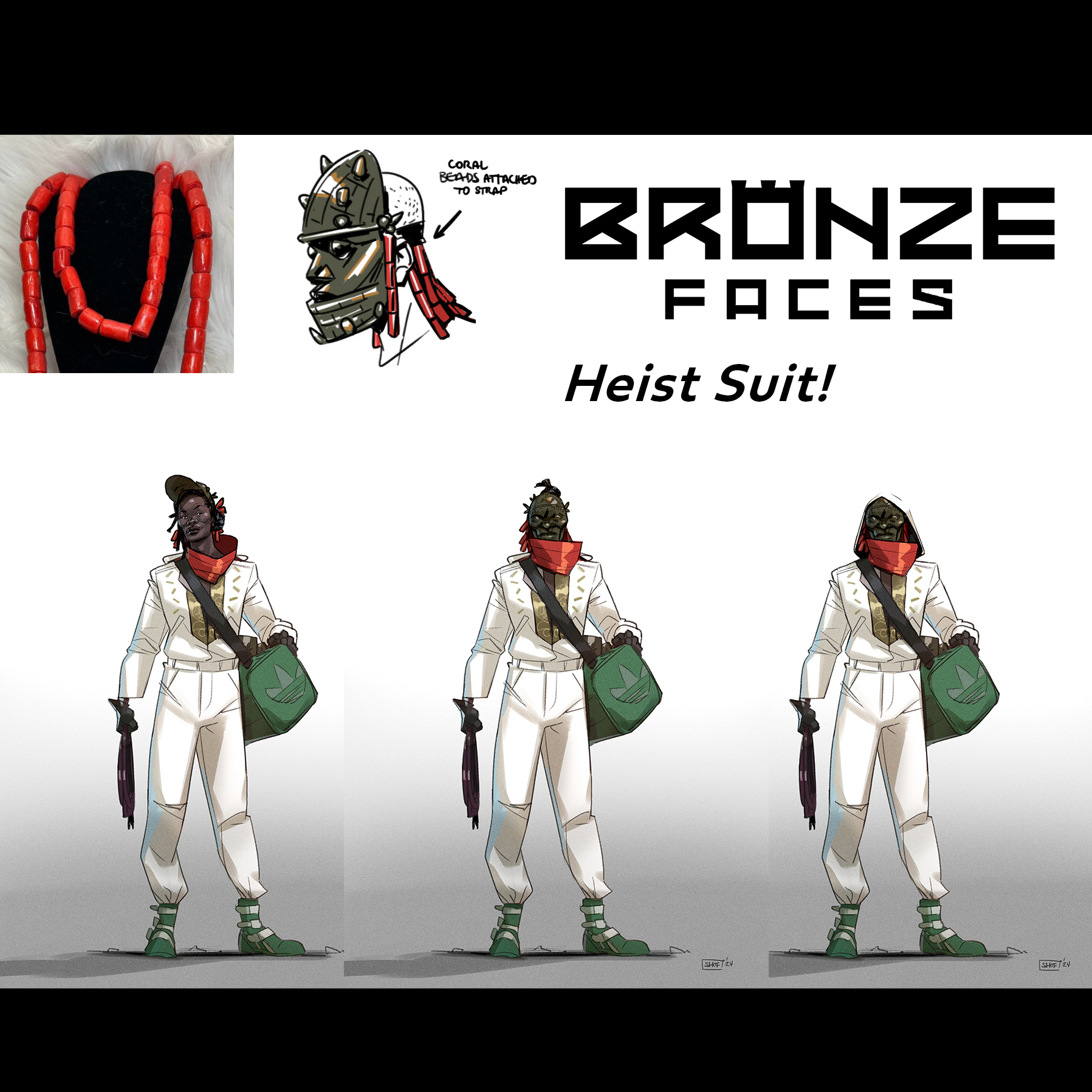
In Bronze Faces, character names, costumes, and locations are embedded with historical, cultural, or mythic significance. How much research went into developing and writing the story, character design, and world-building?
Shobo
Quite a lot, though much of it didn’t quite feel like traditional research, because so much of it came from the fact that we spent our entire childhoods growing up in Nigeria.
Character names are drawn directly from Yoruba mythology. Sango, the warrior king who ascended to godhood by sheer force of will. Temperamental, all-consuming, god of fire and thunder. Gbonka, the seasoned warrior, gifted and patient where Sango is volatile. And Timi, the innocent, supremely talented figure caught between the two. It was hard for the character work not to fall into place. You put those three in the same room, and there’s no way they don’t either kill each other or fall in love. Maybe both.
One of the most deliberate decisions we made was to invert the genders of Sango and Gbonka. It allowed us to see the characters through a different lens and increased the magnitude of what Gbonka and Sango, in particular, have had to overcome in society to get to where they are. It also ensures that our versions stand apart from other modern interpretations of these figures. Yes, they’re named after three powerful mythological figures, but we want the reader to live with these versions of the characters, and have the mythological weight serve as an anchor.
Beyond that, as Shof and I both grew up in Nigeria, the social dynamics between characters draw from that. Gbonka’s experience in particular, coming from a village into a different domestic arrangement where she becomes a surrogate daughter of sorts, comes from things we observed and absorbed growing up. Timi’s father being an artist and Timi himself being a musician felt completely natural to us. We both grew up around artists, and we came of age watching the rise of figures like Majek Fashek, Ras Kimono, Fela, Femi and Seun Kuti. We saw them struggle to make art, struggle to reach a broader audience. Several chapter titles in the trade paperback are drawn from songs by these artists, which felt like the right kind of tribute. Making art respected in Nigeria has long been a difficult path, and we wanted the book to honor that challenge while celebrating what manages to exist despite it. You can see the love on every page of Bronze Faces, in prose, lettering, design, and of course, the art.
Shof
I read all of the material that Shobo was initially inspired by. I’ve also recently read a few books such as Chibuzo Onuzo’s Sankofa, that contained themes which crystallized themes I’ve been working with for a while. On the art side, we visited our own archives of pictures and experiences of the artefacts, online archives, and past and recent encounters of artefacts at visits to museums in Nigeria and abroad. Similarly, we provided photo reference to Alex for the locations: Books on Festivals in Nigeria, the artefacts, and a few NIGERIA Magazines that we’ve collected over the years helped to give the visuals needed credence and specificity. We also shared a shorthand with Alex because of his African ancestry and has spent time in Africa and African diaspora spaces in Europe.
Michael Oshindoro
Bronze Faces expands African comics offerings. In a comics landscape full of superheroes and the supernatural, Bronze Faces introduces the heist genre. What does the comic format allow you to do uniquely in this story?
Shobo
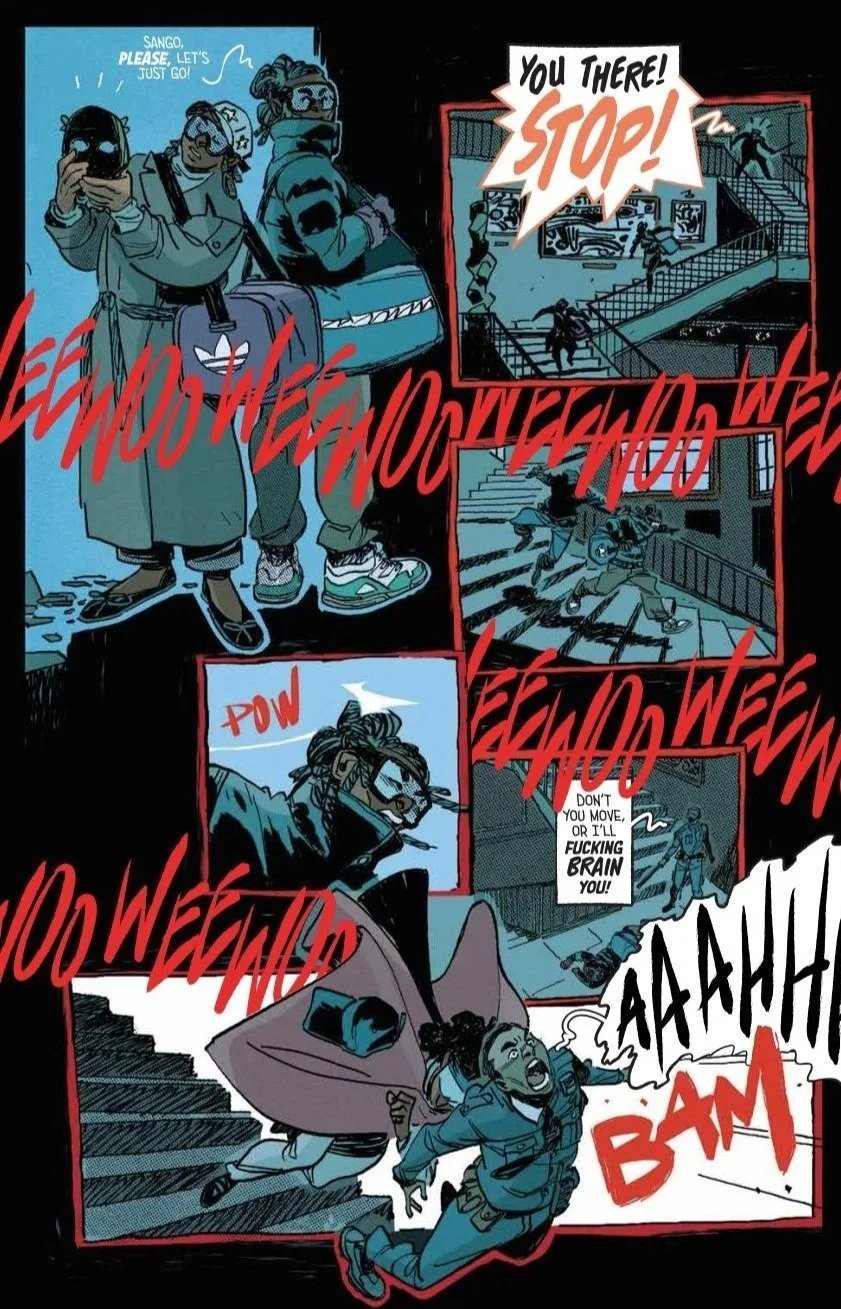
Comics let you live with characters in a way that movies and TV do not. The reader chooses the pace. They choose how long to linger, how much detail they want to drink in before moving on, and we try to take advantage of that. So many panels and pages are filled with subtle world and character building, whether it’s body language, composition, or the choices made by (letterer, Hassan Otsmane-Elhaou). Frankly, Bronze Faces, thanks to the support of our publisher, allowed what’s become a bit of a luxury in modern creative work: time.
Shof
Heist stories are often suspense-filled puzzle boxes where the audience is one step behind. Visually, comics allow you to play with perceptions of time and space in a manner that is unique to the medium. For instance, A character revelation on page 12 is easy to flip back to a foreshadowing of it on Page 3.
Michael Oshindoro
What is the motivation behind Bronze Faces’ part-heist, part-myth structure? At the end of each book, we find a one-page illustration created by the artist Osaze Adamasun. Adamasun’s artworks present a mythic meta-narrative on the complex relationship between the main characters. How important is Osaze’s art for the story in Bronze Faces?
Shobo
Steal something big enough, or be audacious enough about it, and the act becomes mythology. Robin Hood. The Great Train Robbery. D.B. Cooper. In modern Nigerian mythology, figures like Shina Rambo and Lawrence Anini have become folklore. I want to be clear that I’m not putting them on a pedestal, but there’s something worth examining in how stealing something significant cements a person into the cultural imagination. That act of desperation and survival and defiance sears itself into people’s memory. That happens in Bronze Faces, as the myth of the Ogiso spreads across the diaspora, and becomes larger than ever in the hearts and minds of Nigerians at home. Of course, that mythology changes and is warped, and the tale of certain figures might change, as Sango finds, much to her consternation when she speaks to a Nigerian taxi driver on her return.
With Bronze Faces and Osaze’s art, we want to connect the tradition of mythmaking to its original form in Benin: the bronze plaques themselves, commissioned by the Oba to document historical events of note and to honor those who shaped them. When the British stole the bronzes, they stole a kingdom’s way of remembering and honoring itself.
That’s why Osaze’s myth plaques are essential, and I’m grateful we were able to get them in the book. Osaze is a modern-day Benin artist, and it is relevant that artists like him forward the conversation. They may not initially seem essential to the storytelling, but his work bridges the modern-day story and the ancient myth. It shows a continuity of character across centuries. The plaques are evidence that these characters existed before our story and will exist after it. Hopefully, they also pique readers’ interest and make them curious enough to look into who Sango, Gbonka, and Timi actually were. That curiosity is key to reclaiming what was taken, more so than any sword or bullet.
Michael Oshindoro
[For Shof]. Alexandre’s illustrations are breathtaking and utterly gripping, just as Loughridge’s colorings are so immersive, entrancing. As art director, what did you hope to achieve with the character design, environment, and mood of the storytelling?
Shof
It was important to depict a believable dichotomy. There are traditional aesthetics that the history of the Benin Bronzes represents, but true to the spirit of the story, the visuals had to represent how modern Nigerians (locally and in the diaspora) express their identity. Most Nigerians wear Nikes as much as Aso Oke (Yoruba traditional attire). It’s the specificity of this tension we wanted to explore, and what I believe makes Nigerian identity so compelling, interesting, and relatable. For instance, in designing the core characters initially, I looked at a lot of contemporary and historic Nigerian musicians, fashion designers, and politicians, just as much as the historic/traditional counterparts, and of course Alex Tefenkgi, our book’s artist and co-creator, takes that to the next level with reference and his own visual voice.
The characters in the story also travel to several West African countries like Senegal and Sao Tomé. Depicting this visual diversity gives the average audience a richer sense of West Africa, but also a true and natural visual depiction of how the history of the Bronzes and similar artefacts has connected the people of West Africa. It was also important for us to show that Africa contains multitudes and diversity in its language, people, and landscape.
I personally have enjoyed researching the fishing communities and Pierogs on the beaches of N’gor in Senegal just as much as the African diaspora communities of Marseille.
Grab your copy of Bronze Faces here!

COMMENTS -
Reader Interactions