

The Supreme always smelled of hot oil, cardamom and smoke – the kind that sank into fabric and followed people home long after the last cup of chai. Ceiling fans chopped at the warm Nairobi air, pushing it out through open windows that looked onto River Road, where matatus jostled, hawkers shouted, and office clerks streamed past with their ties loosened.
Shazina liked the Supreme because it asked nothing of anyone. Students with ink on their fingers, clerks counting coins from pay packets, waiters balancing plates, street traders grabbing a quick drink – if a person had a few cents for peanuts or enough for a plate of dar na bhajia and a glass of chai, they belonged.
That January afternoon in 1956, she sat with Amina, Baby and Naj at a table near the window, their textbooks stacked like a flimsy barricade against the day. Baby was complaining about an assignment, Amina was insisting a particular lipstick would survive both heat and samosas, and Naj was laughing at them both. Shazina laughed too, on cue, and dipped a crisp, golden bhajia into coconut chutney – sweet, sharp, and fresh enough to make her eyes water. Then she saw him.
He was a few tables down, half-turned in his chair, laughing so hard his shoulders shook. A blue-collared shirt, clean cuffs. Short hair. Dark skin that made his smile flash bright when it broke across his face. He leaned in to listen to someone, attentive in a way that seemed rare, and when he looked up again, his eyes did not skim the room the way men’s eyes usually did. They landed – quietly, directly – on her.
Her throat tightened. She looked away at once, as if she’d done something loud. Across the table, Baby was still talking, unspooling gossip about boys who pretended not to notice them at college. Amina rolled her eyes. Naj said, “If he wants you, he’ll speak.” Shazina did not answer.
In her head, she saw her father’s face, the way it hardened when business was discussed, the way it softened only for her – the only softness left since her mother died – and then snapped shut again. If news reached him that his daughter was exchanging looks with a man – any man – there would be questions before sunset. And this man was not from their community. She thought of Fatima, who had married outside and been cut from family photographs, neatly, with precision and intent. Her name spoken only in whispers, and then not at all. There were rules that no one wrote down, precisely so that they could not be argued against.
She risked another glance. His laughter had faded, and now he was simply watching her, waiting to see whether she would look back. Their eyes met and held. The air between them sharpened. Her hand paused mid-dip. It was not long. A second. Two. Long enough for Shazina to feel the heat creep up her neck, long enough for something in her – something stubborn and reckless – to lift its chin and refuse to look away.
After that, the Supreme became a kind of appointment she didn’t admit to making. She returned at the same time, on the same day, as if it were coincidence – her feet had simply learned the route. Sometimes he was there with friends; sometimes he wasn’t. When he was, he looked for her. When she was, she looked for him. The room remained the same – smoke, fans, the clatter of plates – but Shazina felt the tables slowly shifting, clearing a path.
One afternoon, she came alone and took her usual seat, pretending interest in her chai while her pulse beat in her fingertips. He arrived with others and saw her. His smile flickered – surprise, then something like relief. He didn’t come over. She didn’t go there. But when he left, he looked back once, as if to confirm she’d been real.
The following week, she came alone again and chose a quieter table in the back corner, away from the general chatter and the windows’ public gaze, nearer the oily smells from the kitchen. She ordered the same dar na bhajia, even though her mouth was too dry to eat it. Then, he came in, alone.
He scanned the familiar tables, his expression tightening with brief disappointment, and then his eyes found her. He paused. For a moment he looked as if he might change his mind. Then he exhaled and walked towards her with the deliberate calm of someone refusing to be hurried.
“May I?” he asked, already half-smiling, the question only a politeness.
Shazina heard her own voice – lighter than she intended, “If you don’t mind the smells.”
“I work in a garage,” he said, pulling out the chair. “This is much more welcoming.”
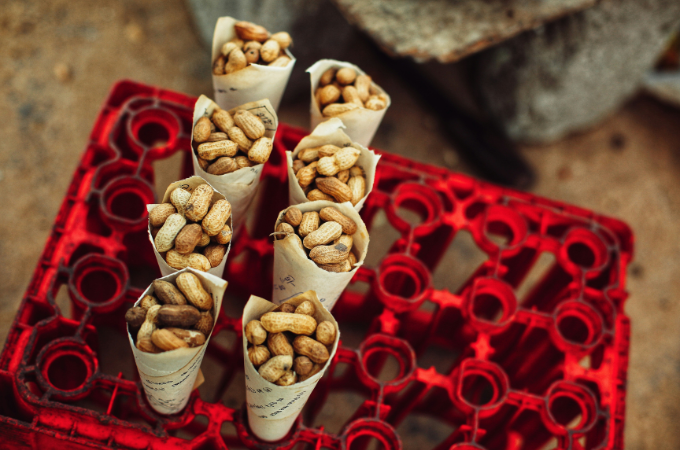
A waiter set down a small paper cone of peanuts between them. Shazina tipped it out and, without thinking, began arranging the nuts into even pairs. She surprised herself with a laugh. “Then you’re either brave or foolish.”
“Probably both,” he said, and sat, careful not to touch her hand as he shifted the pot of chutney. “Counting already?” he asked, watching her neat little piles. The corner of his mouth lifted. “Bibi Accountant.” Then, nodding at the peanuts, “Do they all need to be checked first? Don’t you believe in the luck of the draw?”
It was a simple question. Shazina watched his fingers – clean, but with a faint half-moon of darkness under one nail, grease that no scrubbing had quite reached.
“We make our own luck,” she told him. “You can call me Shazina Meghji.” She hesitated, then added, softer, “At home, I’m just Shazi.”
“Gitau wa Mwangi,” he said, and when she blinked at the cadence of it, he smiled. “You can call me Gitau.”
They ate in small, careful bites, as if the food might betray them by being delicious. He asked about her studies, she asked about his work. He told her he was apprenticed at a garage off Ngara Road and saved what he could, so that he could eventually go to university to complete his degree. “Politics and Economics,” he admitted, almost shyly, “if I ever find a way in.”
Shazina smiled despite herself. “Bwana Politics, then,” she teased, and the laughter in him returned. She told him she was studying accountancy at the Royal Technical College. “For my father,” she added, because that was always the reason.
“Numbers are powerful,” Gitau said. He didn’t say it to flatter her; he said it like a fact.
Outside, River Road roared on. Inside, Shazina felt the world narrow to the scrape of chair legs, the scent of coconut, and the dangerous ease with which his attention settled on her.
They didn’t leave together. He stood first, polite, and she watched him tuck his chair in with unhurried care. “Same time next week?” he asked, as though she might say no.
Shazina should have said no. Instead, she nodded once and felt the decision bloom in her chest, the way chilli did after biting into a bateta champ – the spiced mashed fried potato balls stuffed with minced mutton, which were sweet at first, then stubbornly hot yet impossible to stop at just one bite.
One evening, they sat on a low wall behind the Supreme, sharing a plate of mogo while the kitchen clatter drifted through a propped-open door. Gitau was quiet, turning a bottle cap between his fingers. Shazina waited.
Finally, he said, “My mother wanted me to be a teacher.” He paused. “She died before I finished school. Typhoid. It moved through the village like a whisper – by the time you heard it clearly, someone was already gone.” His voice was steady, but his thumb pressed hard against the bottle cap’s ridged edge. Shazina did not reach for his hand; she understood, already, that Gitau did not want comfort so much as a witness.
“She would have liked you,” he added.
Shazina told him, in return, about the year her mother spent in hospital – the last year of her life – how she had learned to cook pilau at thirteen because her father could not boil water without burning the pot, and how the kitchen had become the one room in the house where she felt entirely herself.
They stayed until the sky turned the colour of over-steeped chai and the city’s noise softened into something almost gentle.
In the weeks that followed, their meetings at the Supreme drifted later into the evening, ostensibly for Gitau’s love of nyama choma – smoky goat, hot fat, the charcoal bite that clung to his fingers. City workers lingered over bottles, and students sat too long over cooling chai, glancing at the door.
One such evening, Shazina came back from the counter with a paper cone of peanuts, as was her habit, and set it on the table. She began sorting the nuts, two by two, their skins crackling softly as she worked.
“You’re doing that thing,” Gitau said.
“What thing?”
“Making order out of nothing.” He watched her hands.
Her mouth twitched. “If I don’t pair them, someone ends up with less.”
“They’re just peanuts.”
“It’s principle.”
He leaned back, content for a moment, then the contentment loosened into something else.
“You asked me the other night what I wanted,” he said.
Shazina looked up. “Hmm.”
“A new Kenya,” he said, and he said it carefully, as if he’d learned that big words could be used against you. “Not speeches. A country that doesn’t swallow people and tell you it’s fate.”
She slid another two peanuts into line. “What do you build first?”
Gitau hesitated – just enough for the word to carry its weight.
“Schools,” he said.
Her fingers paused, then resumed. Two peanuts. Another two. As if she were laying out bricks.
“How many?”
“As many as–”
“Start with one,” she cut in, not unkindly. “One classroom. Where?”
“In places like where I grew up,” he said, and his voice tightened around it. “Not just here. Not just for people who already know how to hold a pen.”
Shazina nodded.
“All right.” She tapped the first pair. “Roof. Walls. Chalk. Slates. A teacher.”
“Teachers,” Gitau corrected.
“Paid teachers,” she said. “Teachers with enough to feed their families. Teachers who don’t disappear the first time a garage offers them a better wage.”
He huffed. “You’re turning it into a bill again.”
“I’m turning it into something that survives.” She slid another pair into place. “What do you pay a teacher with?”
“We tax,” he said quickly. “We–”
“Who?” she asked, and the question was sharp only in its accuracy. “The shopkeepers? The labourers? The men outside who count their coins twice before they buy dinner?”
Gitau’s jaw worked. “Then we build something worth paying for.”
Her eyes flicked up. “Good. That’s how we can make a start.”
He stared at her – not offended, not laughing.
“You don’t think it’s foolish,” he said.
She broke a peanut cleanly and set the halves down with the others. “Foolish is refusing to count.”
His gaze dropped to her neat lines – the paired nuts, the little economy she’d made in front of him.
“My mother would have liked you,” he said quietly. He had said it before – that evening on the wall – but not like this.
Shazina’s fingers stilled. “Then build the first school for her,” she said. “Not for the flag, or the country or the speeches. For her.”
Gitau’s breath left him in a slow, careful stream. He shifted, then set his hand on the table between them, palm open.
She didn’t take it. Instead, she nudged one last peanut from the cone and placed it alone beside his hand, unpaired.
“All right,” she said.
Gitau looked at the solitary nut, then at her. “All right.”
She held his gaze, steady.
Sometime later, they agreed to meet for dinner at one of the newly opened eateries along River Road. Gitau was uncharacteristically late, and Shazina sat alone for too long, hands folded tight in her lap. The radio in the restaurant played one of Fundi Konde’s recent hits, “Jambo Sigara,” the gentle rhythm carrying across the tables as waiters cleared plates. This establishment’s attraction – unspoken but obvious – was the way the middle space could be cleared after dinner to become a makeshift dance floor.
Gitau arrived breathless and apologetic. He slid into the chair opposite her and, before she could scold him, said quietly, “They took Kamau, one of the apprentices, at the garage.”
“For what?” Shazina asked, though she already knew.
“For questions,” he said, and his mouth tightened. “For the oath. For being the wrong man at the wrong time.” He did not need to say more.
The screening camps at Langata were taking in Kikuyu men faster than they were releasing them, and the questions inside were not the kind that expected answers. At the next table, a spoon paused mid-air. Someone near the door coughed and turned his face away as two policemen in khaki stepped in to order tea. The radio announcer’s voice sharpened – Emergency, arrests, forests – and the song on the record suddenly sounded too cheerful. Shazina and Gitau lowered their heads over their plates and spoke with their mouths barely moving: hope, anger, the price. They both believed the British would not be persuaded by politeness alone, and a chill slowly crawled up Shazina’s spine. They ate masala chips and mishkaki without tasting as much as they would have liked.
Afterward, when the centre space was cleared and the music rose, Shazina took Gitau’s arm. She felt the stares at once, the whispering that pricked the air.
Gitau leaned close and murmured, “We can leave.”
“No,” Shazina said. “Let them look.”
They danced. The city seemed to hold its breath around them. Shazina knew any day now this would have to stop: a curfew, a raid, her father hearing the wrong name on the wrong tongue. She wanted to take what was there while she still could.
The following week a name reached her – a man from the corner supermarket two streets over, taken at dawn, released after three days with nothing explained and two teeth missing. She did not need to tell Gitau; he already knew.
“They are looking for reasons,” he said quietly, when she finally raised it. “Anything will do.”
She understood then that waiting for a better moment was waiting for another name. Whatever they were going to do, they needed to do it before the city decided for them.
Later, at the start of the series of roads that would lead to her house, Gitau hesitated as if he wanted to say something that might change everything. Shazina surprised herself by speaking first.
“I don’t want to hide you,” she said. “Not forever.”
Gitau’s gaze flicked to the darkened houses beyond the road. “Your father will not welcome me,” he said gently.
“I know,” Shazina whispered. Then, more firmly, “But I want him to know.”
It was during a particularly delicious dinner of mutton pilau in a small, busy dining room off Ngara Road – a plate fragrant with cloves and cinnamon, the rice slick with fat – that Shazina decided. She would speak to her father herself and not wait until a rumour did it for her.
Gitau went still, spoon hovering. “And if he says no?”
Shazina looked at him over the rim of her tea glass. “Then we find a place where his no cannot reach.”
She allowed herself, afterwards, to dream in bright, impossible pictures: the introduction that went well, the small wedding with a few brave guests, a cottage they would earn slowly, children who would treat their parents’ past like a story, and her father in an armchair, refusing to admit how much he loved his grandchildren. The dream steadied her. She leaned across the table and kissed Gitau on the lips – quick, sure, and watched by strangers pretending not to watch.
That weekend, on a bright Saturday morning, Shazina found her father in the sitting room with the newspaper spread across his knees. Headlines about the Emergency sat beside adverts for tea and soap; the radio in the corner muttered about arrests in the forests. On the sideboard, her mother’s photograph caught the light, the glass slightly dusted. Her father looked up as she entered and his face softened into its familiar, private kindness.
“Shazi. Have you eaten?”
She knew this was reckless. Perhaps a wiser girl would have said nothing and simply gone, leaving a letter from Kisumu to do the explaining. But she would not leave and be scissored out like Fatima had been – erased slowly over the days and weeks. He would hear it from her, face-to-face, and perhaps he would understand.
Shazina sat opposite him, knees pressed together, feeling her heartbeat in her palms. “Abba, I need to tell you something.”
His eyes narrowed the way they did when accounts did not balance. “Is this about college?”
“No.” She forced herself to hold his gaze. “It’s about someone I’ve been seeing.”
The softness left his face as if someone had wiped it away. “Seeing?” he repeated. “Who has been putting ideas in your head?”
“No one,” Shazina said quickly. “It was my choice.” She swallowed. “His name is Gitau wa Mwangi.”
For a moment, her father only stared.
Then his mouth tightened.
“A Kikuyu?” The word came out sharp, almost disgusted – not at the tribe, she realised, but at the danger it carried now.
“He is Kenyan,” Shazina said, and hated how childish it sounded aloud – like arguing with a wall. “He’s kind. He’s clever. He–”
“Enough.” Her father slapped the paper with the flat of his hand, the sound cracking through the room. “Do you know what is happening outside this house? Do you know what they are doing to men in the stations? They are picking them up for the tiniest reason, because of a name, because someone wants to show loyalty to the British. And you bring this into my home?”
It was the first time she heard fear underneath his anger, and it made her braver. “It’s already in the city,” she said. “It’s in the streets. Pretending it isn’t doesn’t keep us safe.”
“Do not talk to me as if you understand safety,” her father snapped. “I have kept you safe. I have fed you. I have worked so you do not have to live like–” He stopped himself, jaw clenching.
Shazina leaned forward. “Like what, Abba? Like him? Like the people you pay to water the garden?”
His eyes flashed. “Do not twist my words. This is not about respect. This is about reality. Our people do not marry–”
“Your people,” Shazina corrected softly. “Not mine.”
Silence fell, heavy and immediate. Outside, a car horn blared and a dog barked, the city itself impatient with their argument.
Her father’s voice dropped. “I will send you to England,” he said. “Your aunt has written again. You will go and you will forget this foolishness.”
Shazina felt something in her go cold and clear. “I won’t go.”
Shazina had learned that when her father decided something was for her own good, his kindness could turn unbreakable. He stood, walking around the coffee table, and for a second, she thought he might touch her head the way he had when she was small. Instead, he pointed at the door. “You will not see him again. Do you hear me?”
Shazina rose too, legs trembling. “I do hear you,” she said. “But I am not a child.”
She saw that he believed it was over – that he had forbidden the thing and so it would not happen. It did not occur to him to lock the door or keep her in his sight; a lifetime of being obeyed had taught him to mistake silence for surrender. She had only until he learned otherwise.
Shazina left before her courage could leak away. She had already done what fear had prepared her for: a small case of clothes and her most precious things waited at Amina’s house, hidden beneath spare bedding. She went to her friend’s as she would on any study afternoon. She did not look back until she was outside the gate, and then she let herself take one long, aching glance at the home she was about to break. At the corner, Hamid the watchman shifted on his stool and watched her a beat too long, as if memorising the direction of her footsteps. Her father had told him once, half-joking: always keep a lookout for her.
Amina’s brother drove them to Nairobi Railway Station in a rattling car that smelled of petrol, the two girls in the back caught in their own thoughts. Baby and Naj had come to Amina’s that morning, summoned by a telephone call that said only come. Baby had cried, openly and loudly, the way she did everything. Naj had not cried. She had pressed a small envelope of money into Shazina’s hand and said, “Write to us. When you can.” They did not ask her to stay. They understood, all three of them, that asking would only make it harder. Shazina held her case on her lap and tried to keep her breathing even. Amina’s brother did not talk much; he kept his eyes on the road, and Shazina was grateful for it. The plan was simple: Kisumu. A marriage away from Nairobi’s tightening fist. Time enough to make her father’s anger soften into resignation. She told herself this story again and again until it almost sounded like truth.
The station was busy as usual: families shouting, children crying, traders threading through crowds with baskets of roasted maize and peanuts. A few khaki uniforms moved through the press, not quite policing it, but reminding everyone of the Emergency all the same. The train to Kisumu ran only three times a week, and Saturday at 1:30 p.m. turned the platform into a small festival of farewells. Shazina kissed Amina goodbye and stepped onto the platform.
She paid ten cents for roasted peanuts from a boy with dust on his cheeks and watched him vanish into the crowd. Automatically, she tipped the nuts into her palm and began pairing them, before nervously popping them into her mouth, two-by-two. She could hear, as clearly as if he were beside her, Gitau’s teasing: “Bibi Accountant.” Her eyes found the rail tracks and, unbidden, the old stories came – labourers brought across the ocean, the maneaters of Tsavo, death along the miles of track. Today the line was her escape, and the thought tasted bitter, like strongly brewed kahawa chungu coffee.
One-thirty came and went without Gitau, and without the train. A delayed train was normal. Gitau’s absence was not. He had promised to be early, to find her first, to keep her from thinking–
At two o’clock the distant whistle cut through the noise. The platform surged. Suitcases thumped onto boards. Goodbyes turned frantic. Shazina stood very still and searched faces until they blurred. She pushed towards a porter and caught his sleeve.
“Have you seen a man in a blue shirt?” she asked, hating how foolish she sounded. “Tall. Carrying a small bag.”
The porter barely glanced at her. “Everyone carries a bag, madam.” He shook her off, already moving.
The train arrived in a roar of steam and metal. Shazina ran along the carriages, scanning windows, stepping around bundles, calling his name – quietly at first, then louder, as if volume could summon him. No one turned. No one answered.
When the train finally pulled away, she stood where the crowd had thinned, the wind of its departure tugging at her dress. Tears slid down her face without permission. She wiped them with the back of her hand and tasted salt and smoke.
She turned and pushed towards the station office window, breath tearing. “Excuse me.”
The clerk didn’t look up.
A policeman stepped between them, palm out, baton hanging at his hip. “Move along, miss,” he said without meeting her eyes. Shazina swallowed her questions and backed away into the crowd, small and furious.
She heard her name being shouted and a flicker of hope rose – then fell. Her father came running down the platform, breathless, his tie askew, fear and anger battling on his face.
He reached her and pulled her into his arms as if she were small again. “Shazi,” he said, voice rough. “Come. It’s going to be all right. He’s made his choice.”
Shazina did not fight him. She had nothing left to fight with. He guided her away from the platform, out through the station and to his car, opening the door with hands that shook despite his certainty.
That evening and the next day, Shazina heard nothing from Gitau. She went first to the garage, chin high, and asked for him by name. Men looked past her; the foreman told her, without unkindness, that she should go home. At Amina’s house she tried the number he’d given her for messages – no answer, only a crackle and then silence. She returned to the Supreme and sat for hours in the smoke and chatter, staring at the door until the fans blurred above her. She wanted one sentence, one scrap of proof that he had not simply stepped away from her. But the days folded over themselves, and numbness became easier than hope.
*
Gitau had left the garage just after midday that Saturday, hands washed raw, hair still carrying the faint scent of engine oil. He had borrowed a clean shirt from a cousin and folded his work clothes into a small backpack. In his pocket was a crumpled piece of paper with Shazina’s handwriting – platform, time, Kisumu – creased so many times it had begun to tear.
He walked fast, keeping to the shade where he could, heart beating a rhythm that matched his steps. He pictured her on the platform, chin lifted in that stubborn way, pretending she was not afraid – hands unconsciously sorting peanuts into tidy pairs. He pictured the life they had spoken into being over mutton pilau and tea: a room of their own, a future that belonged to them.
Near the station, two policemen stepped into his path. One of them pointed at his bag. “Where are you going?”
“To Kisumu,” Gitau said. He tried to keep his voice steady. “I have a train to catch.”
The other policeman’s gaze moved over him slowly, reading him like a document. “Kisumu,” he repeated, tasting the word. “And what’s in your bag?”
Then hands were on his shoulder. The bag was yanked open. A shirt unfolded and held up like evidence. “You’re going to join them,” the first policeman said. “Running to the forest.”
“No,” Gitau said, the panic rising hot in his throat. “I’m meeting someone. My fiancée.” The word felt both brave and absurd in his mouth.
The policeman laughed once. “Your fiancée?” His eyes narrowed. “Who?”
Her name rose in him, whole and certain – Shazina Meghji – and for a moment he held it on his tongue, ready. He could make her real to these men. He could hand them the one true thing he carried and let it stand for him. But at what cost?
Some truths were not theirs to have. He shut his mouth around her name and kept it there. Safe from their suspicions.
“Who?” the policeman said again.
Gitau said nothing.
The silence did what no answer could have. The policeman’s face closed; a man with something to protect was a man with something to hide. The fist came before Gitau saw it move – pain bloomed white across his jaw – and then cold metal bit into his wrists. They marched him through a side gate into a courtyard that smelled of dust and stale sweat. Men sat along the wall with their heads down. Someone coughed, deep and wet. A guard shoved him into the shade and locked the gate behind him.
Gitau twisted his hands and felt the paper in his pocket crumble further.
Beyond the wall, somewhere in the city, a train whistle sounded – high and distant, then fading. He pressed his forehead to the rough stone and tried to count the seconds, in the hope of keeping a promise alive. The whistle thinned, stretched, and was gone. In its place came only the ordinary sounds of the courtyard: a guard’s boots on gravel, a fly circling the shade, and somewhere beyond the wall the city continuing, as if nothing at all had been lost.
Gitau closed his eyes and counted the seconds the way Shazina held peanuts – two by two, as though pairing things together could stop them from disappearing.
Photo by Sujeeth Potla on Unsplash








COMMENTS -
Reader Interactions