

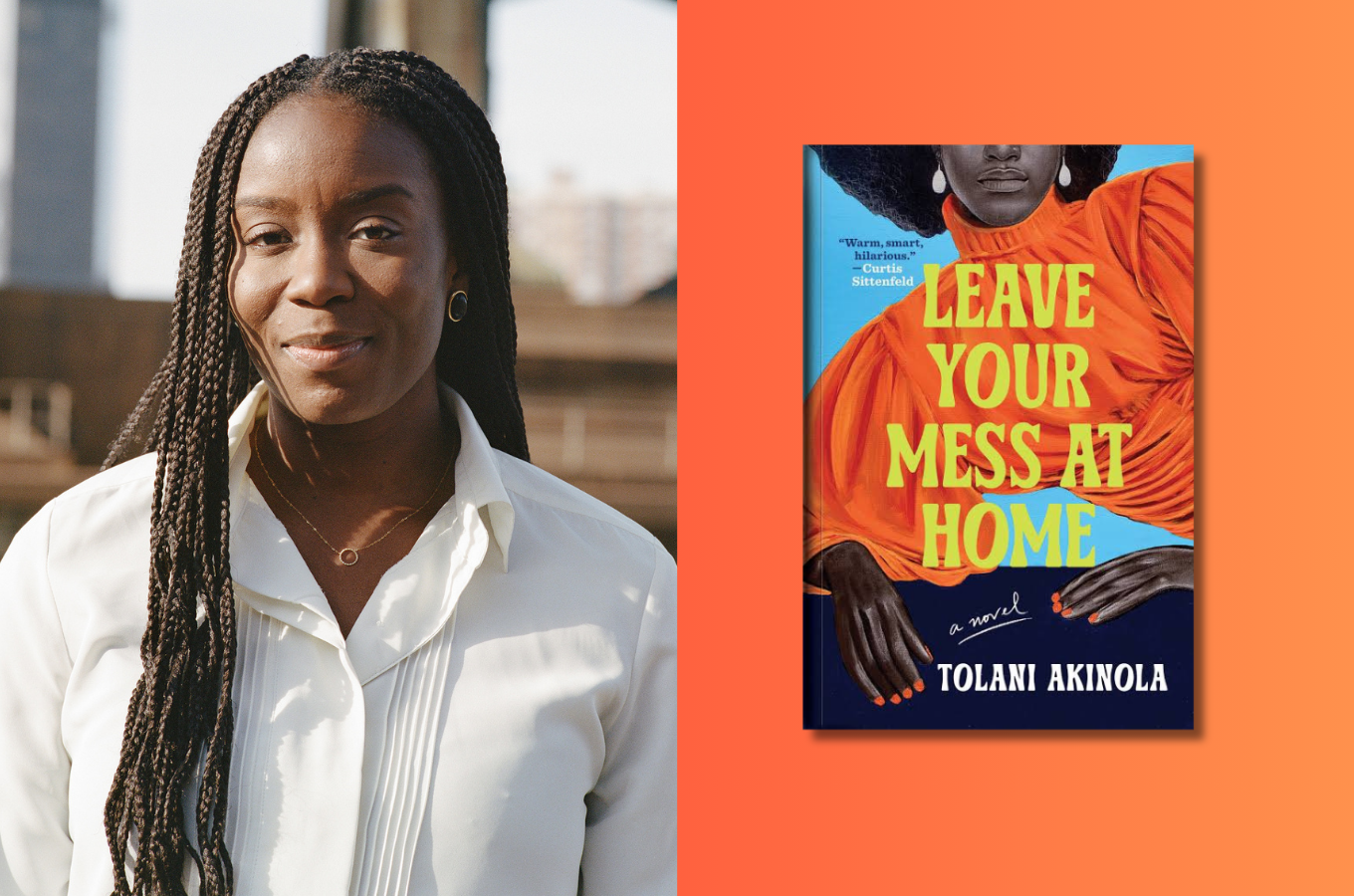
Nigerian literature isn’t new to dysfunctional families, and perhaps this is because family is such a prized institution in Africa. In Nigeria especially, it is often the source of our conversational themes. Tolani Akinola’s Leave Your Mess at Home joins the rank of books that explore the complicated, sometimes messy business of family.
The novel follows the four Longe siblings, each of them struggling in their own way to live up to—or away from—the expectations that have been placed on them. Sola, the eldest, returns to Chicago after a decade away, newly single and disgraced, while Anjola is nursing an unrequited love for her best friend. Karen, the youngest, is grappling with her sexuality and self-image, and Ola, the family’s golden child, is questioning his marriage and what it means to raise a Black son in America. When Soola’s return brings the siblings together at their Nigerian immigrant parents’ Thanksgiving table, years of secrets, resentment, and unresolved family tensions finally come to the surface.
For Akinola, however, the Longe siblings’ complicated relationship with one another isn’t entirely imagined. Although she doesn’t come from a family as big as the Longes, she has a younger sister with whom she admits she didn’t always get along and to whom she hated to give her hand-me-downs. Siblinghood is a complicated subject for anyone who has one, but Akinola feels especially sorry for only children because of how enriching her relationship with her sister has become. That relationship eventually found its way into the book, particularly in the ways the Longe siblings confront and spar with one another. In some ways, their dynamic imitates the relationship Akinola has with her own sister.
Leave Your Mess at Home is, at its heart, a book about siblinghood and the complicated expectations we inherit from the people we love. In this conversation, we sit down with Tolani Akinola to discuss family and expectations, both from your parents and the ones you have for yourself. Ultimately, we ask: can you really leave your mess at home?
Brittle Paper
The title, Leave Your Mess at Home, sounds almost like an instruction, but the novel seems to argue that our mess follows us everywhere. What made “mess” the word you wanted to use to think about the Longe family and the human condition more broadly?
Tolani Akinola
On one hand, there’s the reality of I just needed a title. I could not find a title that worked. When I had finished editing, my editor was kind of like, “Yeah, so we need a title. It’s time to stop dilly-dallying.” And I was like, “Can’t we wait some more?” Anyway, we could not wait some more. She had suggested something like Sorry for the Mess. I was like, “You know, I do like the mess part, but I’m not sorry for it.” We can never be sorry for it. Maybe the point of the novel is that we perhaps should not be sorry for it.”
The title of the manuscript had when it went out to publishers was House Longes Has Gone Astray. So I was definitely interested in this idea of people falling below the mark, or the expectations they have of themselves; that society has of them; and that they have of one another. And it’s very much the case for this family. But I also felt like that title was way too long. I also feared that readers would assume rhyme assume the name “Longe” rhymes with “astray.”
But I think that “mess” part stuck with me because it is true. This is a very messy, dysfunctional family. But I look back on the novel and also feel like it’s a mirror for me in a sense, because I’m like, “Oh, we are all very messy and imperfect people.” And I think that often with immigrants in the US, the feeling of needing to put on a good face in the world is even more compounded. Beyond just, “I’m a human being and I don’t want my shame out there in the world,” I think the experience of being in a country that’s not your home means you, in particular, need to look like you have it together to justify your being here. That was something I was thinking a lot about.
Brittle Paper
Each of the Longe siblings carries a very different kind of struggle: Sola is dealing with public failure and estrangement, Anjola with unrequited love, Karen with sexuality and self-image, and Ola with marriage and impending fatherhood. How did you approach making each of their “messes” feel distinct while still showing the ways they are connected?
Tolani Akinola
Good question. I always say this: I started out with just one of the Longe siblings, Anjola. I knew she had three other siblings, and I had come up with a brief character sketch; I’d been really fascinated by each of them. So, really early on in the novel, I was like, “I need their perspectives as well.” I don’t know why it just occurred to me that they needed to be there. I think in terms of making them distinct, the way that I’d originally written it, it was kind of like they were vignettes, but in a sense they were brief windows into moments in their lives. And so I had really just been focused on them as individuals.
They were people who had really fascinating struggles in their lives that I wanted to delve into, but they were also living very separate lives, and they just happened to come from the same family. So the work over time became, ‘How do I braid these individuals together so that their particular ways of loving make sense in light of the family that they come from?’ Also, they are each a window into one another’s lives, not just their own lives, if that makes sense.
It helps to support the main story because if it were just Anjola, it’s like, “What’s going on with her siblings too?” I think when you have all of them together and you understand why Anjola is this way and why they all are the way that they are, it makes more sense.
Brittle Paper
There is such a strong tension in the novel between the life the Longe parents imagined for their children and the lives their children are actually living. What does the book suggest happens when children inherit not just their parents’ hopes, but their definitions of what a successful life should look like?
Tolani Akinola
I think this is something that Nigerians in particular deal with. But I also wonder if it’s a universal human condition thing. I think often when people have children, there’s this idea that the child is an extension of them, a reflection of them in the world. And maybe the purpose of the child’s life is to, in a sense, make up for what the parents could not accomplish.
Across cultures, people are dealing with this. It’s a form of parenting that is very commonplace, but perhaps not so healthy. And I think that each of the siblings in the novel is, in a sense, carrying a burden. Some of them may feel guilt; some of them are resisting that guilt. It makes it difficult to fully own your own life if you continue to live it in the shadow of your parents’ lives or as an extension of your parents’ lives.
Someone described my novel as a coming-of-age novel, and I was like, “How are the siblings coming of age now? The siblings are all grown up.” But I get it now. How do you become an individual if you are living within the shadow of your parents’ expectations and either trying to fulfil those expectations or pushing against them? Either way, you’re not focused on yourself and the way that you’re perhaps trying to live.
Brittle Paper
That’s interesting because in Nigeria, there’s this constant reminder to “remember the child of whom you are”, which really emphasises children as an extension of their parents.
Tolani Akinola
Yes, and the interesting thing then about being Nigerian-American is that you’re living in a society where people are so “Do what you want.” If you’re living in Nigeria and there is a collectively understood and held value (of collectivism), then to what extent does it feel harmful or damaging? I don’t know.
But then if you’re an island, and you feel like an island in a society in which the value is very much about being an individual and carving out your own path and doing what you want to do, and the extent to which you are a reflection of your family is not that important—but then your family is teaching the opposite thing—it becomes really tricky.
Brittle Paper
The novel is deeply interested in the things families leave unsaid—secrets, resentments, disappointments that accumulate over years until they can no longer stay buried. Why was it important for you to let those things explode at a family gathering rather than have the characters confront them privately? I do think having them explode at a family gathering is such a Nigerian thing. There’s always a quarrel at a family gathering
Tolani Akinola
Something I’m curious about is, at Nigerian family gatherings, do you find that the quarrels tend to be intergenerational? Because I always felt like the quarrels would be between my mom and her siblings, or maybe with my grandmother.
Brittle Paper
Definitely. Two years ago, we did my grandma’s 20th memorial, and there were quarrels between my mum and her siblings. It was the same thing at my paternal grandfather’s burial, with my dad and his brothers. I feel like it’s the same when I talk to people. I’m like, “Just always expect a fight.”
Tolani Akinola
That’s true. I guess I asked because the Thanksgiving debacle is very much the climactic scene in the novel. The secret that it exposes is between a mother and her daughter. So I agree that often Nigerian family gatherings can be hard. Actually, the last one I went to, I was surprised that there wasn’t a big argument. There was a slight shade, but no big debacle.
Thanksgiving in the US in particular is really big. And for immigrants, it can be complicated. It’s not always complicated, but it’s like, “Why exactly are we doing this?” But then, as you assimilate, you do it. But obviously, it’s not going to look like a typical American Thanksgiving because what is the point of stuffing?
So I think that there are things about my experience that I find really humorous, and I think that was one of those things where I was like, “Oh yeah, this seems like it would be a really humorous scene.” Also, it was an excuse to bring all these people together who wouldn’t have come together otherwise.
I don’t know if I necessarily was thinking about the Nigerianness of it all in terms of “Family is here; things are about to pop off.” But the most delightful thing, though, is that readers from all across the diaspora have been like, “Oh yeah, that tracks.” You know?
It’s really lovely to be affirmed in that way. Because often with the creative process, you’re like, Everything is up for debate and negotiation with yourself. So it’s really lovely when your book is out in the world and people are like, “Yes.” It’s like, “Okay, I trusted myself.” But also, it’s really nice to be validated in that sense.
Brittle Paper
The question “What do we owe to our families, and what do we owe to ourselves?” sits at the heart of the novel. Did you begin writing with an answer to that question, or did the Longe siblings complicate your own understanding of where familial responsibility should end and self-preservation should begin?
Tolani Akinola
I don’t know if I ever had an answer to the question in mind, but I do think that the process of writing the novel changed my thinking. When I started writing the novel, I would have been in a place where I maybe felt that it was unfair for parents to have the expectations that they do of their children and that people probably did not owe as much to their families as they thought that they did or felt that they did. I think I was very interested in releasing that version for myself.
But over the process of writing the novel, I think that I maybe arrived at a sense of, you know, there’s no neat binary to be found here. I think that family is a place of mutual responsibility and care, and sometimes that is lost upon people. I really like that definition of family as a place of mutual responsibility.
I also think the novel suggests that showing up as who we really are can be a really vulnerable exercise, especially when we fear rejection and shame. If we’re in a family and we’re not doing that, then what are we doing? Yeah. But of course, it’s easier said than done.
Brittle Paper
There is a lot of tenderness in the Longe family even when they are hurting each other. How do you write about forgiveness and unconditional love without suggesting that love requires us to excuse the harm people have caused us?
Tolani Akinola
How do I do it? Short answer: I think I just hold that as a belief somewhere. I think genuine love either requires accountability or won’t try and avoid it. For the characters in the novel, the wounds are really deep. And because of this, I don’t think that at the start of the novel some of the siblings in the novel would be able to say, “I love my siblings.” I was curious about what that kind of repair could look like if the harm had been so profound. How do you find your way to a place of forgiveness?
I was also interested in exploring what it looks like when you know that the accountability is never going to come. How do you then change the shape of your love in order to accept that person just can’t meet you in that way?
Brittle Paper
Listening to you talk about that made me think of the popular line by Bell Hooks that says love and abuse cannot coexist. Do you believe that too? Because I find that it’s not as neat as it is in theory and in practice. And because you’re writing about family and love, I wanted to know what you think about that.
Tolani Akinola
It’s an interesting question. I don’t know if I agree. I think there’s part of me that’s like, ‘We owe ourselves preservation and distance from people who harm us. But the reality is that people do love people who are abusive to them. It happens.
I think abusers sometimes do love the people that they’re being abusive towards. It doesn’t justify it or mean that you should continue to be in that situation. So I don’t know. I guess you have me disagreeing with the great Bell Hooks.
Brittle Paper
I think I agree that it’s not as neat as she puts it. Because you can have a parent who physically abused you—I mean, we’re in Nigeria; you get flogged—but you also know that your mother would cut herself open just to save you. It doesn’t make the abuse right, but life is not always as neat and put together as we’d want it to be. And your novel is literally Leave Your Mess at Home.
Tolani Akinola
This is true. No, I agree with you. I think that, unfortunately, it’s often the case that love and abuse are existing together. Why else does anyone continue to be in a relationship that’s abusive if there’s not love there as well, you know?
Brittle Paper
In the end, the Longe siblings are not magically “fixed”. They’re still carrying their histories, flaws, and complicated relationships. Do you think the real work is learning how to get rid of our mess, or learning how to live honestly with the parts of ourselves and our families that will always be messy?
Tolani Akinola
It’s definitely the latter. I think that, like you said, the directive to “leave your mess at home” is kind of impossible because we all are carrying the things that have shaped us. I love my ending—not to say too much more—because the novel leaves them in a place where you know that they haven’t magically transformed, that they’re not so very far from where they were at the beginning.
But perhaps, if there is any distance from where they were at the beginning, it is that they have each, in their own way, learnt to accept and reclaim the parts of themselves that were messy, or maybe that they had sought to exile or hide.
They allowed themselves to exist in internal, psychological places that they didn’t even want to allow themselves to exist in. So I feel like, yeah, if the novel has any takeaway, I would want readers to begin to examine the parts of themselves that they maybe would not want to reclaim and would want to hide away.
Brittle Paper
Thank you so much. I’ve really enjoyed talking to you.
Tolani Akinola
Likewise.


COMMENTS -
Reader Interactions