

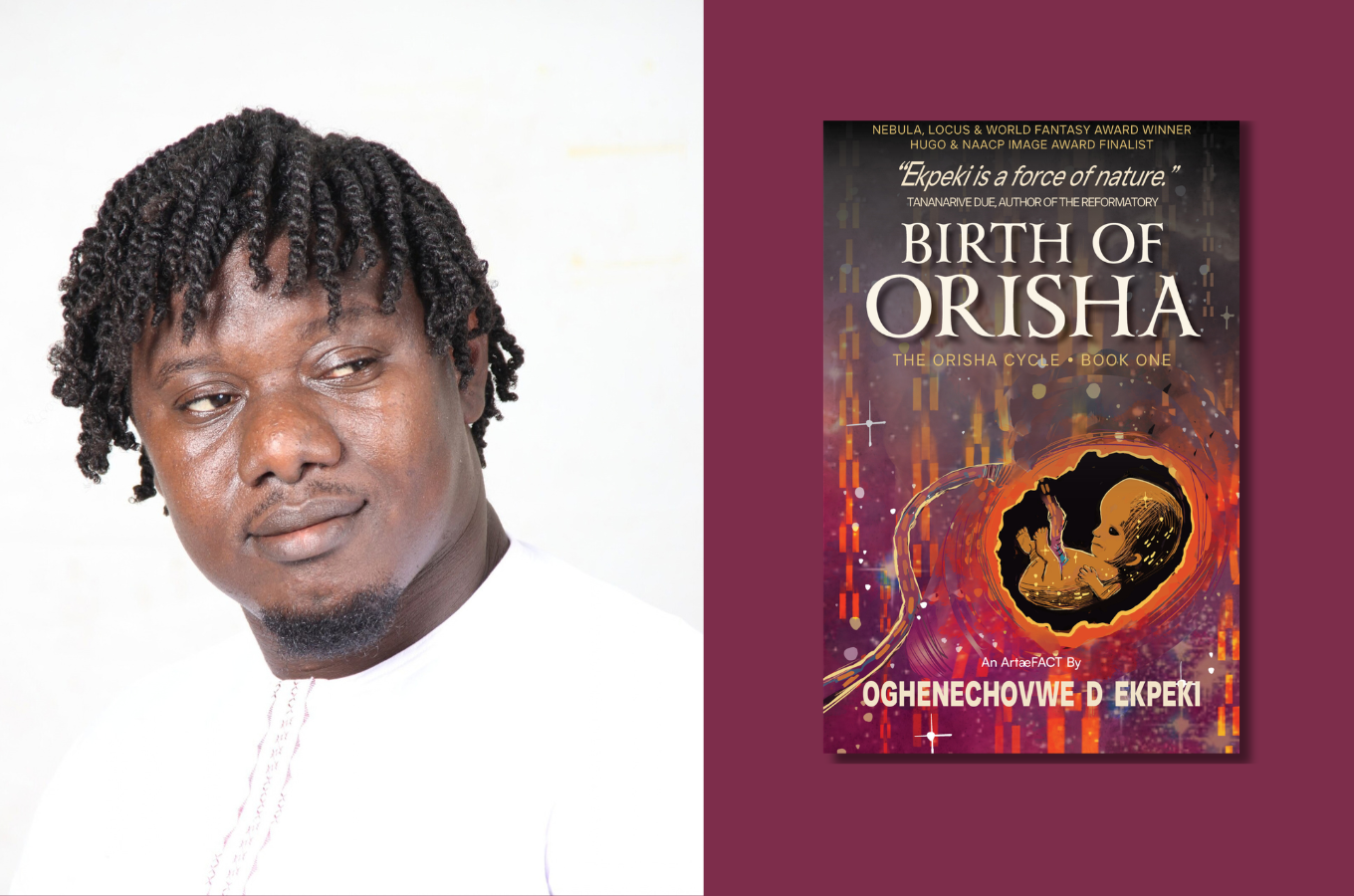
Oghenechovwe Ekpeki’s Birth of Orisha begins before its first page. Across its dust jacket, a foetus suspended in deep space is connected by an umbilical cord that doubles as a wormhole to a fully realised Orisha, while Ifá binary, black holes, stars, fire and digital rain turn the cover into a map of birth, destruction and transformation.
For Ekpeki, the imagery is not simply an illustration of the story. It is part of the story itself. Drawing from Ifá, Afropantheology and what he calls Afrocosmology, Birth of Orisha brings together the biological, spiritual, technological and cosmic to imagine time, existence and transformation through an African cosmological framework. Even the book’s physical form participates in this vision, from its structure and artwork to its unusual dust jacket.
In this conversation with Brittle Paper, Ekpeki takes us inside the ideas behind the cover, unpacking its binary codes, wormholes, black holes, the Igba Iwa-Odù, and the cycle of birth, death and rebirth at the heart of Birth of Orisha.
Brittle Paper
The cover of Birth of Orisha immediately tells a story before a reader even opens the book. What were you hoping the reader would see and perhaps wonder about when they first encountered it?
Oghenechovwe Ekpeki
You know how they say a picture is worth a thousand words? Well, I want more for this picture. These pictures. Forty thousand each. I want the full dust jacket comprising the two covers to tell one cohesive story, the entire eighty thousand words of the book.
It’s a visualisation of Afrocosmology, my framework, philosophy, subgenre and so much more. I want it to convey the themes and ideas that lie within the book. As for what I hope the reader will see, so much. Probably more than they can in one go. Each of the elements in the cover has multiple meanings. So I am hoping that it’s a cover a viewer will return over and over again to.
Brittle Paper
There’s a striking visual conversation between the unborn child on the back cover and the fully realised Orisha on the front. Can you take us through what is happening across those two images?
Oghenechovwe Ekpeki
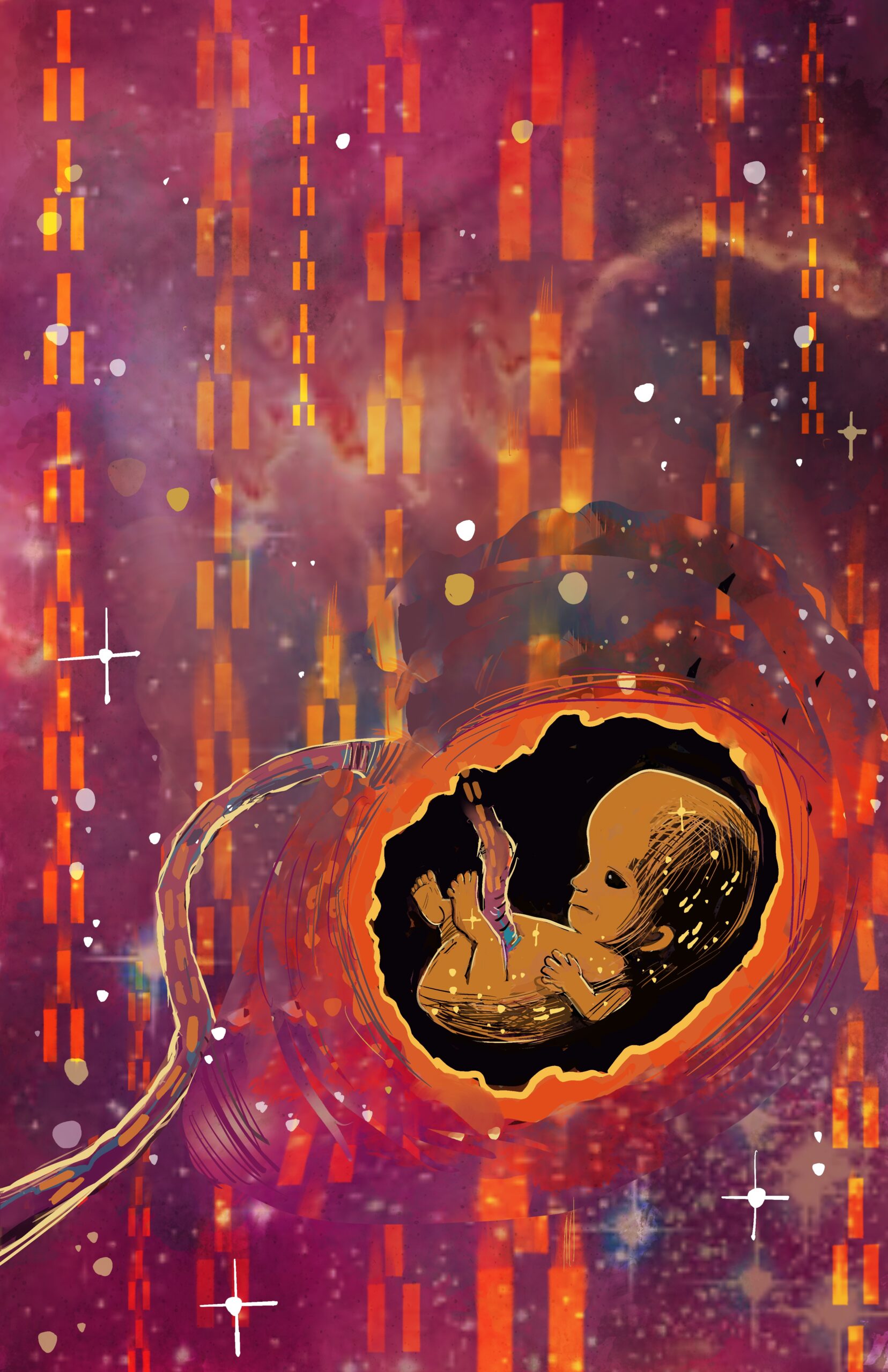
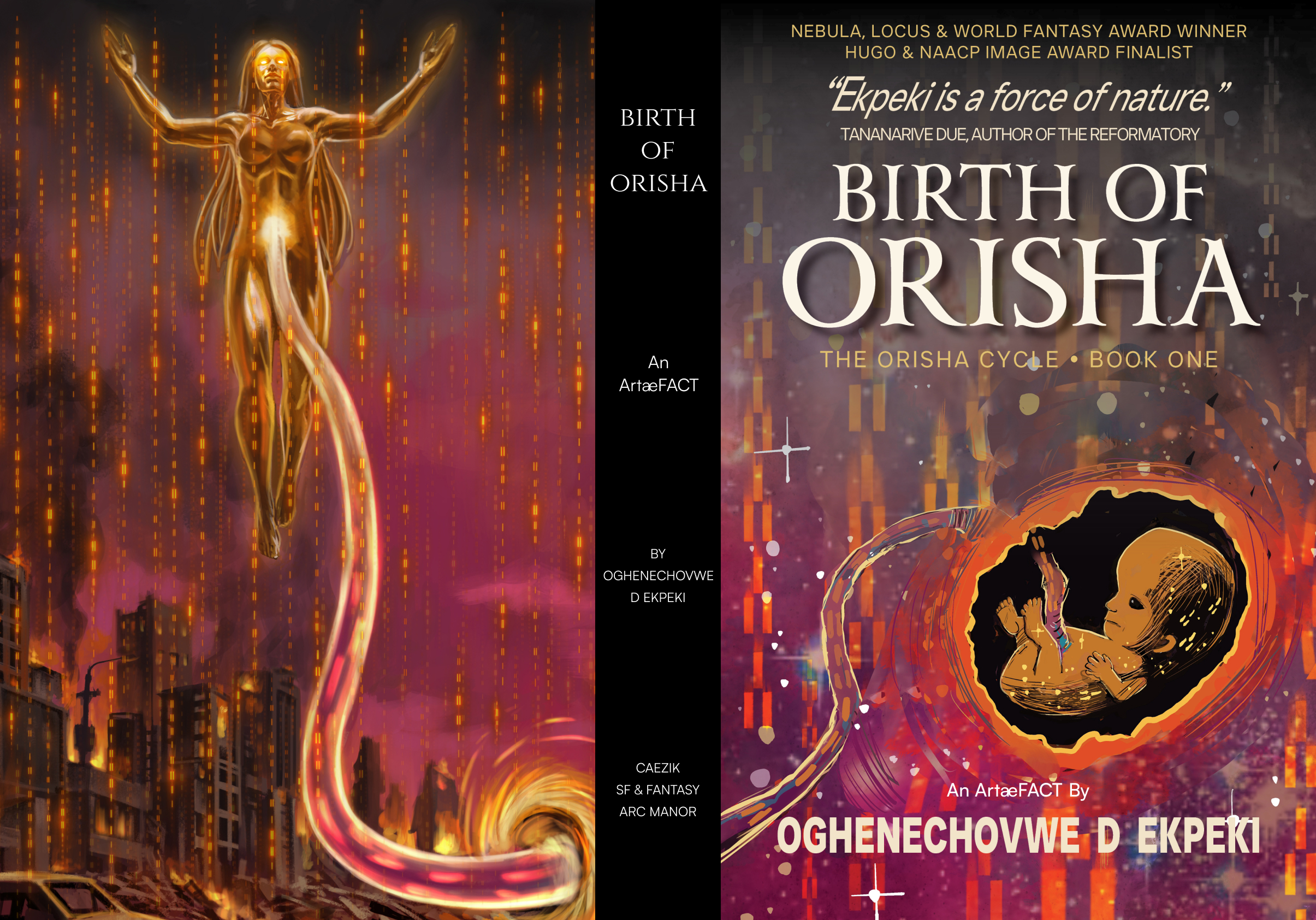
The front cover is set in deep space, with digital rain made from Ifá binary, I and II, the building blocks of existence. In the bottom right, a foetus sits inside what evokes an amniotic sac, black hole, or Igba Iwa-Odù, the calabash of existence. Inside the foetus are stars and Ifá binary, which flow into it through an umbilical cord that also functions as a wormhole. The space around the foetus bends with the gravitational pull of the black hole.
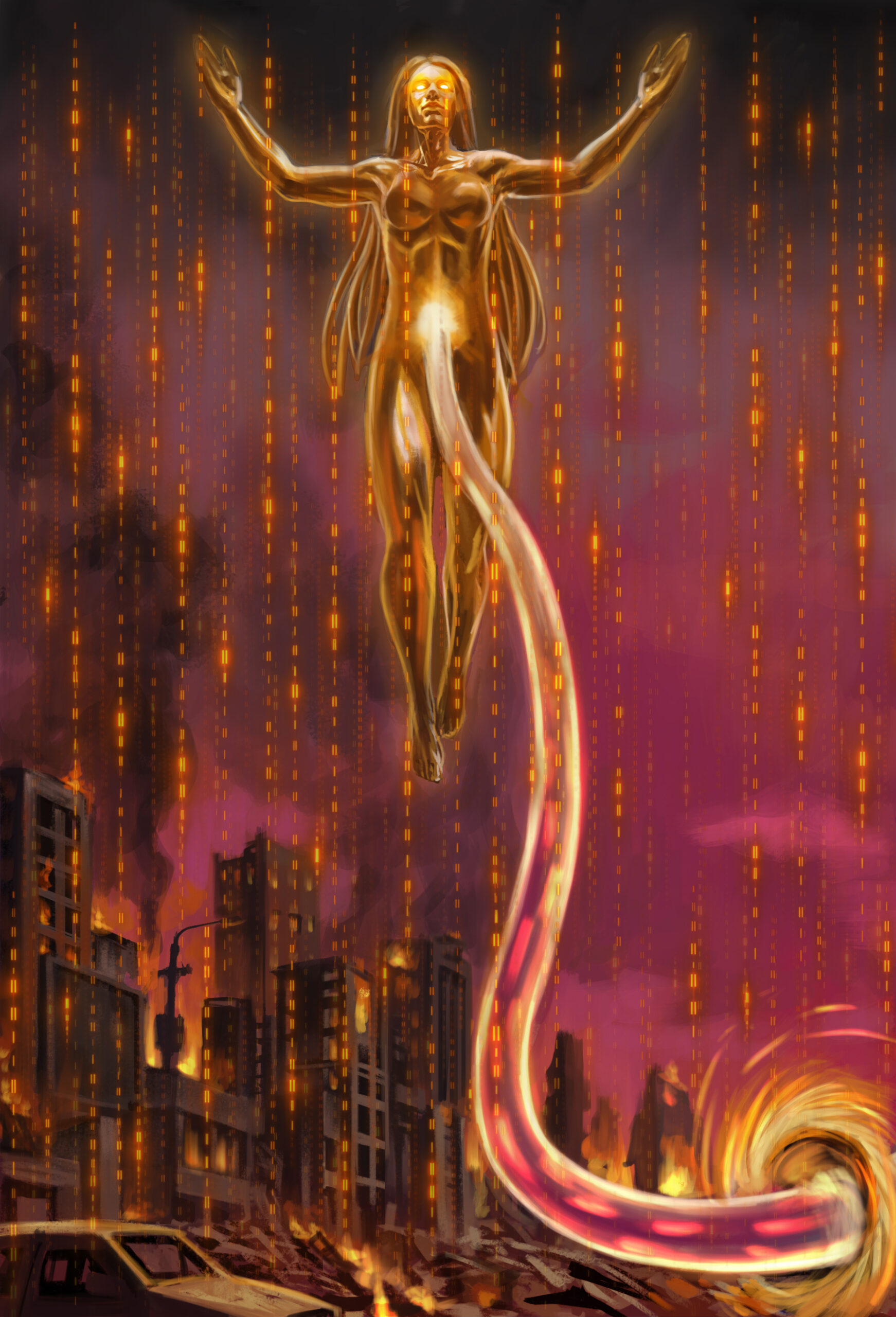
The spine is itself a black hole, separating the two sides of the cover. The wormhole reappears on the back, emerging from a tear in space-time and extending toward a fully realised Orisha. The Orisha and the foetus are the same being at different points in time, connected by the wormhole-umbilical cord. While the front represents the order and serenity of the cosmos, the back depicts destruction, chaos and a world reduced to ashes.
Brittle Paper
One of the most fascinating elements is the “digital rain” running through the artwork. You’ve described it as drawing from the Ifá binary while also resembling DNA sequencing. Why was it important to bring these seemingly different systems – technology, biology, and Ifá – into the same visual language?
Oghenechovwe Ekpeki
You must have seen something like this in The Matrix: code falling down the screen in cyberpunk green. Here, it is gold, and instead of computer code, it is Ifá binary, I and II, representing the building blocks of existence. It also resembles DNA sequencing. The code falls through deep space, surrounded by stars.
But this is not just any binary. It is actual Odù, specifically 15, Ọ̀ṣẹ́ Méjì, and 16, Òfún Méjì. Ọ̀ṣẹ́ represents fertility, children and birth, while Òfún represents realisation, culmination, destruction and conclusion. The Odù binary is an encoded message, falling in patterns that reflect the themes of the cover. Depending on where you begin reading it, the patterns correspond to either Odù 15 or 16.
I wanted the cover to bring together the different elements of Afrocosmology: the cosmic, technological and scientific, including the biological, alongside the spiritual, which is often dismissed as fantastical. But the spiritual is very much an African reality, as we say in Afropantheology. In Ifá, too, the physical and spiritual, heaven and earth, are connected, as represented by the Igba Iwa-Odù. I wanted the image to capture all of this at once: the bio-spirito-cosmic.
That is why so many of the concepts have dual or even triple meanings. The goal is to bring together ideas we often treat as separate: Afrofuturism, Afropantheology and Afrocosmology; technology, spirituality and cosmology. They are all connected. As Arthur C. Clarke famously suggested, sufficiently advanced technology can feel like magic. Afrocosmology and Ifá, in a sense, were there first. I explore this further in the book’s introduction, where I define and expand on Afrocosmology.
Brittle Paper
The baby’s amniotic sac also becomes a black hole, and the Igba Iwa-Odù, the womb of existence. What does this image of the womb mean within the world of Birth of Orisha?
Oghenechovwe Ekpeki
The book itself is about birth. There are many births in the story. How a person is reborn from the gender they were born in, how a person dies, how they become more, an Orisha, the full realisation of themselves and how they become light, as in Òfún Odù 16.
It doesn’t just stop with the baby in the womb. It follows that transformation, the chaos, and destruction from the back cover enable the transformation. The story encompasses everything in the process. Birth, unbirth, death, rebirth. The Orisha Cycle.
Brittle Paper
The umbilical cord connecting the two covers can also be read as a wormhole, allowing the cover to move between the biological, cosmic, spiritual, and digital. What does that connection say about your understanding of time and the Orisha?
Oghenechovwe Ekpeki
The umbilical cord-wormhole is a vehicle that allows us to traverse the cosmic cycle of time as it’s spoken of in Ifá and Afrocosmology, which sees time not as linear, the way western philosophy often does, but as cyclical.
The baby is the potential, the past of the Orisha. And the back cover has the realisation, the future of that potential, its manifestation. And both exist at the same time, connected by the wormhole-umbilical cord. It’s, as I said, a representation of age-old philosophies of Ifá and Afrocosmology, the time cycle.
If we can fold space with a wormhole, the way we can see the black hole spine of the book, we would perhaps be able to see and traverse between those times, through the umbilical cord-wormhole that connects them.
Brittle Paper
The two sides of the cover also seem to move between creation and destruction, birth and rebirth: the child emerges from serenity while the realised Orisha appears against a world in flames. How does this tension shape the story itself?
Oghenechovwe Ekpeki
On the front cover, the child in the Igba Iwa-Odù, floating in deep space and encased in a black hole, protected by its event horizon, is born from order: the order of the universe. But at this stage, they exist only as potential. To reach their full potential, they must be fed by the chaos, destruction and ashes of the burning world. That is the price, the cost. Their growth and realisation require sacrifice.
Odù 15, Ọ̀ṣẹ́ Méjì, represents fertility and plenty, while 16, Òfún Méjì, represents realisation and destruction. One naturally moves into the other. Both are required for completion, and both exist side by side depending on where you are looking from.
The story mirrors that shift from potential to realisation, moving from order to chaos. It also reflects part of the story’s arc: what we call apotheosis, or the hero or heroine’s journey. Not much of a spoiler, I hope.
Brittle Paper
You’ve called Birth of Orisha an “artefact”, a form in which the writing, illustrations, cover, structure, and scholarly material all function as parts of one artistic and intellectual object. How does the cover embody that idea, and what does it tell us about the kind of book you wanted to create?
Oghenechovwe Ekpeki
It is written as ArtæFACT, combining “art” and “fact” with the æ ligature. The book’s different elements work together to tell the story, almost like 4DX cinema for books. It is meant to function simultaneously as art, culture and fact, carrying ideas about life, existence and the universe through the frameworks of Afropantheology and Afrocosmology.
The form extends beyond the prose. The foreword, introduction, outroduction, physical format and artwork all contribute to the narrative. The cover, for instance, is not simply an illustration but tells the story visually. The book reads from left to right, while the cover reads from right to left, creating a cycle that reflects the Ifá understanding of time. The spine functions as a black hole, while the wormhole connecting both covers allows the reader to move between different points in time.
The book is also structured around Ifá: it is divided into Parts I and II, the Ifá binary, with 16 chapters in each, representing the 16 principal Odù. The themes of each chapter correspond to the Odù they represent, just as the Odù binary on the cover reflects its themes.
ArtæFACT therefore brings together things we often treat as separate: art and fact, technology and spirituality, Afrofuturism, Afropantheology and Afrocosmology. Every element, from the prose to the artwork and physical form of the book, works together to make the same argument. That is what makes it a new literary form.
Brittle Paper
This was an enlightening conversation. Thanks for speaking with us.
Oghenechovwe Ekpeki
You are welcome.
***
Preorder here.





Ìtàn àfàwòṣe October 12, 2026 05:40
Ọkùnrin yìí, Ekpeki, jẹ́ ènìyàn burúkú. Ó máa ń jí ọ̀rọ̀ lọ́wọ́ àwọn obìnrin aláwọ̀ funfun, ó sì máa ń bá àwọn ọkùnrin mìíràn ṣe ìbálòpọ̀.