

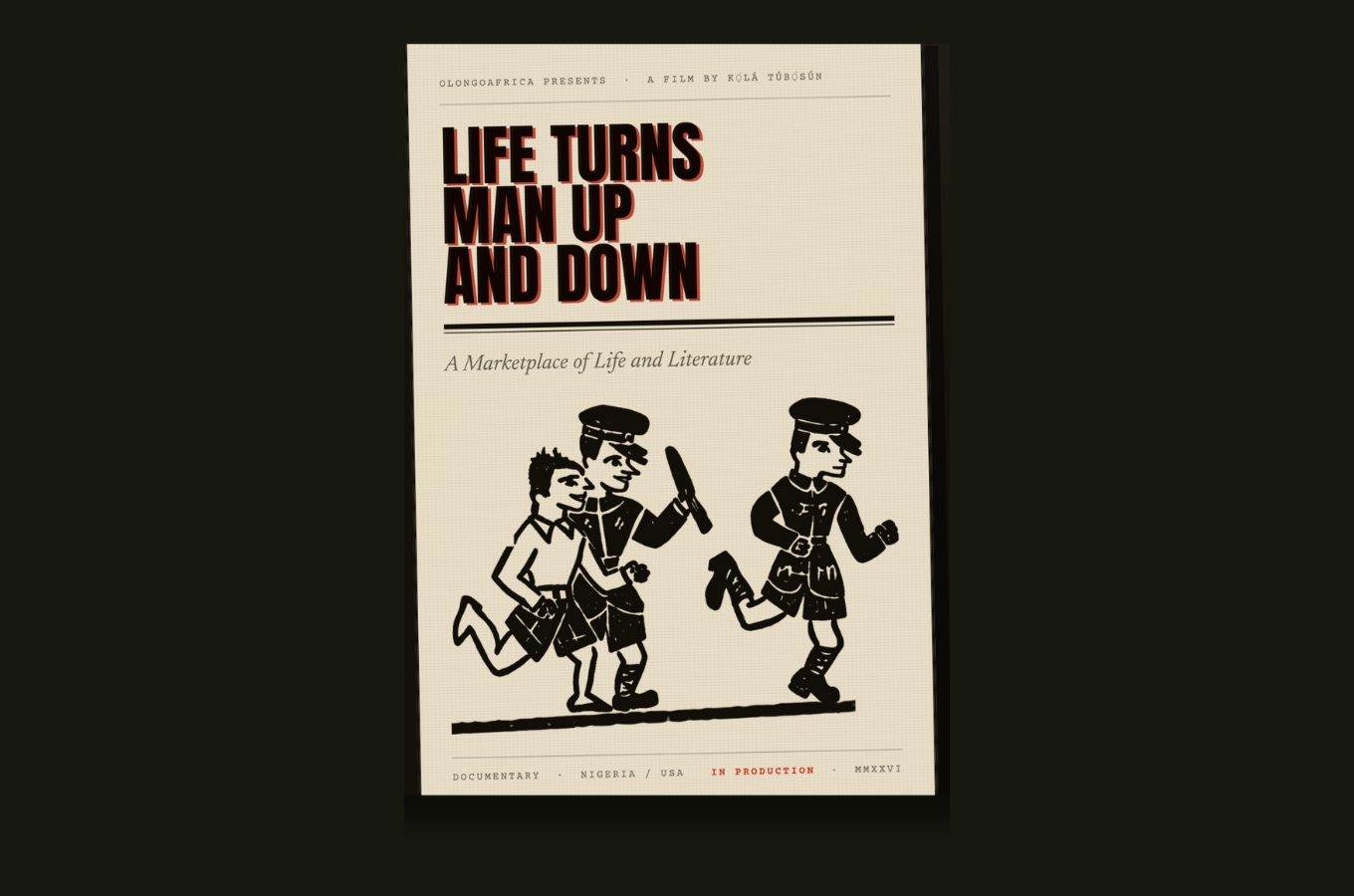
 A new documentary is in production on Onitsha Market Literature, the pamphlet trade that ran out of the market town of Onitsha for roughly two decades either side of Nigerian independence. Written and directed by writer and linguist Kọ́lá Túbọ̀sún and produced by OlongoAfrica, Life Turns Man Up and Down takes its title from one of the trade’s own pamphlets and opens with a question the film sets out to answer: what happens to a literature that never asked permission?
Between roughly 1947 and 1966, clerks, traders, teachers, and school-leavers in Onitsha wrote short books, romance, courtroom drama, political biography, advice on love and money, and had them run off on the same small presses used for invoices and funeral programmes. Sold from market stalls for a few pence and read by people who had never been anyone’s intended audience for a book, titles like Never Trust All That Love You, Beware of Harlots and Many Friends, and Mabel the Sweet Honey That Poured Away built a publishing culture answerable to no one, before it ended almost as quickly as it began. The documentary follows the handful of people who kept the pamphlets when no institution was preserving them, and traces what became of that writing afterward, including how Onitsha, three decades later, turned into the engine room of Nigeria’s home-video industry.
The film’s cast is built around those custodians. Linguist Uju Anya, whose father Udegbunem Anya wrote for the market under three different pseudonyms, appears as both witness and interpreter of the trade; New York-based private librarian Kurt Thometz, whose collection anchors the film, has spent decades arguing for the pamphlets’ place as literature; scholar James Yeku speaks to what a print culture carries over, and loses, once it’s digitised; and Elspeth Healey and Elizabeth MacGonagle of the University of Kansas discuss how a Nigerian market trade ended up catalogued at the Kenneth Spencer Research Library in the American Midwest, and what the pamphlets record that official histories of the period leave out. Still to be filmed are Don Dodson, who interviewed dozens of pamphlet writers, publishers, and readers during the trade’s brief 1971 revival; Georges Ekwensi, eldest son of Cyprian Ekwensi, whose own earliest books were printed and sold through this same trade before he became one of Nigeria’s best-known novelists; writer Chuma Nwokolo; and Onookome Okome, whose scholarship runs the line from the Onitsha pamphlets to Nollywood.
Shooting has already taken the production to New York, Lawrence, Kansas, and Maryland, with stops planned in San Francisco and Edmonton before the film moves to Onitsha and Lagos for the market, the presses, and the writers’ families, followed by post-production. Advising the project are Karin Barber, Georges Ekwensi, Stephanie Newell, and Kurt Thometz, with Olajide Salawu as associate producer.
Alongside the film, OlongoAfrica has been building a companion archive, holding eleven Onitsha pamphlets of its own, including The Struggles and Trial of Jomo Kenyatta, The Nigerian Bachelor’s Guide, and How to Make Friends with Girls, each catalogued and scanned cover to cover. The production is inviting anyone holding pamphlets, photographs of the market, or printers’ records from the period to get in touch, alongside family members of pamphlet writers and prospective funding or festival partners.
More on the film, its cast, and the archive is available at onitsha.olongoafrica.com.






COMMENTS -
Reader Interactions