

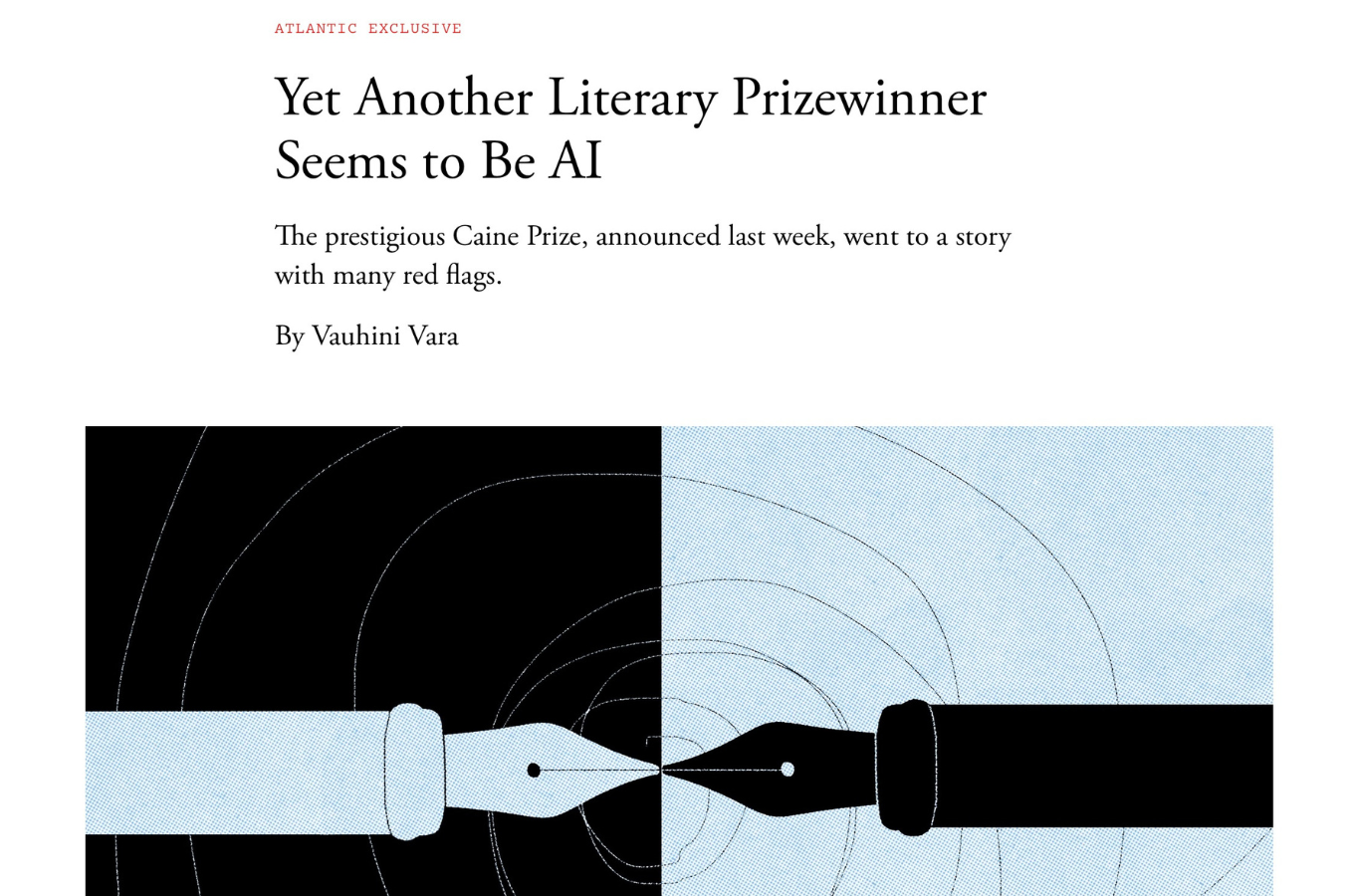
A week after we reported that Zimbabwean writer Simbarashe Steyn Kundizeza had won the £10,000 2026 Caine Prize for African Writing, the prize is reviewing his winning story, “The Blue Fighter,” after an article in The Atlantic suggested it may have been written with AI. The Caine Prize has not announced a finding, and Kundizeza’s literary agency has said it is confident the story is his own work. The article, by journalist Vauhini Vara, has drawn sharp responses from African writers and journalists on X.
The central evidence of Vara’s article, “Yet Another Literary Prizewinner Seems to Be AI,” is a scan by Pangram, an AI-detection tool, which flags almost the entire story as AI-generated, with the epigraph as a notable exception. Vara reports that Pangram rated all 25 previous Caine Prize-winning stories, and Kundizeza’s 2021 story “The Whistleblower,” as fully human-written. She also points to what she sees as hallmarks of chatbot prose in “The Blue Fighter,” including “not x, but y” constructions, a glut of metaphors, and aphorisms, which she says are absent from the earlier story, and to stereotypes of African life she describes as common among outsiders.
The article acknowledges that AI detection is fallible. It cites Pangram’s claim that it mislabels human text as AI in roughly one in 24,000 cases and a peer-reviewed study that found no false positives among non-native English writers, but notes that independent research on the tool’s effectiveness across nationalities is limited. Vara also writes that she contacted Kundizeza through his agent, Adrienne Ingrum of the Serendipity Literary Agency, who said the agency’s CEO would send evidence that the story is his own work. According to the article, neither Ingrum nor the CEO followed up before publication. Vara closes by saying she may well be wrong.
The Caine Prize said in a statement that it is its responsibility to look into such claims, and that it is taking a “human centred approach” that supports writers during the process. It added that the process has begun and that updates will be posted on its website. The statement noted that the prize celebrates stories already published elsewhere, which puts it in a bond of trust with the magazines and journals that publish the original work.
Ellah Wakatama, who chairs the Caine Prize’s board of trustees, told Vara that AI-generated fiction is not eligible for the prize, and that she and her colleagues launched an investigation as soon as they learned of Vara’s inquiry. She said she and a colleague will interview the judges, reread the story, and talk with Kundizeza in detail about his methods, and that a colleague has been in touch with his agent about whether verification could include reviewing earlier drafts.
Wakatama also rejected using an AI detector as a measure of AI involvement. Her stance, she told Vara, is that anyone making such an accusation must offer proof that “does not come from a machine.” She said she would approach Kundizeza with compassion and a presumption of honesty, adding that the accusation coming from outside the African literary community reinforced that. Wakatama, who is also Zimbabwean, pointed to details in the story that she considers distinctly Zimbabwean, and said she does not believe AI models are capable of that kind of cultural nuance. Vara describes her as open-minded and intellectually honest, though she disagrees on the use of detectors. As the conversation ended, Wakatama told her, “I am fervently praying that you’re wrong.”
Tope Folarin, the 2013 Caine Prize winner and a novelist and critic, told Vara that it would be unfortunate if Kundizeza had used AI for any of the story, since its subject is “deeply human.” He also said that many writers from the global South feel pressure to write toward Western expectations, and that chatbots have latched onto that pressure. He called the situation a “tragedy.”
The responses we’ve gathered from X are all critical of the article and its method.
Wale Lawal, founder and editor-in-chief of The Republic, the Lagos-based magazine of news and ideas, wrote: “This is crazy, racist and wildly unethical. Seems? Despite there being no shred of credible evidence? Maddening.”
Karen Attiah, an award-winning journalist who founded The Washington Post’s Global Opinions section and was named the National Association of Black Journalists’ 2019 Journalist of the Year, wrote: “It is really chilling to see how quickly Black, Caribbean, and African writers and academics have become the global face of AI use and plagiarism. For such a serious charge, @vauhinivara’s article rests on…a Pangram scan. No comment from the African writer in question.”
Aiwanose Odafen, the Nigerian novelist and author of Tomorrow I Become a Woman and We Were Girls Once, called it “a very irresponsible article.” She stated: “The only proof given is the use of an AI-detection tool and author’s own assumption of what is considered cliche in African writing. She then goes on to quote Panagram’s own ‘research’ as proof that it rarely detects false positives.”
Oghenechovwe Donald Ekpeki, the Nigerian speculative fiction writer, editor, and publisher, wrote: “These attacks on African and Black writers are nothing new. AI is just the tool of the age. Before this, it was plagiarism. It was almost like a rite of passage. Now it’s AI. The root cause remains the same. Racism, anti Blackness, Afrophobia.”
Romeo Oriogun, the Nigerian poet and winner of the $100,000 2022 Nigeria Prize for Literature, brought in a historical perspective: “From the moment African literature first encountered the West, it has never been allowed to exist on its own terms. The West has always demanded that we defend ourselves and our languages, and its accusations have taken different forms over time. AI is just one of those forms.”
Several writers took aim at the article’s suggestion that Kundizeza’s style had changed between stories. Sue Nyathi, the Zimbabwean novelist and author of The Polygamist and the award-winning An Angel’s Demise, asked: “So are we saying writers aren’t supposed to grow and evolve stylistically??” Elnathan John, the Nigerian novelist and satirist, author of Born on a Tuesday and a former Caine Prize shortlistee, criticized the article and its author in strongly worded terms, saying the journalist is entitled to dislike the story but that the claim about a change in style was the worst part of the piece. “My writing changes every few years. Sometimes significantly,” he wrote. “Different stories also demand different styles… you cannot be a slave to style. Your first duty is to the story.” The only conversation he’s interested in, he said, is whether it is a good story and whether it moves people.
Sampa Kabwela drew reference to a recent case, “It seems that the new form of racism is accusing award winning black authors of using AI. Just two weeks ago, it was the Haitian-Canadian writer. I haven’t read either of the stories, but I see a pattern.” Kabwela’s reference is to Thélyson Orélien, the Haitian-Canadian novelist whose debut, C’était ça ou mourir (It Was Either That or Die), was removed from the Prix Goncourt longlist on September 25 after claims that it was largely written with AI, as The Guardian reported. Orélien denies using AI. In his case, the French and Canadian media separately reported plagiarism in articles he wrote in 2012 and 2013, and the Académie Goncourt cited those reports alongside what it called converging analyses suggesting AI use. Some experts have questioned how reliable the detection tools are.
Another case unfolded earlier this year. In June, the Commonwealth Foundation concluded a month-long review of regional winners of the Commonwealth Short Story Prize after AI allegations, clearing all of them. The Foundation said detection tools can be useful indicators but cannot provide conclusive evidence on their own. As The Atlantic notes, one of the writers who had been flagged went on to win the overall prize.
The Caine Prize has also been here before. In 2019, it removed Tochukwu Emmanuel Okafor’s “All Our Lives” from the shortlist over a failure to attribute an original source, a step the prize had not taken before. The prize was then chaired by Ellah Wakatama. More broadly, Brittle Paper has revisited the plagiarism controversy that followed Yambo Ouologuem’s Le devoir de violence, which shaped his career and the reception of his book.
The New York Times also published an opinion essay on October 11 on AI, fiction, and Black writers, ending with a strong conclusion: “Those with the most to lose in these very public disgraces are young writers from underrepresented backgrounds whose work meets increased suspicion. They are being asked to choose between success and a target on their backs. Unmasking Black writers will cease to be a blood sport only when it fails to find so many spectators.”
At the time of writing, the Caine Prize has announced no finding and has not withdrawn the award. Its statement says it will share updates on its website, and we will update this post as the review progresses.


COMMENTS -
Reader Interactions