

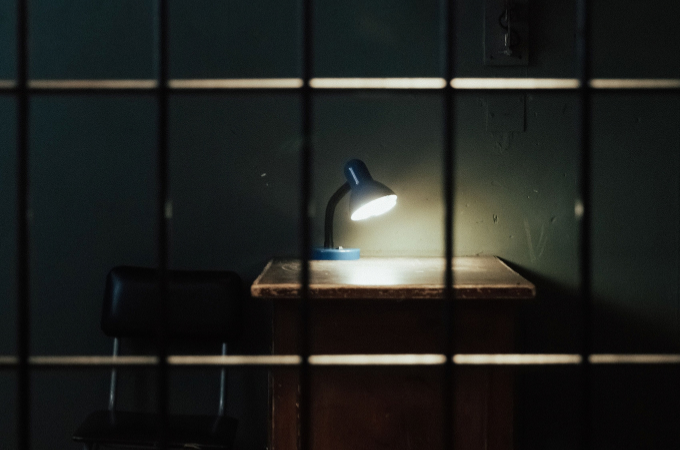
Bryan shifted on the hard plastic chair. The overhead light buzzed steadily. The smell of burnt diesel and scorched plastic clung to his jacket, cutting right through the interview room’s mix of disinfectant and stale coffee. He scrubbed at his thumbs, trying to rub away the black soot ground deep into his cuticles, but it wouldn’t shift.
Across from him, Emily Claver, his lawyer, apparently, flipped open a file with steady fingers. He watched her peruse his papers, noting how she took her glasses off to read, and put them on to look at him. He wondered again if Gina had deliberately chosen her because of what she was, her way of letting him know where she stood on such things. Whatever the reason, she was going to look pretty strange standing beside him in the media.
“You ever represented someone like me before?” Bryan asked.
She didn’t look up. “Define ‘like you’.”
Bryan cleared his throat, the sound too loud in the small room. “You know…” he shrugged. White. Born and bred here, with roots going back centuries. Why was it so hard to just say those words now?
Emily snapped the file shut. “I’ve defended four arson cases, this year. One guilty.” She leaned forward slightly, elbows on the table. “But you’re asking if I’ve represented someone who holds views like yours before. The answer is yes. He got a suspended sentence.”
“So, knowing what I think about people like you…”
“Your sister Gina sends her regards,” Emily cut in. “It’s a good thing we have kept in touch.” She seemed bemused by the blank look on his face. “You don’t remember me do you, Bryan? You were more my brother Keith’s friend, obviously, but I used to come to your house and we would all play Monopoly, and you’d cheat by hiding hotels under the board.”
Bryan exhaled through his nose, the memory of Gina’s furious face when she’d caught him palming those tiny plastic hotels flashing behind his eyes. He’d been twelve. She’d thrown the board at his head.
“You remember that, huh?”
He nodded. The only Black family on the street. They came from Zambia, he remembered. “Your family wasn’t called Claver.”
Emily held up her left hand. The ring glinted in the neon light. “Yes, he is white British. My children have roots going back centuries too.”
But he probably has a Jewish mum, Bryan thought.
He had forgotten the Black family. One day, they had moved out and were never seen again. Then, recently, Black families started to move in to the neighbourhood. But, looking back to Keith and Emily’s family, Bryan realised there had always been a pattern; the Black families never stayed for longer than five years. He had always thought they had gone back to Africa or the Caribbean, or even London or Birmingham, but maybe they had simply moved to the more affluent parts of Middlesbrough.
“I remember a lot of things, Bryan,” she said. “Like how your dad used to shout at the telly every time some politician mentioned immigration. How your mum would turn the volume up to drown him out.” She tapped the file with one finger. “Which brings us to The Truth Injection. You really believe the government hands out free furniture to migrant families?”
“Saw the photos, didn’t I?” he exhaled and threw up his hands.
“And it never occurred to you that these were deliveries to people who had bought the furniture?” Emily said evenly, “I have seen The Truth Injection website, and the photos you are referring to. One of the families depicted consists of a couple of nurses, who work twelve-hour shifts, one of them for most days of the week.” She pulled a printed sheet from the folder, a screenshot of the conspiracy site’s banner, a syringe with dripping yellow liquid into the arm of a young white man. “This is your reasonable source? A blog that also claims the moon landings were faked by the Freemasons?”
The overhead light flickered once, casting Emily’s face in sharp relief for half a second; the curve of her cheekbone, the tightness around her mouth. Bryan’s throat felt dry.
“It wasn’t just the website,” he said. “Everyone on the street was talking about it. My cousin’s mate Tommo swore his cousin saw council workers unloading sofas straight into a Somali family’s flat.”
Emily’s eyebrow twitched. “That’s what you told the police, and they noted that this Tommo is the same Thomas Harlan who served eighteen months for fuelling the flames of the August 2024 riots by spreading the lie that a white teenager had been attacked by a gang of Muslim Pakistani teenagers?” She didn’t wait for an answer. “He knew the truth and handed you a lie anyway. The police checked the receipts. The Dirie family owns three local businesses in Teesside. Those council workers were moonlighting on their day off to deliver furniture the family bought with their own money. The blog editor knew it, Tommo knew it, he even commented on the online retraction before he came around to work you up.”
The police had gone over this with him, Bryan remembered. One of the coppers was a Pakistani. The other was white, but Bryan was sure she was actually Jewish.
“Bryan, listen. The prosecution’s going to argue premeditation. That you targeted the truck because the driver was Black. But if we can show you’re…” she hesitated, searching for the word.
“A complete doyle?” Bryan offered, with a hollow laugh.
“Impressionable,” Emily corrected, her voice softer now. “You believed a falsehood because it fit what you wanted to believe. That’s not the same as malice.”
She slid another photo across the table. Nobby Robertson stared up at Bryan. He looked like a mummy, the type from Egyptian history, with the bandages wrapped around his head and arms, blending into the sterile white of the hospital sheets like camouflage. Bryan’s mind conjured darker versions, of a shriek that seemed to go on and on, burnt flesh reeking, and a flaming scarecrow tumbling out of the back of the lorry into the afternoon sun. That image of Nobby looking up, his ears melting like wax, charred hair falling off his sizzling head, would always remain in his mind.
Emily tapped the edge of the photo. “Police agree Nobby climbed into the truck after you’d already started the fire and were walking away. In his statement, he said he thought it was abandoned, and just wanted to see if he could grab something.” She paused, watching Bryan’s face. “You didn’t know he was in there when you lit the match.”
Bryan’s fingers twitched against the table. He hadn’t known the stupid lad would do that. But all those people who watched Bryan set that lorry on fire must have seen Nobby, even if Bryan himself was walking away. It didn’t matter now, did it? The kid was hanging on to his life by a hairsbreadth over at Captain James Cook Hospital. Bryan’s breath came short, the room suddenly too tight.
“What happens next?”
Before Emily could answer, the door swung open. A uniformed officer, early fifties, tired eyes, pot belly, stepped in without knocking. He didn’t look at Bryan. “Robertson died at 14:23. Family’s been informed.” His voice was professional, as if he were reporting a broken vending machine.
Emily didn’t flinch when the officer spoke, but Bryan saw her thumb press harder against the edge of the file, the nail going white. The officer left without another word, the door clicking shut behind him. The silence pooled between them.
“Bryan, you had a slim chance when all you had on your plate was racially-motivated arson. My job was to show the court that the sort of stories which impelled you to torch a delivery lorry are widely circulated, even in mainstream media, and that the average person in this country would have been just as likely to believe them. But Nobby’s death means you’re looking at manslaughter.”
“So, what does this mean?” he asked. He was surprised at how dry his mouth had become.
Emily looked down at the file. For the first time since she’d entered the room, she seemed reluctant to continue. “It means the prosecution no longer has to prove you intended to hurt anyone.”
Bryan stared at the table. The overhead light buzzed. Somewhere down the corridor, a door slammed.
“There’s something else.” Emily opened the file again and withdrew a sheet of paper.
“What’s that?”
“The driver’s employment records.”
Bryan frowned. “What about them?”
She slid the document across the cold table. Bryan glanced down at the personnel form, his eyes landing on the passport photograph clipped to the upper corner. The face was older, broader, with grey threading through a close-cropped beard. A faint, uneasy recognition stirred in his chest, but he couldn’t place it.
“You don’t recognize him without the football kit,” Emily said quietly.
“What?”
“He didn’t live on Quentin Street,” Emily said. “He went to school with my brother Keith. Used to sleep over at our house on weekends. You, Keith and him spent the whole summer of ’98 kicking a ball against the park wall until the sun went down.”
The room seemed to shrink. The memory clicked into place—a tall, lanky kid laughing as Gina shouted at them to keep the ball out of her garden.
“Eric Agyapong,” Emily said. “His family stayed in Middlesbrough. He’s worked for the council for twelve years. He wasn’t even supposed to be on that route yesterday, he was covering a shift for a colleague.”
Bryan felt cold. Images collided behind his eyes, the roar of the fire, smoke drifting into the summer sky, Nobby’s shrieks as he tumbled out of the back with a sickening thud, his screams rising above the clamour of voices, and the face on this piece of paper. The man he had turned into a threat, an intruder, a story from a website. Part of what everyone said was happening to the country. For years, Bryan had told himself he knew what was happening. Who was taking what. Who belonged. Who didn’t.
Bryan’s mouth opened, but nothing came out. The buzzing light seemed louder now.
Emily closed the file. “You spent years believing people like us were strangers… We weren’t strangers, Bryan.”
Outside, a telephone began ringing somewhere in the station. Neither of them moved.
“What happens now?”
Emily held his gaze for a long moment. “Now we find out if we can convince a jury you couldn’t tell the difference.”



COMMENTS -
Reader Interactions