
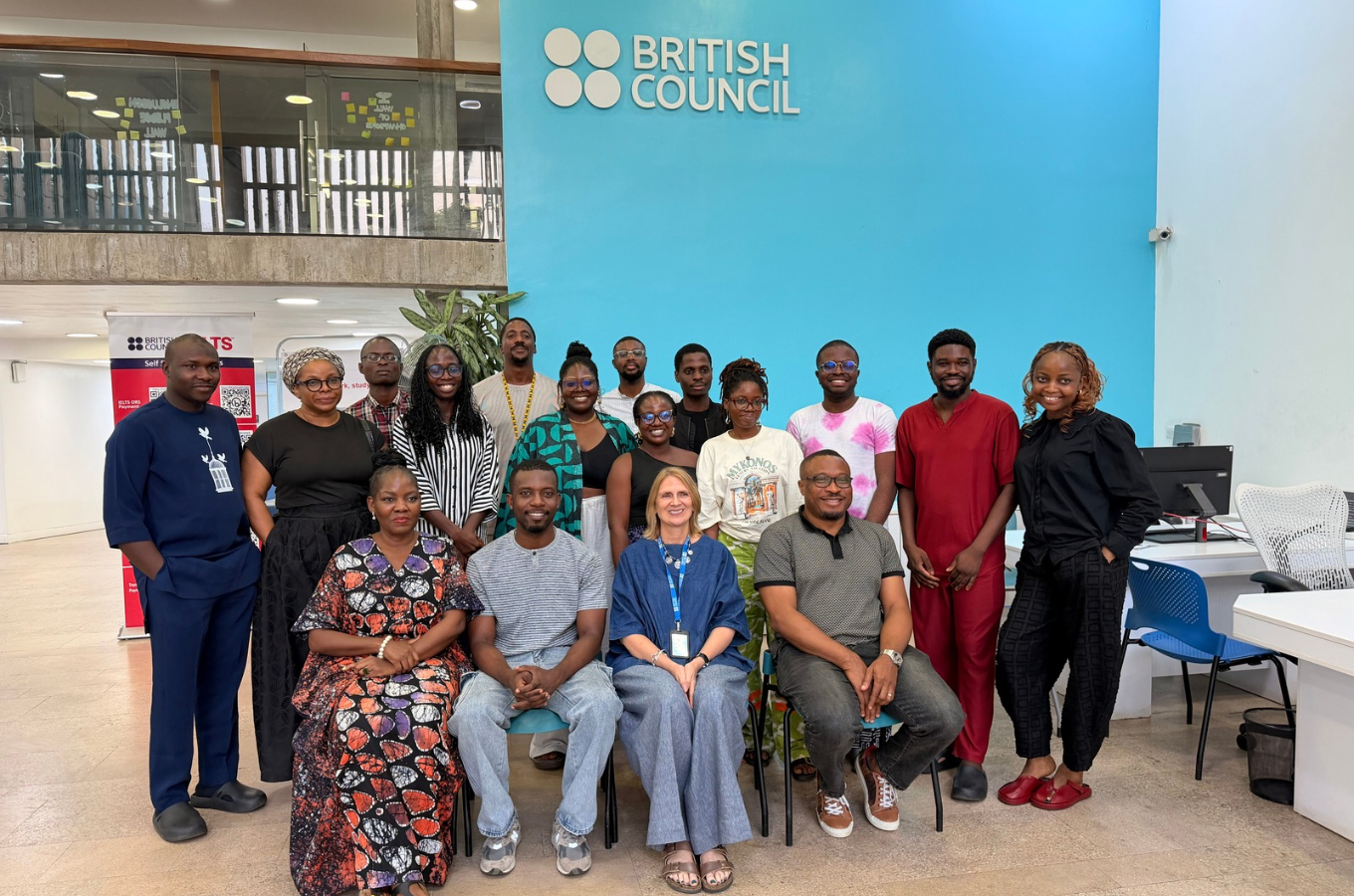
After two days of learning to read and edit more critically, both their own work and that of others, a group of writers gathered in Lagos for an evening of readings, conversation and exchange at the Caine Prize Self-Editing Workshop mixer.
The two-day workshop, held on November 17 and 18 in partnership with the British Council and the Open Society Foundations, brought together 12 Nigerian writers at different stages of their careers. Facilitated by writer and journalist Molara Wood, the sessions explored the writer’s relationship with the editor’s eye, structural editing, line editing and language. Liberian-American author Wayétu Moore also led a masterclass on magical realism and speculative fiction while Eghosa Imasuen of Narrative Landscape Press took participants through a publishing masterclass, offering insight into the industry and the journey from manuscript to publication.
At the mixer, participants took turns reading excerpts from their work, offering a glimpse into the different stories they were developing. The subjects ranged from the difficult dynamics of a mother-daughter relationship to the hilarious absurdities of a character’s wanderings. It was a reminder of the different directions a story can take and the many ways writers make sense of the world.
Donna McGowan, British Council Country Director, expressed her appreciation for what she had heard, noting that the readings offered a hint of the quality of writers the workshop could produce. Harry Kesiena, the Council’s Head of Arts, who had also played an active role in supporting the writers throughout the workshop, was present at the gathering.
The evening also opened up a conversation about artificial intelligence and the future of writing. Eghosa Imasuen, Executive Director of Narrative Landscape Press, encouraged writers to keep inventing and developing their styles, finding ways to make their work distinct even as AI becomes increasingly capable of reproducing human writing. When the technology catches up, he suggested, writers must be willing to reinvent themselves.
Between the readings, feedback from publishing professionals and conversations over refreshments, the mixer offered something beyond the formal lessons of the workshop: an opportunity for writers to encounter one another’s work, exchange ideas and remember that writing is also a communal practice.

COMMENTS -
Reader Interactions