

 Night has the color of old ink as he slips out of the city, first taking leave of his mother in the tall anteroom of her house in the suburbs. She is alone: his father is abroad attending a conference on money laundering at an alpine resort; on such days, the housekeeper is dismissed early.
Swift, murmuring embrace; the mother’s face is averted. A farewell that goes as Emil has anticipated until the final moment. Holding the front door ajar between them, as if to bar his re-entry or to confirm his exile, Vivian Silva offers a parting shot in her native argot: “Careful wat jy vind dar.”
He gets in his car and, as if reluctant, which he partly is, pulls away from the curb. The trunk of the car contains a suitcase half filled with enough personal effects for a few weeks of travel. Three pairs of the crease-folded trousers he wears beneath his lab coat, and which are too formal for where he’s going. Also in the case, which does not belong to him, is a canvas backpack stretched tight with monographs on clinical neurology and cognition.
The commuter traffic on the motorway is in full spate: latemodel metallic blue or gray sedans rush north. It is fashionable now in the city to drive oneself rather than hire a driver, even for the outrageously wealthy. The city’s remaining socialist newspaper—too often lately he finds himself reading it instead of his medical texts—has seized on the trend as proof of an epidemic of virtue signaling that harms workers. From the elevated highway, he has a view over walds of bluegum and night-shadowed pepper trees: a fake forest concealing the slag hills out there where shackled men had delved and died for the gold that made the city rich.
When a moment came to reckon with the country’s history, the city fathers made pragmatic choices, directing that fast-growing trees be seeded across undeveloped tracts of earth to heal the deep gouges made by quarrying machines. And they chose a new name: eGoli became eGeld. Abode of wealth replaced the golden place, a shift in emphasis that was both more and less subtle than it seems.
The ersatz bluegum forests efface eGeld’s present as much as its past. Also out there, in the southwest and the east, are the barracas, the city’s slums, which are invisible for commercial reasons. EGeld’s municipal authority rations electricity based on economic output, so tenement precincts experience seven-hour blackouts each night, even in grayest winter. In the central business district and the northern suburbs, the nightlong glare of streetlights stains the atmosphere orange, erasing from sight astral constellations: the Chisel, the Furnace, the Fox.
More than once it seems that Emil has passed eGeld’s outer limits, but the city is merely shape-shifting, its dwelling places becoming ever more provisional and tumbledown until, twenty miles from downtown, tent settlements stand on either side of the road; these thickets of canvas at last give way to swidden fields.
—
Careful what you find down there. He parses his mother’s advice in two ways (her native tongue is well suited for subtly conveying obscenity). Down there reads straightforwardly—he is, after all, bound for the deep south of the country. But the words also gesture to the thing between his legs. They read as a dig about sexual immaturity, at his ignorance of all the uses for his prick. Nastiness is out of character for Vivian. He takes it as proof of a lingering rancor, toward which he is sympathetic. He has let himself be sucked into an errand of his father’s, a fool’s errand (which of them, father or son, is the bigger fool is not yet clear), in spite of Vivian’s attempts at rescuing him. Only a few months have passed (it feels quite a bit longer) since he told his parents he would take the coming year off. He did not mean to quit medical school—there was no chance of the one year away becoming three, and then final. But as burnout had begun to feel increasingly likely, now seemed the best moment to step away. There were eight years yet of intensive training ahead of him: three in general surgery and five more to specialize in neurosurgery.
Vivian had concealed her surprise—and pleasure—at his news. “You’ll travel?” she’d said. “Or what will you do?” “I’m not sure.” The decision itself rather than what to do had preoccupied him. “I’d like, I think, to take a year just to live.”
“‘To live,’” Errol Silva said in echo, and not because he hadn’t understood. Errol has been fortunate in life, very fortunate, and lucky chances had taught him not complacency but wariness, cunning. Skeptical, he waited for Vivian to press their son on his plans, but his wife sat very still, face glazed with thought, and said nothing.
Emil too refused to be drawn to elaborate, so Errol changed the subject. “How’s the refresh coming?” A reference to the guest annex the Silvas had commissioned to be built behind the main house. The idea had been Errol’s, his intention being to create a diversion for his wife until he turned sixty, when he expects to be named an ambassador. His old allies in government have promised no specific posting, but it will be somewhere in keeping with long service to the party. Errol has lobbied, discreetly, for Bogotá, San José (regrettably, Caracas must now be ruled out), or Rio de Janeiro (the consulate there would represent a small step down in rank, but no matter). Even Port of Spain would do, most any country with a Creole sensibility.
“The construction will go ahead before we landscape,” said Vivian. She had seen through her husband but thrown herself anyway into overseeing the annex, even installing CAD software on her computer to review 3D blueprints. “The other way around would be too disruptive.” The project has proved effective in staving off Vivian’s reveries about diplomatic life in cities her husband thinks of as arid. Vienna. Luxembourg. Bern.
Errol had been content to let lie the matter of Emil’s hiatus until the following family supper a fortnight later. He returned to it in his oblique, lawyerly way. “Either of you read anything about this Braeem Shaka? The one riling up folks down south with political rallies. Our folks. Apparently, he’s an anti-Semite, from what I’m hearing.” Our folks was Errol’s way of discreetly referencing Creoles.
Emil, so often only half attentive during these dinners, missed the abrupt shift in the conversation that followed. So, when his mother said, “a year older,” he did not know the question she was answering. After a beat, it became clear: Errol had asked him about his cousin Andres, and Vivian had answered on his behalf.
“The boy’s not doing well, Celeste tells me.” Errol addressed himself primarily to his wife. “Feuding with the brother, can’t hold down steady work. Bothered me to hear that, I can tell you, Viv. So, I asked Celeste, ‘Should I call Andres up and talk to him?’ I could fix a work trip down there, you know? Take that jungen out for beers and hard talk. Celeste just laughed. She said, ‘Now, how would that work, Errol?’”
“You don’t know him well enough for that.” Vivian was brisk.
Errol had shaken his head. “You’re right, you know. It’s late in the day to start to play uncle.” He gave Emil a meaningful look. “But you, it’s not too late for you to connect with him. Both of your cousins and your Aunt Celeste.”
Emil said, “How do you mean ‘connect’?”
“Get to know them, build that family connection, you know. What do you think of the idea of going down there, spending time with Celeste, them? Andres and Torrance.”
“Over the Christmas holidays, you mean?”
“I’m talking about living with them for six months, a year. These are your relatives, man. Your extended family.”
Vivian cut in. “For what reason, Errol? It would be an imposition on Celeste, even for a few weeks.”
“Funny you say that.” Errol levered morsels of trout meat from his plate onto his fork. “Celeste is forever asking after Emil. ‘How come he don’t visit? He getting on at medical college?’ This kind of thing. You know your aunt. She’d make a big fuss of you.”
“I think Celeste needs moral support, Errol. You and I ought to go down for a week or so and visit with her. We should go down. We haven’t seen them since Karel died.”
Again, Errol shook his head. “It’s not Celeste worrying me. I think she’s rather taken to being a widow, if I’m honest. It’s the boy. It’s a lot to lose a father. Look, my thinking is, go down there, spend some time with him, with them, and when the moment is right, you deliver some tough love.”
“And what if”—Emil chose his words with care— “. . . what if Andres wants nothing to do with me?”
Errol seemed not to have considered this hitch. Looking at Vivian, he rubbed his middle finger along his cheek. “Well, if he’s not interested, so be it. But it would still be an education for you, Emil. You know, reconnect with your roots.”
“Christ, Errol,” Vivian said. “You’re wanting Emil to play babysitter and explore his roots, when all he wants is a break. Breathing space from the intense preparation to become a neurosurgeon. And are you really asking him to throw himself on the hospitality of his less well-off relatives, people he’s not seen in five years? For a few months?”
“Christ yourself, Vivian.” Errol shifted in his seat, and he turned now toward Emil. “What’s breathing space? What does that mean? You’re going to go lounge on a beach somewhere? See some sights? Rome, Venice, this kind of thing?”
“What’s the implication here, Errol?” Vivian held tight to her sudden fury; her voice barely rose. “He’s being shiftless because he wants a hiatus. That’s your response?” The signs of her outrage were physiological. Vivid. She jabbed her arms in a birdlike motion, exposing the insides of her wrists; in her throat, the jugular vein stood out beneath the skin.
“It could work,” Emil interjected, although he was care- ful to leave his meaning unclear. He felt embarrassed before his mother’s ire. Shamed. He did not merit such a righteous defense. And he is conflict-averse enough that he’d already begun considering what going along with Errol’s idea might entail. In the next breath, he said, “Maybe I can learn something from Andres too.”
Even though he knew this would inflame Vivian even more. “What are you saying, Emil? What do you mean?” Vivian caught her breath. “This is crazy. If it’s down to anyone to save Andres, that would be Celeste. And where in all of this is Torrance, where does he figure? Maybe he needs rescuing as well?”
“Let me think about it,” Emil said. A fleeting pleasure, seeing his father quail beneath Vivian’s anger.
“Yes. Sleep on it,” the mother said. “I’m done with the topic, Errol. Done with concerning myself with Andres and Celeste as if they’re children. And for god’s sake, Errol, spare me any talk of roots in this house. Spare me. Keep that . . . kak for your comrades.”
A family squall, and one blown out as abruptly as it flared. Were anyone peering in at the window, the Silvas would have presented a curious tableau. Vivian staring into her plate as if scrying. Errol slumped in his chair, wetting his lips with the tip of his tongue every few moments, chastened in the stony silence, awed too by his wife’s capacity for outrage. There were stains in the bottoms of the wineglasses, the lees dark and gritted as coffee. At the lip of Emil’s own plate was a row of translucent trout bones; Nanda, the housekeeper, had missed a few in her deboning.
***
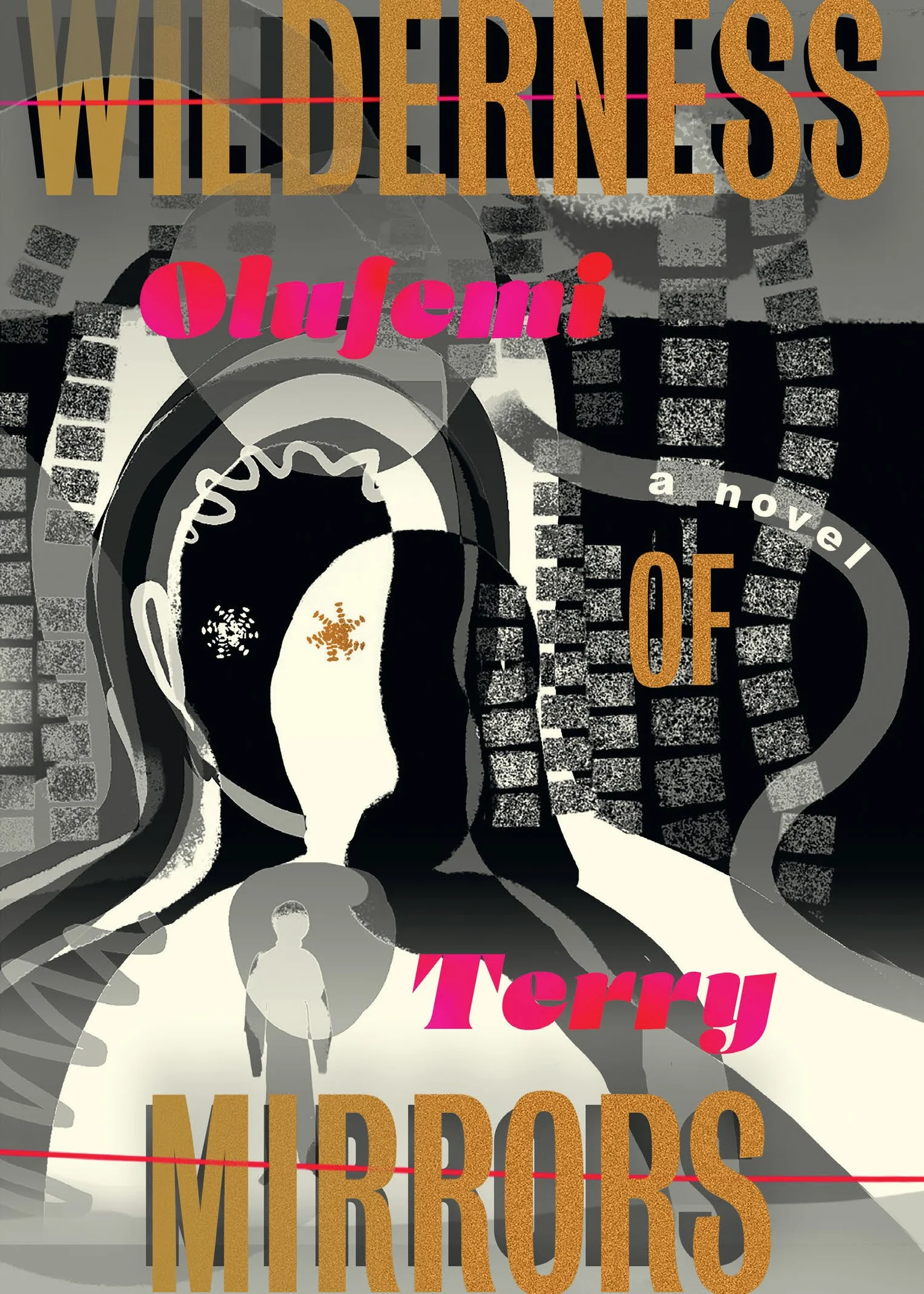
Excerpt from WILDERNESS OF MIRRORS published by Restless Books. Copyright © 2025 Olufemi Terry. All rights reserved.
Preorder a copy of the book here.






COMMENTS -
Reader Interactions