

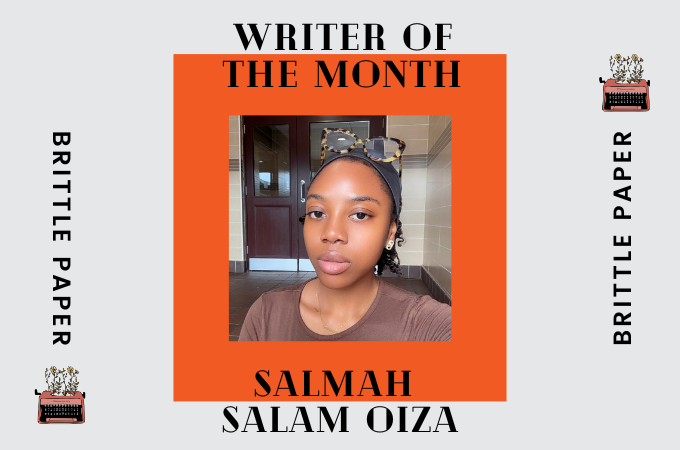
Brittle Paper’s Writer of the Month for October is Salmah Salam Oiza!
Salmah is a Nigerian writer, poet, literary curator, and communications strategist. Her work explores the interior lives of modern Nigerian women—their desires, contradictions, faith, and dreams. Writing across genres, she moves fluidly between different forms, often circling themes of longing, shame, class, femininity, and morally complex relationships.
She is the author of the forthcoming chapbook Foreign in a Long-Familiar Leap Year, a deeply intimate collection of 13 poems that follows her journey through a leap year marked by migration, questions of belonging, and the quiet labor of self-discovery. She is also the voice behind Dear Salmah, a long-running personal blog and newsletter where she shares her favorite things—from books and music to beauty finds, travel notes, and reflections on navigating life and love. She invites readers into her world and has cultivated a loyal readership drawn to her warmth, honesty, and lyrical style. Salmah is also currently working on her debut novel, Love Insha’Allah, a sweeping love story set entirely in Nigeria that examines intimacy not only as romance but also as a negotiation of identity, history, and selfhood.
A core part of her writing practice is challenging binaries and pushing against reductive narratives that flatten identity. She writes with a deep awareness of the dangers of the “single story.” Her work deliberately rejects frameworks that seek to box women—especially Black Muslim women—into stereotypes. Intersectionality is central to her voice, which seeks nuance over simplicity, humanity over labels. Her work draws inspiration from a broad lineage of voices and traditions, including writers such as Leila Aboulela, Warsan Shire, Safia Elhillo, Audre Lorde, James Baldwin, and Chimamanda Ngozi Adichie.
She is a curator and project lead with the Birmingham Global Shapers Hub, an initiative of the World Economic Forum, which brings together young leaders to drive impact in their local communities. She uses this platform to champion creative expression, gender equity, and storytelling as tools for social change, while fostering a network of diverse voices shaping the city’s cultural landscape. Outside of writing and community work, Salmah is usually experimenting with elaborate tea rituals, curating playlists for every mood, rewatching her favorite guilty-pleasure dramas, or, in her own words, “being thoroughly bossed around by my cats.”
Now, please join me for a lovely chat with Salmah!
***
Brittle Paper
Salmah, congratulations on being our October Writer of the Month! This campaign took a very short break, but I’m excited that it’s back and I get to sit down for a chat with you! Your poetry publication, “January Is a One Way Ticket,” was my September highlight!
As always, we need to start from the beginning, so tell us about who Salmah Salam is and how she became a writer?
Salmah Salam Oiza
Thank you so much, I’m really honoured.
I think I’ve always been surrounded by stories. Growing up in Nigeria, I had Nollywood films in the background, folktales from my father about tortoises and birds, and the rhythm of mosque sermons that sounded half-prayer, half-poem. Those things sank into me before I even realised they were teaching me language.
I didn’t set out to “become” a writer at first — writing was more like a way of holding on. When I moved to the UK, I found myself jotting down lines on the bus, after prayer, even on my phone in the grocery store. Over time, the scraps became poems. Looking back, I think I became a writer the moment I started paying attention — to time, to memory, to the small textures of life that demanded to be named.
Brittle Paper
That’s a beautiful journey into your discovery that you are, in fact, a writer! I grew up with my parents telling me stories, but my dad didn’t go down the folktale route; he would just blend together bits of every bedtime story he could remember in the moment, which is probably why I’m an editor and not a writer!
The WotM tradition is that, before we chat about your work, I have three questions to help us get to know your literary personality a bit more.
First up, what is the earliest book you remember loving as a kid?
Salmah Salam Oiza
The earliest book I remember really loving was Purple Hibiscus by Chimamanda Ngozi Adichie. I read it at an age when the world it described felt both close and impossibly distant — Nigerian, yes, but also full of silences and violences I was just beginning to notice around me. It taught me that literature could name what was often whispered about, that a book could be both beautiful and bruising at once.
Another book that stayed with me, for very different reasons, was Lord of the Flies. It unsettled me. I didn’t have the vocabulary then, but I knew it was about power and cruelty, about how quickly people can turn on each other. I carried it like a secret unease, returning to it years later and realising why it had gripped me so young.
Alongside those, I read whatever else I could get my hands on: Pacesetters with their drama, the moral stories tucked at the back of newspapers, school anthologies. And, outside the page, there were Nollywood films on VHS, mosque sermons that moved like poetry, my father’s folktales about greedy tortoises and clever birds. All of that was literature to me before I even knew to call it that.
Looking back, I think those early books and stories gave me two things at once: the boldness to name difficult truths (Purple Hibiscus, Lord of the Flies), and the reminder that ordinary lives — our lives — were worthy of the page.
Brittle Paper
Your description that “literature could name what was often whispered about” is such a brilliant way to sum up why so many of us are drawn to books and stories.
Is there a book, for good or for bad, that you wish you could bring up in every conversation?
Salmah Salam Oiza
Yes — Americanah by Chimamanda Ngozi Adichie. Not because it’s perfect, but because of what it did for me when I first read it. It named migration, hair, love, race — things I was just beginning to make sense of in myself. It opened a door. I’ve argued with it, disagreed with parts of it, but I carry it like a companion text to my own life. For good or bad, it’s one of those books I find myself circling back to, wishing more conversations would make room for the messy, layered truths it holds.
Brittle Paper
The last question is always the same. If you could have a dinner party with your favourite artists, who would they be?
Salmah Salam Oiza
This is such a fun question. I think I’d start with Warsan Shire (poet) because her work gave me permission to write about intimacy and ache without apology. Then Octavia Butler (writer), because her imagination feels prophetic, and I’d just want to sit quietly and listen to how she saw the world. Sade (musician), because her voice is pure atmosphere, and every dinner party needs that kind of soundtrack. Lately I’ve also been loving Celeste (musician). And finally, someone from home, maybe Nollywood-era Stella Damasus (actress), because those films shaped me long before I knew they were art. I like the idea of a table where lyric, prophecy, music, and melodrama can sit together.
Brittle Paper
I know I said that was the last of those questions but since you have clearly have a knack for describing things so beautifully, I’m adding one more. If your writing were a dish, and yes it will be served at the dinner party, what would it be?
Salmah Salam Oiza
Jollof rice, without question. It’s layered, it’s communal, it carries memory. You can taste the smoke of the firewood, the sweetness of ripe tomatoes, the heat of pepper that lingers long after. My poems are like that — simple on the surface, but textured with what you can’t quite name. And just like jollof, everyone has an opinion about the “right” way to make it. For me, writing is about that same argument, that same insistence that flavour — or truth — comes in many forms.
Brittle Paper
Salmah, on that note, let’s dig into the jollof rice you served up in September. “January Is a One Way Ticket” is just that, it is so simply presented, yet it packs a punch when you get into it. I know I have already said this to you before, but this really is one of my favourite poems I got to publish this year. I’ll be honest, as a reader, short stories are usually able to draw me in more than poetry, but this piece is so good at condensing all those emotions and anxieties into just a few lines. You really did a fantastic job!
I know this question may seem obvious on a surface level, but what inspired this poem?
Salmah Salam Oiza
Thank you so much. That means a lot to me. “January Is a One Way Ticket” was the very first poem I wrote for what later became Foreign in a Long-Familiar Leap Year. It was born out of that moment of departure — leaving Nigeria for the UK with excitement on the surface but also fear underneath. I wanted to capture the feeling of being suspended: of holding a ticket in your hand and realising it’s not just paper, it’s rupture. The poem is short because the feeling itself was blunt, clipped. There wasn’t room for ornament — it was just: I am leaving, and I don’t know when I’m coming back. Writing it was my way of naming the ache without softening it.
Brittle Paper
Usually, if the writer had written a short story, I select my favourite section. I rarely do this with poetry because it feels wrong in a sense, almost intrusive to separate parts. But if you’ll allow me, I do want to point out my favourite part of your poem, which is:
I do not look back at the compound.
I know what I’d find:
a plastic chair tilted from last night’s goodbye,
my mother’s wet, pleading eyes—
What’s left of that country
will wear you thin.
I feel like it encapsulates the whole poem so well, and the chair line is the most heartbreaking description for me, even more so than the mother’s eyes.
Salmah Salam Oiza
Thank you for sharing that — it means a lot when I hear about which image lingers with everyone. I remember writing that line about the chair and almost deleting it, because it felt too ordinary. But in the end, it’s those small, ordinary things that often carry the deepest weight. Everyone knows what a plastic chair looks like — it’s not poetic in itself, but placed in that moment, it holds the entire scene: the absence, the weight of goodbyes, the fact that life has shifted but the chair is still there, tilted, waiting.
For me, my mother’s eyes are the obvious grief. The chair is the quiet grief, the kind that sits in silence after everyone has left. I think poetry often lives in those silences.
Brittle Paper
I honestly cannot say it any better than you have just so beautifully done. It really is the quiet grief that, in this poem especially, grips your heart more than anything.
For readers who loved Salmah’s poem, we have two very exciting projects for you to look forward to! The first being the forthcoming chapbook, Foreign in a Long-Familiar Leap Year, in which the poem, “January Is a One Way Ticket,” will be featured as well.
Salmah, how would you describe this chapbook, and what can readers expect from it?
Salmah Salam Oiza
The chapbook is very close to my heart. Foreign in a Long-Familiar Leap Year is structured like a calendar — each poem marks a month in my first year living in the UK. It’s a book about migration, but also about the small ways we survive it: faith, humour, homesickness, joy, discovery. Readers can expect a collection that is intimate and honest, that moves between clipped, raw lines and more expansive, lyrical ones. My hope is that it feels like company, a year you can carry with you, whether you’re in Abuja, London, Lagos or somewhere in-between.
Brittle Paper
I’m so excited about this collection because there is something so warm and comforting when you have a collection of poetry or stories that you can feel carries you wherever you carry it. And it feels like you have created just that.
You mentioned earlier that at this fantasy dinner party, the musicians you are inviting are being selected because of the soundtrack they will add to the atmosphere. You seem like every detail in your work and creative thoughts is thoughtfully curated. So, for your chapbook, is there a soundtrack or musical accompaniment?
Salmah Salam Oiza
The soundtrack would sound like airports and afterparties — like Burna Boy’s “Ye” bleeding into Solange’s “Cranes in the Sky.” A mix of Afrobeats joy and quiet, melancholic soul. Migration is never just ache or just celebration; it’s the way you can be homesick on a dancefloor, or feel joy while missing your mother’s cooking. I think the playlist would be called Foreign Frequencies — because every month in the book hums at a different pitch.
Brittle Paper
Something I’m particularly excited about is that you’re also working on your debut novel. As a lover of literature, especially from African writers, and as a Muslim woman myself, I’m so deeply curious about what Love Insha’Allah is about! I know you’re still currently working on it, but please tell me there is a synopsis you can give us in the meantime?
Salmah Salam Oiza
Yes! Love Insha’Allah is still very much in progress. At its heart, it’s a love story set against the backdrop of faith, family, and duty. It follows a young woman navigating an arranged marriage in northern Nigeria, while wrestling with questions of autonomy, desire, and what it means to love within — and sometimes against — tradition. It’s about the collision of personal longing and communal expectation, and the rebellions that happen in-between. Writing it has been both terrifying and liberating, but I’m excited to see where it takes me.
Brittle Paper
I feel like you have more hours in the day than the rest of us, or you’re just so much better than we are at managing them. Not only do you work, you have a chapbook that is soon to be published, a debut novel in the works, and you have a personal blog and newsletter. Do you find that because you’re writing in different forms and spaces, that your writing process is different for each one?
Salmah Salam Oiza
Thank you for saying that [laughs] but I promise, I don’t have extra hours! I just try to use the hours I do have with as much intention as possible. And yes, the process shifts depending on the form. Poetry feels like bursts, it often arrives suddenly, on a bus ride or after prayer, and I jot it down quickly before it slips away. Prose, on the other hand, demands discipline and patience. With fiction especially, I have to show up at the desk even when the inspiration isn’t there. Blogging and newsletters sit somewhere in between, they’re looser, more conversational, but still require me to carve out time and quiet. I think moving between forms actually helps me. When one feels blocked, the other reminds me that language can take many shapes.
Brittle Paper
You mentioned that poetry comes in bursts, and it feels like when that happens, you have to succumb to the muses! Poets often talk about how poetry feels like a conversation you are pulled into. Do you feel that your poetry speaks to you?
Salmah Salam Oiza
They do, and if one were going to pull me into conversion, it would probably be “Spaghettification.” I think it would tilt its head at me and say, “You think you’re the one doing the stretching, but look — I’ve been stretching you this whole time.” That poem changed me. It taught me that you can write about dislocation and still find intimacy in it. Sometimes I feel like the poems are the ones writing me, not the other way around.
Brittle Paper
Salmah, you’ve really treated us to a lovely chat about your work and your writing. Before we go, apart from all of your beautiful literary works, what is one thing about yourself that you want to share with our readers?
Salmah Salam Oiza
I suppose I’d share that I’m someone who finds joy in small, ordinary rituals. I love baths, I collect scarves in far too many shades of cream and burgundy, and I’m always chasing the perfect cup of mint tea. Writing is my anchor, but those little pleasures keep me grounded. I think joy is underrated as a survival tool, and I hope it comes through in my work, even when the poems lean heavy.
Brittle Paper
It has been such an absolute pleasure chatting to you! I am speaking on behalf of all of us when I say, we are excited about the chapbook, we are impatiently awaiting the novel, and we are so honoured to learn more about you!
To read more of Salmah’s work, tune in Friday, and for more interviews with our writers, check out June’s with Tolulope Popoola here.




Judith October 12, 2025 04:48
I love the chemistry between the writer and the editor, very Weldone and fun to read interview