

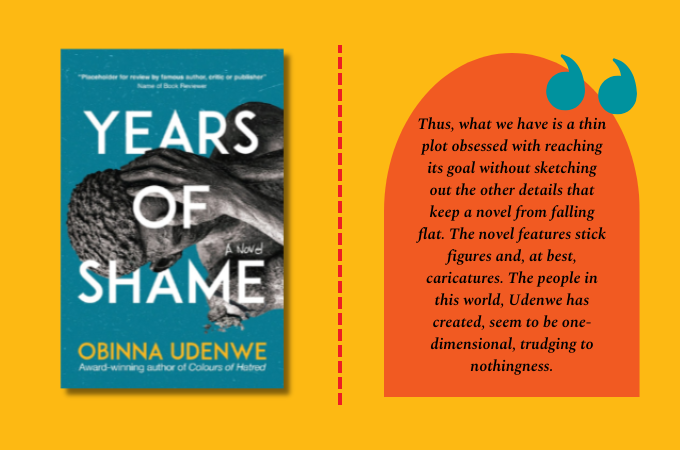
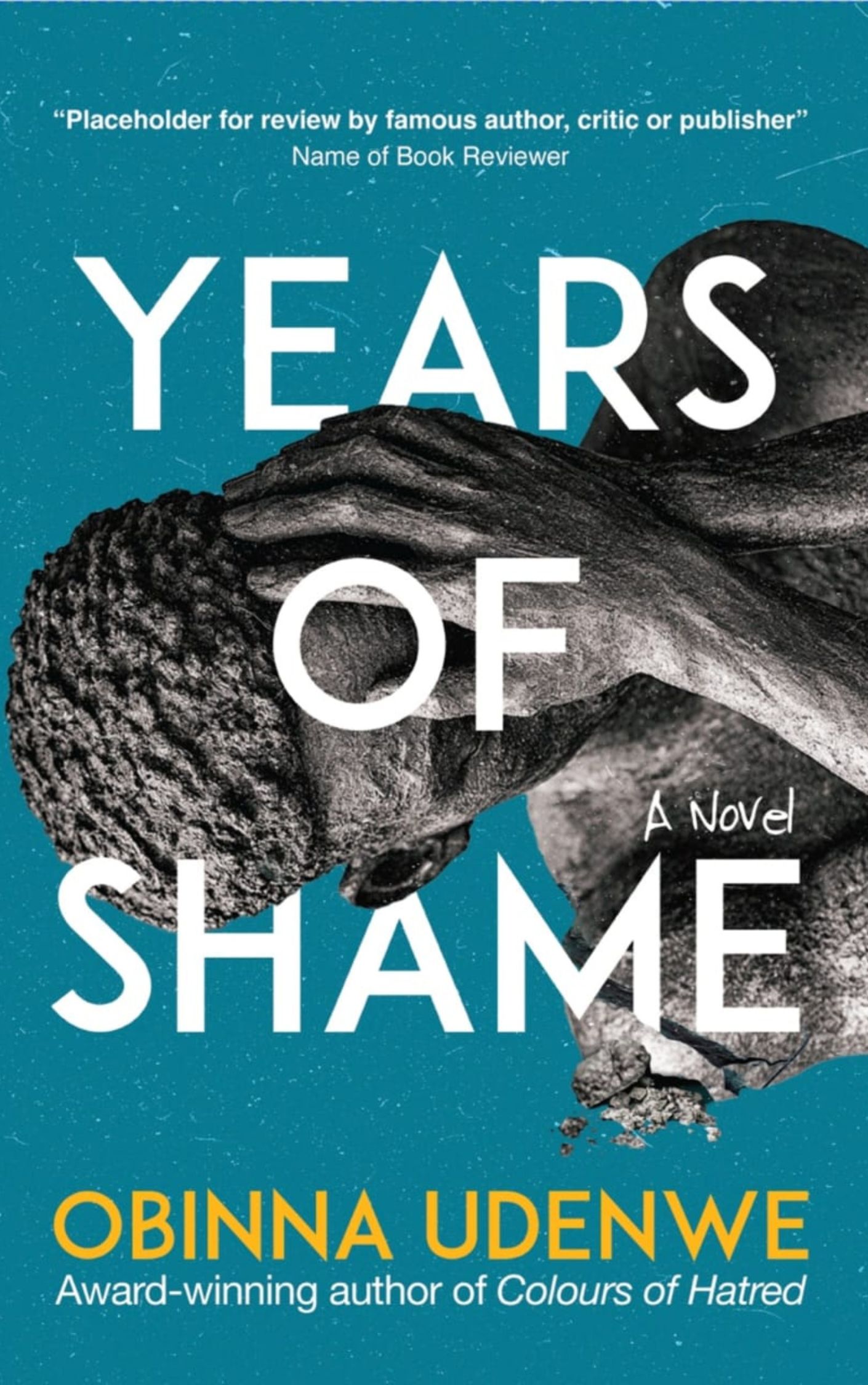
Udenwe’s vision for Years of Shame, as shared on the author’s social media pre-launch, resonates with indigenes of Abakaliki: a desire to give the people’s culture and traditions a seat in the minds of fiction readers. From its centring of the 1969 first Izzi revolt, a relatively unknown episode in the history of the South East, to its description of the rigorous back-and-forth required before a man takes the dreaded ukpa ji ukpa nwa oath, he touches on principles that have long informed Igbo pride: communal peacekeeping, an insistence on integrity and diligence, and the resilience of a people committed to thriving despite intra-ethnic divisions. While a noble pursuit, its execution leaves a bitter taste for any avid reader of good fiction.
Years of Shame chronicles the life of Patrice Ikebe, an Ogada man, after he swears a deadly oath, ukpa ji ukpa nwa, following his accusing a neighbour, Methuselah Enigwe, of theft. What follows are melodramatic twists only rivalled by cash-grab Nollytube drama scripts. Patrice cowers for most of the book, before fate, and before Chief Douglas Akidi. His pig-headed insistence that Methuselah stole his money, even in the face of contradicting proof, drives home the book’s most poignant lesson, the tomfoolery of not listening to well-meaning advice from elders and society.
Udenwe, as is evident in previous books, has a good handle on plot, and it shows. Every appearance, character decision, or thought serves his central goal, revealing whether or not the gods of the land would vindicate Ikebe in the years following the oath. Still, the abrupt break and rush to the end in Chapter 7 can only make one wonder if Udenwe felt that characters outside of the protagonist did not deserve to bloom. Thus, what we have is a thin plot obsessed with reaching its goal without sketching out the other details that keep a novel from falling flat.
The novel features stick figures and, at best, caricatures. The people in this world, Udenwe has created, seem to be one-dimensional, trudging to nothingness. Chief Douglas comes across as a blustering, pompous oligarch who, whenever he appears in the company of an Abakaliki character, lunges into an unrealistic diatribe against them. Udenwe’s crediting him with the traits, rapist/paedophile and womaniser, do not aid his development. There is little characterisation beyond scheming (Douglas’ wives), callous (Douglas), and pig-headed (Patrice) for the characters in Udenwe’s book.
Ekwutosi, Chief Douglas’ first wife, is defined only by her body size. Several sections of the book are devoted to describing her being overweight:
She was a tall, thick, and imposing woman. The flesh on her arms, if cut, could feed a battalion. There was no need talking about her stomach, for when she sat, her stomach protruded down in folds, almost extending to the floor. Now, she mostly did not go out, for to walk was a herculean task. Her face was puffy, with assorted flesh covering her cheeks and jaw area, ensconcing her ears, making them appear small.
The above portrayal goes beyond characterisation into caricature, reducing her to a spectacle of physical excess. His repeated emphasis on her immobility and isolation suggests an underlying fatphobia that equates size with dysfunction. This stands out as both dismissive and harmful.
Udenwe seems to have come a long way from the unmitigated chaos of his debut novel, Satans and Shaitans. Yet, what we have here in Years of Shame is another failure in editorial rigour. Overwritten metaphors and clunky phrasing mar it. Page 131’s “The office was scented. There was the scent of tobacco as if someone was smoking,” is one of the many pointers that perhaps this book was released straight to print. This oversight is unbecoming of an author who has been shortlisted for the prestigious NLNG Prize for Literature.
Transliteration shimmers in Years of Shame. For most Igbo readers, several sentences resonate. Here’s an excerpt from the village head’s speech to the people gathered before they decide on which oath would be administered:
So, think things over, again and again. If by tomorrow you are still convinced that you did not take this money, then your people will come and question you. After your household and extended family have questioned you and you still believe your hand did not turn to that of a monkey in the pot of soup, your kindred will gather in a meeting and help you search your mind.
His account of the oath-taking is almost anthropological. His accounts of the Izzi revolt peppered throughout Chief Douglas Akidi’s diatribes, though overdone, possess an aliveness peculiar to someone who has done the deep work to get the story right. This is one of the book’s very few silver linings.
Music plays a significant role in mood-setting throughout the novel. It features a wide-ranging playlist — from Schubert’s “String Quartet in G Major” and Sinatra’s “The Girl from Ipanema” to Nelly Furtado’s “All Good Things (Come to an End)” and Celestine Ukwu’s “Money Palaver.” These choices suggest the writer’s intent to evoke emotional textures and underscore particular scenes. Yet, with over ten tracks referenced, the effect wavers between meaningful motif and mere name-dropping. If the aim was to structure the novel around music, a clearer formal commitment—like in Oyindamola Shoola’s Face Me I Face You or Chimeka Garricks’ A Broken People’s Playlist—would have made that intention more coherent. Also, Douglas’ monologue to Irene about music on Page 225 is irrelevant. As it is, the musical references risk coming off as an afterthought, serving more to showcase the author’s eclectic taste than to flesh out the story.
From its vision to reawaken conversations about the Izzi revolt and the repercussions of intra-ethnic strife, to its preoccupation with music name-dropping and overreliance on flat characters, this novel seems rushed and would have benefited from a steadier editing hand. Years of Shame is what happens when a writer, perhaps blinded by hubris or previous acclaim, is so consumed with a subject that he blunders toward it, leaving incongruities in his wake.




COMMENTS -
Reader Interactions