

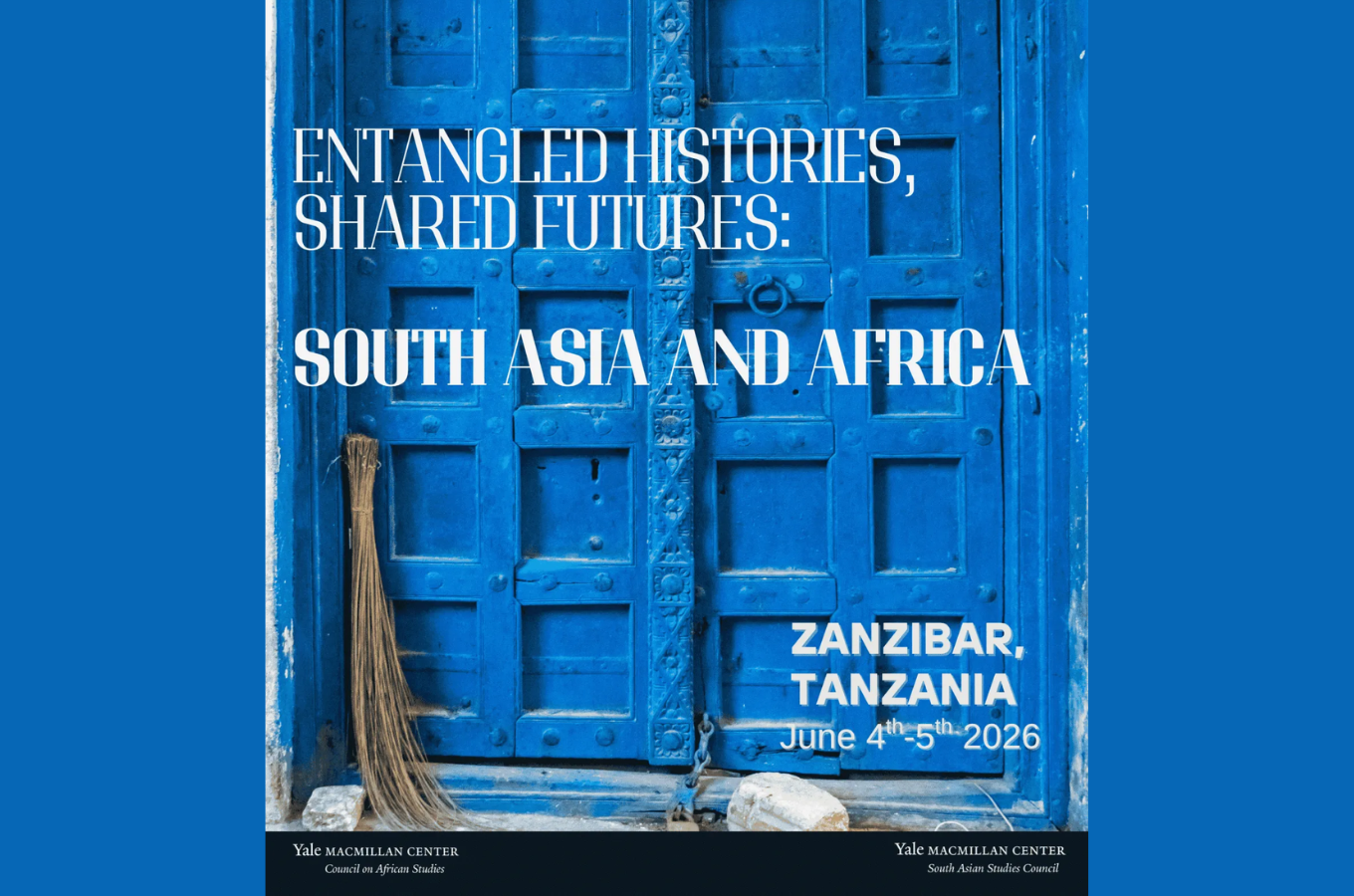
Yale University’s Council on African Studies, in partnership with the MacMillan Center for International and Area Studies, will host a two-day conference titled Entangled Histories, Shared Futures: South Asia and Africa on June 4 and 5, 2026. The conference takes the position that these two regions have long been studied in isolation or through Cold War geographical frameworks that obscure their entangled histories of trade, migration, shared ideas, solidarity, and political alliances, and convening on the Swahili Coast, where centuries of Indian Ocean exchange made South Asian and African lives genuinely inseparable, is itself a scholarly statement.
The conference brings together scholars from disciplines including history, anthropology, political science, economics, literary studies, environmental studies, and public health to think across the two regions. The thematic areas are broad and ambitious: colonial histories and the formation of diasporas; decolonization and solidarity between independence movements; new economic and cultural relationships; and shared challenges around land, resource extraction, democratization, and the politics of race, caste, and ethnicity.
The Indian Ocean has always been a literary space as much as a commercial one. Swahili literature is inseparable from centuries of South Asian contact; the South Asian diaspora in East and Southern Africa has produced writers like M.G. Vassanji and Shailja Patel whose work doesn’t sit comfortably inside either African or South Asian literary categories. A conference that takes these entanglements seriously at the level of scholarship creates the conditions for a literary criticism capacious enough to hold all of that history.
That Yale is hosting this conversation in Zanzibar rather than New Haven is a significant gesture that the field is at least trying to situate knowledge production closer to its actual subjects. Whether that gesture translates into a more sustained decentring of Western institutions in African and South Asian studies remains to be seen. But for now, the conversation is the right one, in the right place, at a moment when both regions are being asked, with increasing urgency, what they owe each other and what they might yet build together.






COMMENTS -
Reader Interactions