

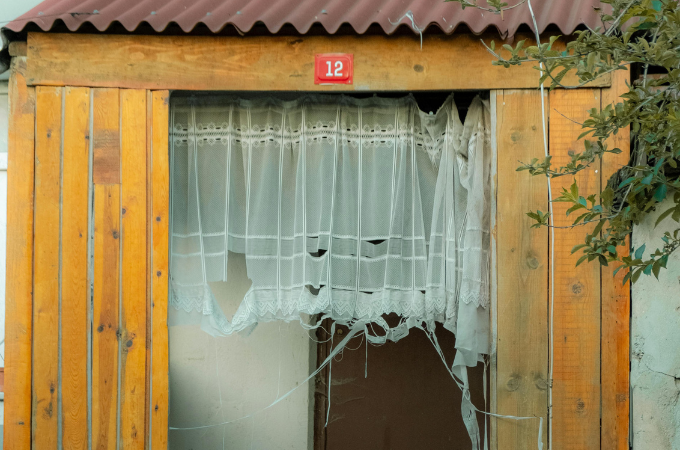
Part I
It was a hot and sticky day in Northern Abuja when Jumoke was dropped off at Grayson Manor Estate by her sister, Olanna.
“Grayson Manor” itself rose in front of them, impossible to ignore. The giant G and M carved into the front gates were so large that it felt like the estate wanted every prospective tenant, from miles away, to know exactly where their money was going. The letters gleamed obnoxiously in the sun, polished to the point of arrogance.
Beyond the gates stretched rows of carefully curated trees, imported, expensive, and intentionally exotic. Even the African pear trees, heavy with ripened fruit, looked like they had been positioned by some rich man’s idea of symmetry rather than nature. Everything here was manicured, staged, and over-proud, like the estate itself was constantly posing for a photograph no one asked for.
Stepping out of the 2010 Hyundai, the air seemed to ricochet dramatically. The air was crisp in Abuja. Unlike the loud, thick, uncomfortable Lagos air, it was serene to a degree. Jumoke could hear every conversation around her. Especially that of the strict-looking woman near the gate who wore about four sleeves of wrapper on a humid day like this, yelling at a boy by the name Adamu, to “Stop being idle and help your brother move his suitcase!” as her pale foundation dripped down her colored shirt. Jumoke wondered whether the woman’s odd aura came from genuine frustration at Adamu’s idleness, the scorching heat, or from what life had dealt her. She wondered if the woman was truly Adamu’s mother, as she was about twelve shades lighter than Adamu, with badly discolored skin and knuckles as dark as coal.
Olanna squeezed her shoulder, snapping her back into foreign reality.
“Well, Jum, this is it. Welcome to Abuja. Let this place buy us time. I’ll call you every day, you hear?” she said, with a look of sadness mixed with pride. Before letting her respond, Olanna hugged her tightly, whispered a prayer, and made the sign of the cross over her forehead three times, fast, like she was trying to seal it in quickly before the sun melted the blessing away.
Jumoke reciprocated in the hugging, her arms bracing Olanna’s mid-back, as she loosened her stiffened neck on Olanna’s shoulder. Sniffing in a mixture of detergent, cheap vanilla perfume, and a hint of spice, she smelled the last of home.
“I heard you, Ola. Please do call me.” But her voice betrayed her. It wobbled at the edges, dipped, then snapped back like a rubber band stretched too far. Olanna noticed—of course, she did—but she didn’t press it. She only cupped Jumoke’s cheeks gently, thumbs brushing the faint sheen of sweat collecting there.
“Go on,” Olanna whispered, smiling the kind of smile only an older sister could give, part encouragement, part warning, part don’t-you-dare-fall-apart. “Before that woman with the four wrappers decides we’re blocking the gate,” Olanna added. As if summoned, the woman glared in their direction, fanning herself with the ragged edge of her wrapper like she was about to burst into flames. Adamu, poor boy, dragged two overstuffed suitcases behind him with the defeated posture of a child who had already accepted that life was for suffering.
Jumoke exhaled and picked up her own boxy suitcase, the one Olanna had bought second-hand and repainted sky blue so it would “feel new.” The handle squeaked.
Everything about her felt squeaky.
Olanna rounded the car and slid back into the driver’s seat. “Text me when you settle in, okay?” she said through the window, already blinking too fast. “And Jumoke… don’t shrink yourself here. Abuja people, they can be very egotistical and classist. Don’t join them, but don’t let them press your neck either.”
“I won’t”.
“You’d better not. I love you, Jumie”.
They shared one last smile, the kind that felt too heavy to hold for more than a second. Then Olanna put the car in gear, gave a small wave, and pulled away from Grayson Manor. The Hyundai whined like it hated the Abuja hills, then disappeared around the bend.
And suddenly, Jumoke was alone.
Alone with her suitcase.
Alone with the silence.
Alone with the distant hum of generators that shouldn’t have been running at all, considering how “24/7 GUARANTEED LIGHT” was written in bold gold lettering on the estate’s brochure.
She turned slowly and headed towards the entrance. The gates’ security booth was perched beside a small patch of artificial-looking grass. Inside the booth sat a plump, tired security man scrolling through his phone at maximum brightness, squinting hard. He looked up, uninterested.
“You be new tenant?” he asked.
“Uh, yes. Jumoke Bamidele. Block B… Flat 12,” Jumoke answered with passion but mild angst.
“Block B? Bathroom block,” he repeated, adjusting his cap.
Jumoke frowned. Bathroom Block? She hoped it was a joke. But the man had already gone back to scrolling whilst muttering something about “Instagram people no dey too get sense.”
She sighed and defeatedly followed the path leading deeper into the estate, knowing she would have to find Block B by herself since the man by the booth was as good as useless. The bricks beneath her feet were warm and arranged in sharp, geometric patterns that looked beautiful but felt unnecessarily complicated, like everything else here.
As she passed the rows of duplexes, one thing became obvious: every house looked the same. The same mahogany paint. The same tall, thin windows. The same satellite dish angled in one direction. It was almost eerie. Block A loomed to her left, sleek, tall, and shining. Block C was farther down, near the pond with koi fish that kept flip-flopping around. And then there was Block B.
She found it tucked beside two slightly leaning palm trees, humbler than the others, less maintained, with a water tank humming somewhere above it. A woman’s bra was hanging over one of the balconies, floral and loud, as though marking territory. Bathroom Block indeed. Jumoke squared her shoulders; this was where she would stay. Where she would study. Where she would build whatever version of her future that this city allowed her to have.
Jumoke lifted her suitcase, took a breath thick with heat and possibility, and pushed open the entrance door to Block B.
Part II
Mother Mary dangled across her neck in an unbalanced choreography, bidim-bum-bidim-bum-bidim-bum, as Jumoke stripped and set the rosary on her newly bought parlor table, right next to the two novels she kept idle, procrastinating that she would eventually read them. Two months at Grayson Manor. Sixty days, but somehow it felt like she had lived lifetimes here. The walls had a way of swallowing time and stretching silence. Days were long, but nights were longer.
“Jumie baby!!” A voice floated from the doorway of her flat.
Uju, her closest thing to family here, was leaning on the doorframe like she owned the place. That was the thing about Uju, she never knocked. She always said knocking was too formal and too stressful for single girls who are simply “trying” to survive.
“Ah, madam, you’ve removed Mother Mary. Should I be worried?” Uju asked, perched by the entrance of Jumoke’s flat.
Jumoke laughed. “She’s heavy. And it’s hot. Come inside.”
“A rosary is heavy???” Uju questioned, standing arms akimbo, before fully stepping inside. “You’re right though, Jumie; it really is hot outside. It’s fucking hot. I even had Chief drop me off today because I couldn’t walk back, and you know I never do that. That’s how hot it is.”
Uju’s braids slid forward as she melted deeper into the sofa, one leg dangling carelessly off the side, the other tucked underneath her. Jumoke tied her scarf tighter, wiping the back of her neck, before fully comprehending Uju’s statement.
“Chief dropped you? Since when are you collecting rides from him?”
Uju rolled her eyes dramatically. “Don’t start. He was already in the area. And he said he missed me.” She mimicked a baritone voice, “Uju baby, since morning I have not even heard your sweet voice.”
Jumoke snorted. “And you believed that?”
“I didn’t,” Uju said, shrugging, readjusting her shirt as if she was embarrassed by Jumoke’s constant bickering. “Jumie, his car has AC, and I was one minute away from melting. So yes, I entered, sue me.”
“You’re a giver of wahala; what if someone were to see you in his vehicle and run to tell his wife?” Jumoke challenged.
Uju gasped. “See slander! So, because a married man wants to carry me in AC, I should now enter the sun and faint? For what? For who? Abeg o. His wife should face her husband, not me.”
Jumoke paused. Those words scraped a tender place inside her. “Uju, that argument won’t hold on judgment day,” Jumoke added, as she poured herself a glass of water.
Uju waved her hand dismissively. “My dear, judgment day is not today. And besides, let me tell you. Abuja married men? They’re like mosquitoes. If you don’t slap them away, they will bite you. I am simply slapping.”
Jumoke pinched her lips together before looking away and trying not to laugh.
She didn’t agree with Uju’s logic, not even a little bit. But she understood the exhaustion behind it, the survival instinct of a girl navigating a city that demanded too much and offered too little. Still, she couldn’t pretend she didn’t feel a pinch of disapproval and concern. Or both, mixed with affection she couldn’t shake off.
“Just be careful,” Jumoke murmured. “Not everyone forgives easily.”
Uju softened, the bravado slipping for a brief second. “I know, babe. Don’t worry.”
Then, as if dragging herself away from a moment she didn’t like the taste of, Uju clapped her hands sharply and grinned. “Enough about me and my imaginary problems. Let’s talk about something better. That new fine boy.”
Jumoke frowned as she sat opposite Uju, maintaining full eye contact. “What fine boy?”
Uju’s eyes widened with excitement. “Ah! Haven’t you heard? Okay, sit down, because the gist is sweet. Room 14. Fresh face. Fresh trouble. And I swear on my side part, he greeted me today with shoulder shakes. Shoulder shakes, Jumie!”
Jumoke blinked. “That’s not real information.”
“No, no, it is,” Uju insisted, sliding to the edge of the sofa like a gossiping prophet.
“In this Block B? Shoulder shakes mean drama. And I feel it in my spirit… It’s about to involve you.”
Jumoke stared at her, unimpressed. “How?”
Uju’s grin turned wicked. “Because, Jumie baby… he asked about you.”
Jumoke laughed, but it came out thin. She reached for the rosary on the table, rolling the beads between her fingers. Uju watched her, then looked away.
Part III
By now, Jumoke had promised four separate times to come home.
“Next week. I promise.”
But next week came, and she never went.
The weight of traveling back, the noise, the people with eyes that wanted updates, was just too much. Jumoke hadn’t left home with anyone’s blessing but Olanna’s. She slipped out with a suitcase and loud silence. Instead of explanations, she sent money home. Small transfers here and there. Cash to fill the gaps she couldn’t fill with her presence, but Mama always responded with voice notes heavy with breath and bible verses. Mama never regarded the money sent.
“My daughter, where have you gone? Why don’t you pick up my phone?” Mama’s voice would rise and fall, half pleading, half scolding, but always full of what Jumoke could not decipher as fear or care. Jumoke would listen with the volume low, phone pressed to her ear, the air humming around her. She would type and erase replies until her eyes blurred. But what could she say that didn’t sound like betrayal to someone who believed endurance was holy? So, she sent more of what she could measure. Another five thousand. Ten when she had it. “For food,” she’d write. “For your medicine.” As if money could stand in for a daughter’s body at family functions, her smile in church, her hand in the husband’s she had left behind.
On some days, the guilt sat heavier than the heat. On others, she felt a thin, sharp relief that terrified her. From the outside, it might have looked simple: a young woman renting a small flat in a new city, trying to enrol in a new university, learning new bus routes. But inside, it was something else entirely.
It was that she was a 19-year-old in a new land who had walked out of an arranged marriage and resented the mother who signed her away, yet still couldn’t cut the fragile, stubborn thread that tied her back to them.
Now, everything was different. Her body was even different. Fuller, softer & curvier in ways she hadn’t seen back in Lagos. Her hips had found new shape, her thighs grew thicker, her arms rounder.
Most afternoons, after the long stretch of campus and the emotional weight of her new life, she’d sit on her verandah. Block B, Flat 12. She’d routinely eat yam porridge from a small steel bowl, letting the sun warm her face. The hibiscus tree beside her flat swayed gently, petals fluttering like they were breathing. The air here held her differently, clean and thick, with stillness. Jumoke found a strange comfort in the quiet, watching clouds drift lazily. Some evenings, she thought about home. Some evenings she didn’t. All evenings, she thought about Olanna. How was life treating her? How was her mental health? Was she eating?
She’d scroll on Olanna’s Instagram page, Rhude Gal Ola, curious, looking to see if she had posted a new selfie or any proof of life. Anything that showed she was fine, even if she was pretending. A selfie. A quote. Anything. But there were just old pictures and old smiles.
Jumoke also wondered when harmattan would hit the north. When she’d have to start lotioning up like her life depended on it. Uju said northern harmattan could peel a person like an orange skin. Jumoke wasn’t sure if she was exaggerating.
Today, she swallowed her last piece of yams and looked down at her empty bowl, then at the soft curve of her stomach beneath her shirt. See your life, she muttered to herself, shaking her head with a small, surprised laugh. She sighed. Long, deep, from somewhere below her ribs, she rose from the plastic chair and picked herself up. The metal bowl clinked lightly in her hand as she stepped back inside her flat. The door shut with a soft click.
Part IV
The first time Jumoke went to Derek’s flat at night, there was no reason she could say out loud. No emergency.
Clean jeans, the black top that made her feel a little older, and a blue scarf tied tight over her hair. She stood in front of her small mirror and stared until her own face started to look unfamiliar. Her phone stayed in her living room. If she took it, someone would call. Someone would pull her back with another pretentious checkup call.
Tonight was about silence. The corridor outside was dim, one bulb flickering, paint peeling in patches. Jumoke walked slowly, counting her steps. Seven doors and a left turn. Derek’s flat.
Her heart hammered in a way that reminded her of her wedding day, the heat, the eyes, the way her chest had pounded under layers of white and expectation. Right there in the corridor, the memory rose so sharply it made her throw up in her mouth and almost made her stumble. His hand closing over hers at the altar, the pastor’s voice booming, her mother’s eyes shining like this was the life. For a split second, she wished she had stood up that day, pulled her hand back, and slapped her mother hard enough for the microphone to catch it, hard enough for every watching eye. The rage flashed through her body, hot, clean, useless now but real, then settled into the quick pace of her steps as she kept walking.
She knocked once, lightly. For a second, she thought of turning back, letting the sound disappear into the night like it never happened, but the door opened before the thought finished.
There he was, Derek. He stood there barefoot, in a faded T‑shirt and shorts, the soft light behind him turning his edges gentle. He stepped aside without touching her. She entered. The door clicked shut. Inside, the flat looked different at night. The TV glowed blue in the corner. A fan on the floor turned its head slowly, pushing warm air around. The room smelled of soap and something faintly sweet—milo and milk tea, maybe, or fresh bread. She sat on the edge of the sofa. He sat at the other end. A movie played, but she barely saw it. Her eyes kept catching on small details: the notebook open on the table, a pen lying across half-finished notes; the way his knee bounced; a tiny burn mark on his wrist. All the ways a life could be ordinary and self-directed.
She thought of her wedding night then, again. Of her mother’s voice, saying endurance like it was a fruit of the Spirit, of how she sobbed in Olanna’s arms. Here, nobody had pronounced anything over her. Nobody had told her what to give, when to open her legs, or when to close her mouth. If she stayed on this sofa, that was her choice. If she left, that too. Her body didn’t fully believe her mind yet. Uju had no idea where she was, nobody did. She was here because she felt like it. Her palms were damp. Sweat gathered along her spine. But under the nerves, there was a thin, sharp line of something else. Desire, yes, but also stubbornness. A quiet anger, even.
The first time she saw Derek, she was already angry. The estate security man stood in his booth, arms folded, insisting her package had never arrived. He kept saying it like it was a conclusion, and not an excuse.
“Ms Bamidele, we did not see anything. Maybe you should ask the sender.”
Jumoke’s voice rose despite herself. She hated that. The way frustration climbed her throat and announced itself before she could stop it. The security man watched her the way men did when they thought a woman was being “too much.”
“So because you didn’t write it down, it didn’t happen?”
He shrugged.
That was when a car slowed beside them. A Corolla, paint fading with an awfully rickety engine. The window came down.
“ Oga,” Derek said, not smiling, not aggressive either.
“If the package entered this gate, then it entered this gate. Check your book again.”
The security man frowned. “And you are?”
“Someone who lives here,” Derek replied.
The security man sighed in defeat and reached for his logbook.
Later on, she had thanked him, awkward and still flushed with anger.
That was all.
They had spent more time together before tonight. Coffee on the estate steps, a walk to the corner shop that stretched into a longer one, the sky changing its mind above them. An afternoon where he helped her fix a cupboard hinge and stayed afterward, sitting on the floor while she cooked. Once or twice, Uju had been there too, folding herself easily into the space between them, laughing, leaving without ceremony. Nothing had been named, but familiarity had settled, quiet and unforced, until Derek’s presence no longer felt like an interruption but like part of the background of her days.
On the TV, two characters were kissing. Jumoke looked away. Derek’s arm lay on the back of the sofa, not quite touching her. The space between them buzzed. His fingers brushed hers once, by mistake or on purpose. She didn’t flinch. The second time, she let her hand stay. Her skin hummed where they connected, a simple, ridiculous miracle that she could want and not die for. He glanced at her, as if asking. She met his eyes, steady for once. This was the part where, in all the stories she’d been fed, the man decided, and the woman endured. But tonight had not been arranged by anybody’s uncle. Nobody had prayed them into a corner. If anything happened, it would be because they kept moving forward.
Her heart thudded.
This is me, she thought.
What followed was not like the warnings. At one point, she almost laughed, at the angle, at the way her elbow slipped, at the fact that nothing in her body knew what it was supposed to perform. She swallowed the laugh. Jumoke let herself be present instead, listening to the small sounds: the fan turning, the city humming outside like it did not care for what was happening in the room. Under the flicker of pleasure, in her throat and under the heat, something else lived. Jumoke bathed in it.
When it was over, there was no instant clarity, just the familiar ache of being inside her own skin. The room felt smaller now, the air was denser. Derek murmured something she didn’t fully catch and rolled onto his back, one arm flung over his eyes, already drifting toward sleep.
Jumoke lay still, staring at the ceiling. The feeling that had pushed her here, this need to prove she could choose, had started to thin, like music fading from another room. She had chosen. That was true. But this choice had not saved her. It hadn’t fixed her. It hadn’t erased anything. It hadn’t quieted her mother’s voice. The thought sat in her chest, heavy and fragile at once: I chose this. I also don’t want to stay.
She turned carefully, easing herself out of his loose hold. Her legs shook when she stood from all the things she was carrying at once. She gathered her clothes from the floor, smoothing fabric that refused to lie flat. In the bathroom, she flipped on the light. The harsh bulb exposed everything. The tiles. The rusty tap. Her face.
Her scarf hung crookedly on the hook. She reached for it and stopped. Her hair had escaped in the dark, springing free from the neat afro she had forced it into before she left. Now it stood around her head in crushed coils, some flattened, some rebelling, all of them refusing to obey. She raised a hand and tried to smooth the coils down. They resisted, springing back up. She sighed, looked at her roughened afro, and knew she had to visit Madame Zariat’s Braiding Salon first thing tomorrow morning.
Part V
“Sometimes I think you want too much, Jum.”
“But wanting is free.”
“But wanting everything?” Olanna teased. “That’s expensive, my girl.”
Harmattan arrived the way rich people arrive at weddings. Late, dramatic, and acting like everyone had been waiting for it. For weeks, the air in Abuja had been stubbornly chill. The sky was still too blue, and the nights were very dry. But that morning, the wind had finally changed. It blew softly and dustily through the streets, carrying the smell of dry season: cold metal, red earth, and something faintly sweet.
Jumoke inhaled until her lungs tingled. At last. She had been craving this weather, this softness, this dryness, this extra zing. Harmattan made the city feel forgiving. It made her feel more visible. She crossed the road carefully, sidestepping a puddle of engine oil that shimmered rainbow-bright in the sun, and waved off the first few taxi drivers who called to her.
Outside was bursting with energy. Hawkers clogged the roadside, voices overlapping “Pure water, gala, puff puff!” their trays balanced expertly on heads. Mothers manned frying pans darkened by years of use, some with babies tied to their backs, others visibly pregnant, sweat shining on their foreheads. The air smelled of diesel fumes, hot dough, and dust kicked up by passing tires. Horns blared, and somewhere a radio crackled out highlife through cheap speakers.
“Madam, where you dey go? I go do am for 2,500!”
Jumoke didn’t break stride.
Another one tried. “Two-one! Last!”
She laughed. She wasn’t rushing, especially not if taxi drivers were overcharging.
She lingered outside, letting the cold air sink into her fresh braids. Her scalp still tingled from the long hours inside Madame Zariat’s Salon, where the air had been thick as smoke and twice as hot, even though it wasn’t summer.
Madame Zariat’s Salon was tucked behind a gas station, down a narrow alley. It was a place Jumoke wouldn’t have found on her own. Uju had scribbled the name on a scrap of paper weeks earlier, promising, “They won’t cheat you there.” Inside, every girl wore a hijab except Jumoke, which made her stand out in a way that felt alienating. She’d almost turned back when she first arrived, standing at the mouth of the entrance with her tote bag. But she’d gone in anyway, and that was when she was handed over to HaZinu.
HaZinu looked about thirty-five, maybe a little older. Her hands were quick and confident, already sectioning Jumoke’s hair before she fully relaxed. There were two babies tied to her back, two wrapped in one long, orange-faded wrapper. Their small heads rested against HaZinu’s shoulder blades, one lighter, one darker. Both were fast asleep. Twins, Jumoke thought at first.
HaZinu had been crouched over a bowl of what looked like millet when Jumoke walked in, eating hurriedly. The moment she noticed a customer in her presence, she wiped her mouth with the back of her hand, jumped to her feet, and greeted her with an enthusiasm that felt slightly oversized.
“Ah! Fine girl. Welcome, my dear. Sit sit. You are very beautiful o.”
Too much praise. Too fast.
Jumoke clocked it immediately. The way HaZinu kept apologizing for nothing, the way she hovered, eager to please. A woman who didn’t have the luxury of offending customers. A woman who couldn’t afford to lose work.
As the hours passed, their talk slowly loosened into small, ordinary things like where Jumoke was schooling, how long HaZinu had been in Abuja, the price of tomatoes this week, thin threads of gist knitting them into something like almost-friends. HaZinu kept talking as she braided, millet residues flying out her mouth into the air.
“You are so young. God has really done you well. Your skin, your hair, very soft. You people that grew up abroad, eh?”
Jumoke smiled but didn’t correct her.
“Your husband must be taking good care of you, madam,” HaZinu said lightly.
Jumoke’s stomach dropped. “I don’t have a husband.”
HaZinu stopped for a second. “Oh,” she said gently. “Sorry, madam.”
Then, sat an unshaken tension in the air. It was there, and it was loud. Jumoke’s leg bounced and bounced on the floor until the tile squeaked. She did everything in her power to act sane. Why had HaZinu said sorry like that? Had she sounded rude? Or was it that to some women, marriage still sat on a shelf like an achievement, something you displayed and never dared return, no matter how it fit?
Four and a half hours in, and they were nearing the end of braiding. HaZinu’s fingers never slowed, even with the weight of two children on her back. Jumoke stared at them for a while until she decided to break the sour silence.
“Are they twins?”
HaZinu shook her head softly, adjusting her blouse. “No. Sisters.”
“How old?” Jumoke queried?
“Two years and eight months,” HaZinu responded, as she nodded toward the lighter one with her finger. “She no dey like to leave her junior. They are intemperable.”
“Inseparable?” Jumoke offered, them both locking eyes through the mirror.
HaZinu’s face lit up. “Ehen. Na that word. Inseparable.”
Part VI
6 months in Abuja.
8:05 pm
Jumoke’s phone lit up, buzzing in the dark. It was Olanna. She answered on the second ring.
“Hey,” Olanna said, her voice low. “Were you asleep?”
“No, just lying down.”
“Lying down or thinking?”
Jumoke smiled faintly. “Both.”
Olanna hummed. “You’ve been quiet for months, Jum. I’m worried.”
“So have you.”
A pause.
“Someone called me this evening from your husband’s side,” Olanna said carefully.
Jumoke’s fingers curled into the bedsheet.
“They were asking questions,” Olanna continued.
“About me?” Jumoke asked.
“Yes.”
Jumoke rolled onto her back, staring at the faint crack running across the ceiling.
“I got a message too, Ola, or should I say DM?”
Olanna didn’t speak right away. “From who?”
“His best friend,” Jumoke said quickly.
That silence, the kind Olanna only used when she was choosing her words, settled between them.
“You don’t have to talk about it,” Olanna said.
“I know,” Jumoke replied. Her voice wavered slightly, then steadied.
“I just… It’s strange. Abuja feels so far until it suddenly doesn’t. I’ve been going to God, Ola; is he not hearing me?”
“Is this about God ignoring you, or is it just them thinking that distance will bring you back?” Olanna countered.
“And if I don’t go back?”
Olanna exhaled. “Then they will start calling it rebellion.”
Jumoke swallowed dryly. “They already do.”
Another pause settled.
“Do you remember,” Olanna said slowly, “how they said it would be easy?”
Jumoke swallowed. “They said I would adjust.”
“They also said he was a good man,” Olanna added.
“He might be,” Jumoke replied. “I don’t know. I never really knew him.”
“But he knew you,” Olanna said gently.
Jumoke closed her eyes. “He knew what I was supposed to be,” she said. “What I was supposed to do. What a wife should endure.”
Silence filled the air; it was as dense and choky as smoke.
“Did you ever want it?” Olanna asked.
The question landed, yet still broke something in Jumoke.
“No. You know this, Olanna,” Jumoke said.
The fan whirred above her, uneven, tired. “I didn’t know silence was agreement,” she continued. “I thought if I stayed still enough, they would tell me it was all a joke.”
Olanna’s breath hitched on the other end of the line. “That’s not consent.”
“I know,” Jumoke nodded, even though Olanna couldn’t see her, tears soaking her cheeks. “I know that now. I… I did not consent to this bullshit.”
The room felt smaller, warmer. The orange walls pressed in, the green corner watching quietly, as it had always known.
“You didn’t do anything wrong,” Olanna said firmly. “Leaving wasn’t disobedience.”
Jumoke turned onto her side again, clutching the phone to her chest. “I’m scared they’ll come looking,” she admitted.
“They might,” Olanna replied. “But you’re allowed to be gone.”
9:15 pm
The call was over now, and quiet was back. Jumoke stared at the door until her eyes blurred and the tears came again, hot and stubborn.
If they came looking, they would not find a wife, just a 19-year-old girl in Block B, Flat 12.
Image from Zişan Özdemir from Pexels





The Lohokha Weddings June 17, 2026 18:29
The title is intriguing; it makes you wonder about the story behind it. What inspired the title choice?