

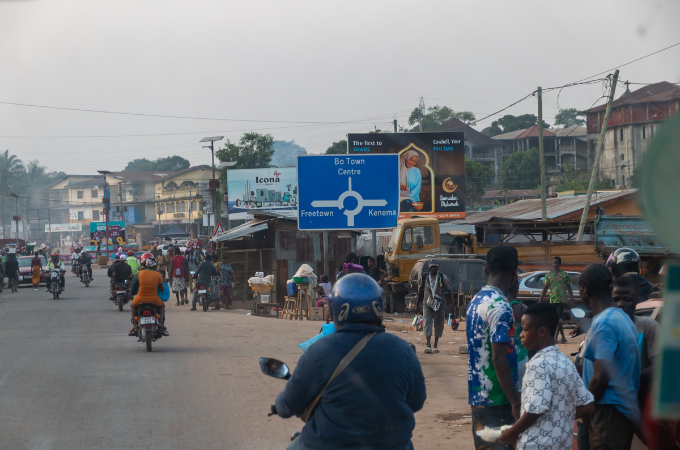
It’s 12 pm, and sweat clings to our clothing. We stand at the border. There’s a tap for washing hands and a hand sanitizer on an old, metallic sink right in front of us. An officer at the border called Hadjie asks if I’m Nigerian. I say ‘yes’, and despite a settled tiredness on his face, his eyes light up.
“You’re Nigerian? Welcome to Sierra Leone. We love Nigeria. They died for us,” he says, referring to soldiers, especially from Northern Nigeria, who were deployed to fight in the eleven-year Sierra Leonean war.
Professor Kehinde Andrews, our travel companion, speaks with Officer Hadjie, who says passionately: “We mother UK. We father UK. See,” he flings his hands towards the rough road. “They don’t help us. They leave us.” His voice is thick with pain from abandonment and a sort of retrogression he feels his country should not be shrouded in.
We take pictures at the border – something that has been almost impossible to do at other crossings due to security concerns and hostility. The officers are calm and nice. They do not have that hard, unfriendly face that I am used to now. Officer Hadjie says afterwards, “We love strangers.” I see his words as a hypothesis that will be tested during the few days we will spend in Sierra Leone.
The bus drops us at a resort in Lungi-Town, where we will make our home for two nights. Marbles, trees, soil, clay, and other natural elements are embedded in the architecture of where we stay. It almost looks as if I am returning to myself within its walls.
The next morning, our bus passed a throng of keep-fitters, happy to jog along the street to loud Afrobeats. They’re laughing, talking, happy to stay fit, and enjoying the warmth of the early sun.
We head to Tagrin Bay, where we will be taking a ferry to Freetown. On the way, walking there, Bodzo Badzaa and T-Ben (the musicians amongst us residents) meet a street boy eager to sing and talk. His name is She-She Money.
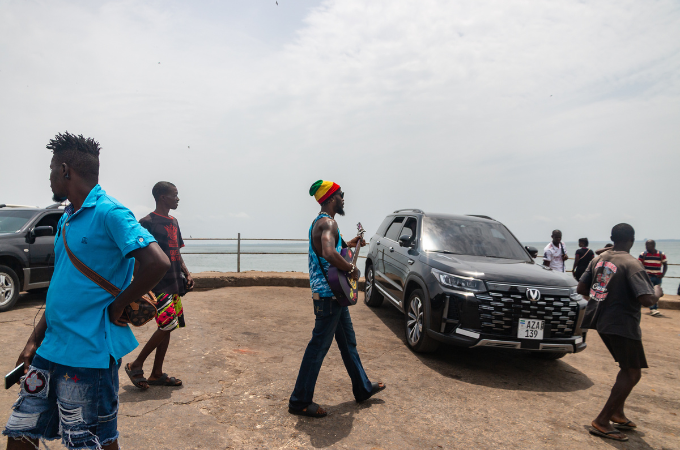
He sings, raps, laughs, and promises to call his other friends to join him on our return from Freetown later in the evening. I interview two men, Peter Conteh and Santigie Kamara, on the shore of Tagrin Bay, asking, “If you could choose to be born in another country all over again, would you still choose Sierra Leone?” Against the sounds of the waves washing deeper into the shore, the clear blue sky, the gentle breeze on skin, and hums from conversations all around, they take turns replying.
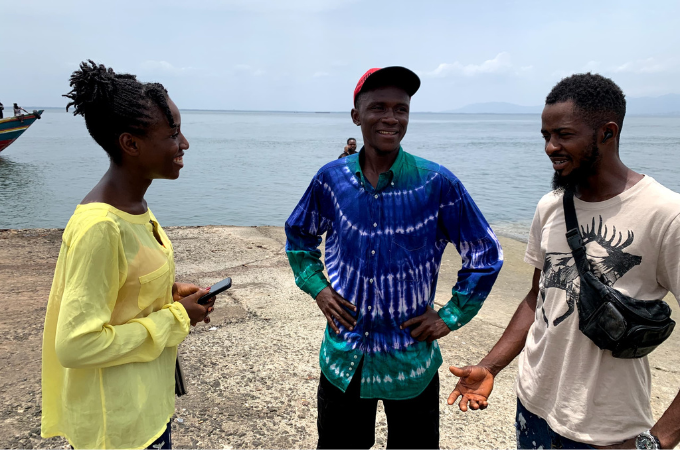
The first man says. “As for me, I do. I prefer to be in Sierra Leone. The poverty is very hard in Sierra Leone, but the thing is, we have freedom. Some countries don’t have freedom. In Sierra Leone, we have freedom. We can move from one place to another. Some countries… if you are born in a place like America, you need to pay taxes… even in Sierra Leone, we have taxes, but the taxes is not too much.”
“And it’s for those who have money and can afford the taxes,” the second man adds.
The first man continues, “I prefer to be born here. It’s just that Sierra Leone is very hard.”
When I ask the second man the same question, he says his answer is the same as his colleague’s. He adds, “Sierra Leone is a beautiful country. You enjoy a lot of things…like the living. If you have money, you enjoy Sierra Leone. If you are poor, you feel the hard fact of Sierra Leone. Sierra Leone is the kind of place outsiders admire. Like you. You are from Nigeria; how do you feel about Sierra Leone?”
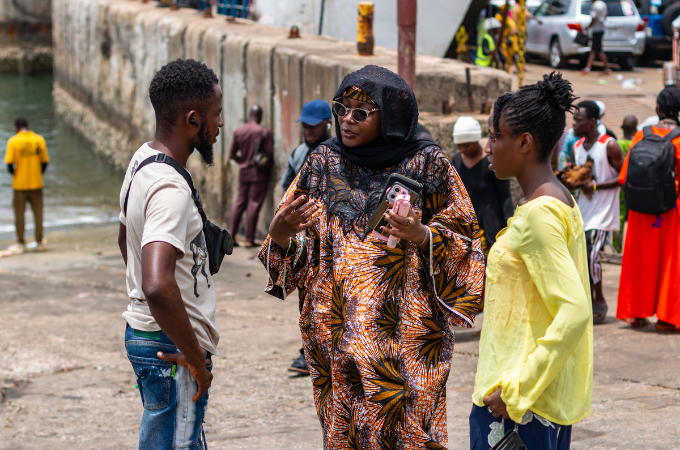
I go on about how hospitable they are as a people and how loved I feel already.
He says, “see?” with satisfaction. “If I go to another country, say Nigeria now…maybe they will kidnap me. But here, you free…to walk. Nobody will arrest you. No one will ask you. You can hold hundred million and walk. Here, no arm robber. They will even want to carry your money…to help you. I’m not lying. If you have money, let’s test it out.”
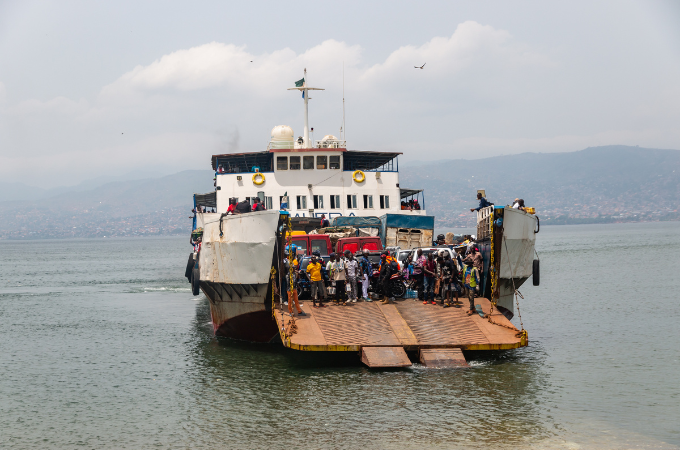
Before the ferry leaves, cleaning takes place. A girl, short pointer broom in hands, sweeps and attempts to throw away the dirt (which comprises nylon, dust, food remains) in the ocean through a hole on the side of the ferry. The sight greatly troubles me. How can we have clean and beautiful seas if we make it a refuse dump? A uniformed officer catches her just in time and shouts at her. He is speaking their local language. I do not know what he is saying, except that she stops sweeping out into the sea and gets a dust pan.
The beauty and dirt in the sea as we move on the ferry are evident. On one hand, the sea – a living, breathing thing – has beautiful glistening ripples that remind me of fish gills. On the other hand, remains of food, nylon, and plastic float on it.
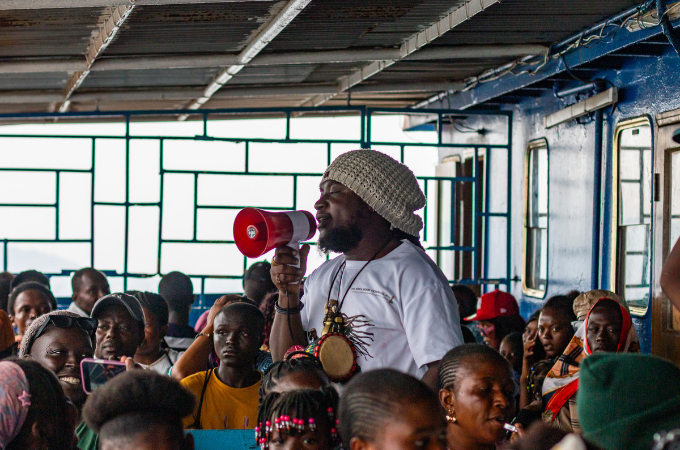
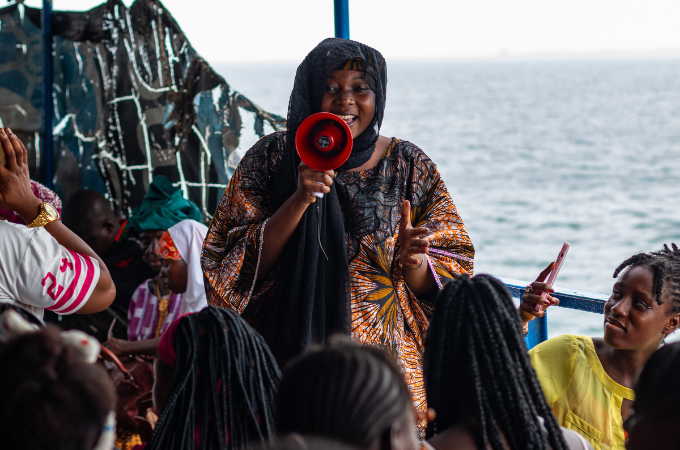
I look away and focus on the drama going on around me. The ferry is a world of multitudes – a boy is singing in tune with a radio where songs of different West African countries are being played. He sings just beside a woman with a silver tray of boiled plantain, potatoes, yam, groundnut oil, and pepper, who is beside another woman who has projected her voice to share the Gospel in Creole. As she preaches, some passengers (which happens to include us residents of LOATAD…lol) sing along to T-Ben’s guitar. Megbona borrows a megaphone from a woman who has just finished advertising her medicine, and preaches the gospel of Pan-Africanism. He says, “The White man’s god cannot save you. Only a Black god can save the Black man.” T-Ben speaks of humanity to the people and the importance of taking life one day at a time. He says, “When you breathe in and out, that is your god.” Afterwards, Basira takes the megaphone to perform a poem rooted in her state, Kebbi.
A few feet from me, a man is selling cultural caps for men, just beside another person selling the cure of all the world’s sickness and diseases in the bottled plastic herbs and creams in his hands. I enjoy this because it means I can focus on everything and nothing at the same time.
In front of me, a boy is tying a tie on his friend. They are laughing. Everything is poetry in motion. I ask if I can take a picture of them. They say yes.
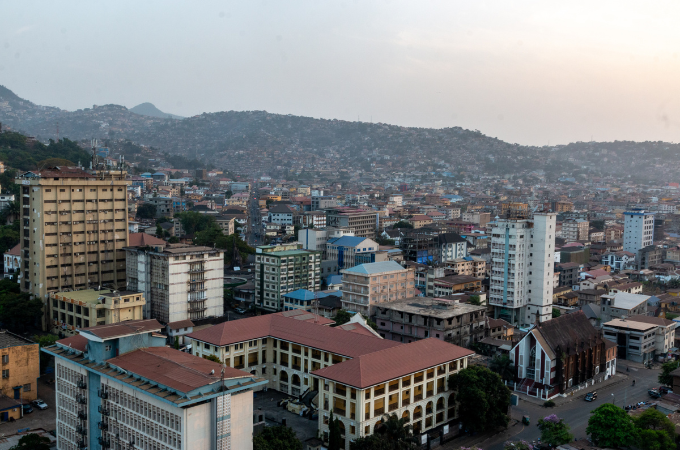
Across the sea are houses spread across the Lion Mountains. “Due to the war,” Joseph Kaifala, a Sierra Leonean writer, poet and historian who we met in Freetown says, “People left their homes and didn’t come back. They moved to the mountains. The only problem is the people grew, but the amenities didn’t.”
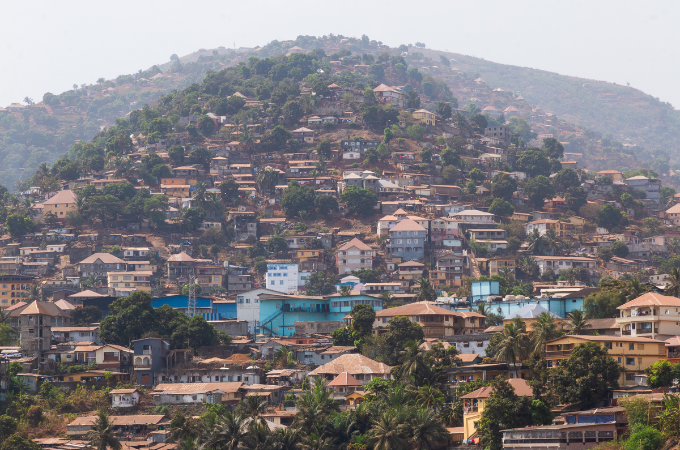
Joseph Kaifala gives us a tour of the city. His black afro contrasts with his white beard under the light of the setting sun, as he tells us of the country’s Pan-African links. According to African Commission on Human and Peoples’ Rights (ACHPR) of the African Union (AU), as set out by The African Charter, “When the slave trade began to be outlawed near the close of the eighteenth century, Sierra Leone became a resettlement site for freed slaves from England and the Americas, thus the name of the capital, ‘Freetown.’”
“The news of a little Black republic,” says Kaifala, “where Africans could be free, spread far and wide. Formerly enslaved returnees, a lot of them Nigerian Yorubas, created a strong link between Abeokuta and Sierra Leone.”
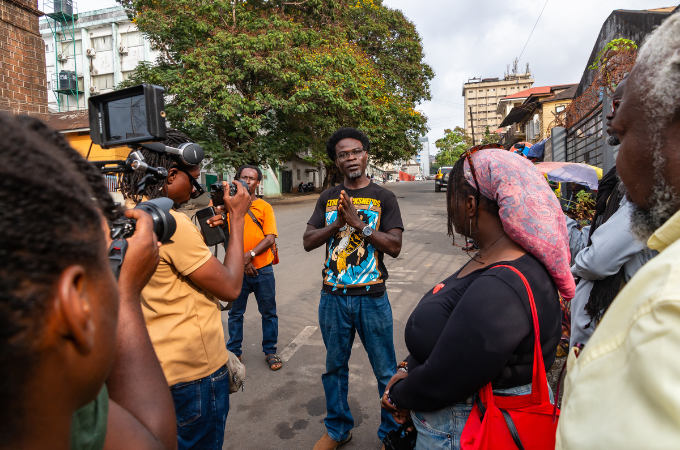
In the 1800’s, Sierra Leone was a British colony, and Sierra Leoneans did not need a passport to go to England. But then it became expensive to run the country. When the British wanted to start taxing the people, they refused to pay. The British wanted a “Hut Tax.” Traditional leaders were not used to that kind of tax. They asked, “How can I pay you for my hut?” It led to the Hut Tax War of 1898. The British government arrested a few chiefs and sent them into exile. Kaifala mentions some of the Sierra Leonean chiefs who resisted slavery were sent into exile by the British, and ended up going to Ghana.
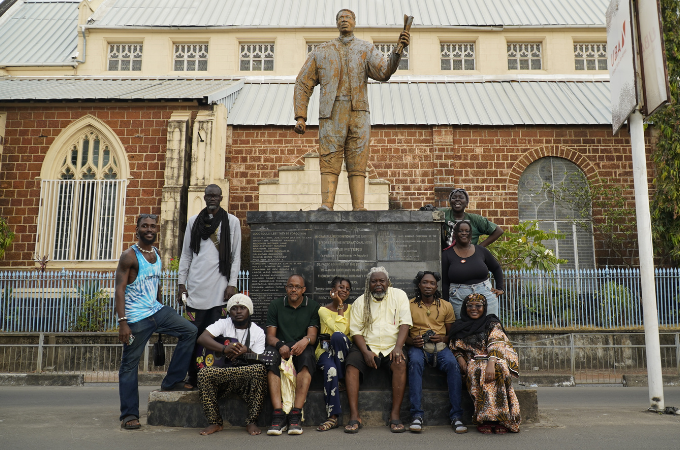
When it came to education, the Fourah Bay College, a prestigious centre for learning and the first Western-styled college in Africa, served both Sierra Leone and other West African countries at the time. We visit monuments of the times and seasons the country has experienced – monuments of colonial heritage, such as the Cathedral Church of St. George; monuments of war such as Connaught Hospital; monuments of the struggle such as the building with a plaque inscribed: PREMPEH I ASANTEHENE OF THE ASHANTI CONFEDERATION LODGED IN HOUSE ON THIS SITE BETWEEN 1896 & 1900 WHILE ON HIS WAY TO EXILE IN THE SEYORELLE ISLANDS; and monuments made in the image of great Africans such as Edward Wilmot Blyden and Isaac Theophilus Akunna Wallace-Johnson.
As for reparation, he says the Sierra Leonean government is deliberately trying to create a door of return. That is, anyone who can trace their ancestry to Sierra Leone would get free citizenship. In reference to Ghana’s recent reparations agenda at the UN, he says, “We are proud of what Ghana has done,” and looks forward to how the reparations fight will go.
We take a break at a craft shop where everyone explores the various sections of the shop filled with wooden, traditional beaded gourds, colourfully woven mats, Ankara bags, waist beads, bracelets, and clay pots. The Nigerian in me bargains hard, and I buy a pretty, colourful beaded bag for almost half the price initially mentioned.
After shopping, we continue our tour. As we walk along the tarred road in a group, a light-skinned, young man with a black afro walks up to Seth. He asks, “Are you a Pan-Africanist?” To which Seth replies “yes” and mentions where is from: Ghana. The young man smiles and says, “I’m Ukrainian-Sierra Leonean,” which Seth finds very fascinating.
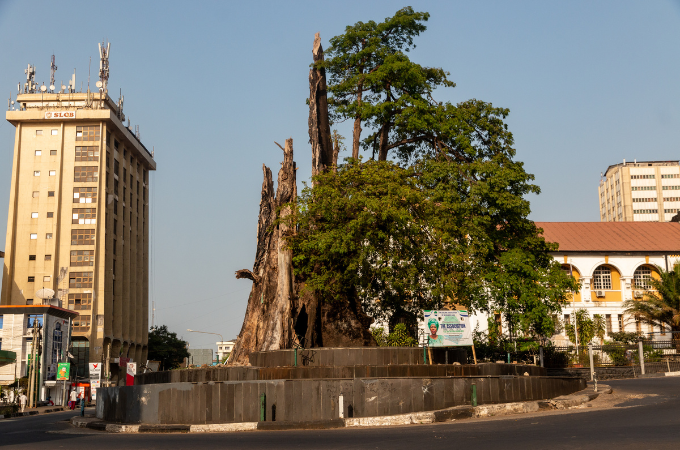
We visit the historic Cotton Tree of Freetown. Although the exact number of years the tree has been living is unknown, it is said to be hundreds of years old and one of the oldest of its kind in Freetown. According to Visit Sierra Leone, “It is believed by some to have been the resting place for the Black Poor when they arrived in Sierra Leone in 1787. They apparently rested and prayed underneath the shade of the tree. The Nova Scotians upon arrival in 1792 are also said to have sung ‘Return ye, ransomed sinners home’ at this site.” During a heavy storm in May 2023, the centuries-old tree fell. Despite the fact that it has endured several fires, its mighty and resilient trunk still remains. Currently, people without homes use it for shelter.
The statues are most interesting to me. They’re all over the streets in Freetown, alongside free public sitting spaces for strangers and citizens. Coming from a country where you can barely find intentionally built sitting spaces on roads, Freetown captures my heart in that aspect. We move from one statue to the other, read the engraved words, and stop to take a group photo at the statue with important names of some African brothers and sisters of blessed memory engraved.
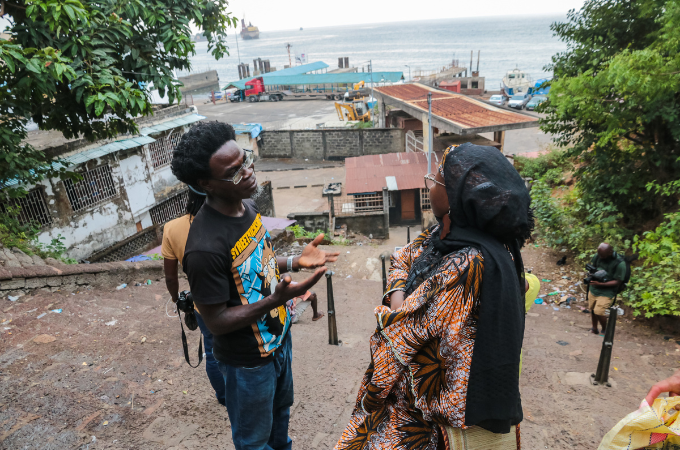
Our final stop for the day is the Old Wharf Steps. In snake-like corners and streets leading to it, there are men, women, and children going about their everyday lives. A group of men and a few women scream excitedly in front of a football match on the TV, and another smokes quietly in an adjacent corner. Joseph Kaifala tells me people used to write poetry about the place, something about “the steps was rising from the river and cascading like water flowing and etcetera etcetera…” Laughter fills my mouth. It is beautiful, really. It is worth writing poetry about. When we reach the steps, I see a big ship on the sea. When I ask about it, I quickly learn it is the Turkish ship with a generator that provides electricity for the country.
“How much does the country pay for it?” I ask.
“We don’t know how much is paid for it,” Joseph Kaifala says.
“Say a million dollars?”
“Probably more than.”
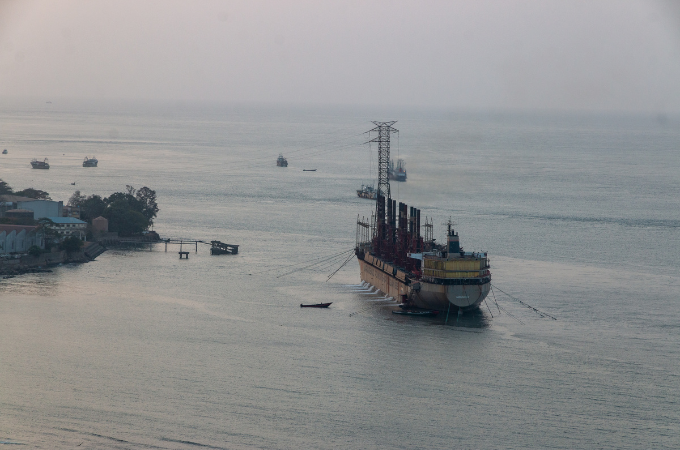
This leaves me curious, wondering about benevolent neo-colonialism, a chapter in Nobody Can Give You Freedom, which we had discussed on the bus. I think of why we cannot create our own means of survival and sustainability without being in chains to foreign countries.
Walking back, there is a man all buttoned up with glasses speaking with Professor Kehinde Andrews about Pan-Africanism, his voice laden with conviction and passion. He says, “Pan-Africanism is good…Letting Western life overshadow undermines African progress. We need to resurrect it. Talk about unity and progress of Africans. We are united. Jamaican. Senegalese. Nigerians. All Africans. Pan-Africanism fell along the way and we need to bring it back.”
I cannot help loving the city. Leaving Freetown at 6 pm in a blue tricycle – the wind gently caressing my skin –, I look up the mountains and think: “I want to live here. I want to call this place mine. I want to have a house in Freetown, up in the mountains. It feels like a place my bones can ease into, like a place my eyes can look at and call glorious, like a place my hands can touch and call mine.”
Looking back at Freetown, I see the city for what it is: a place of absorbing. Every African culture is welcomed and given a room to stay. Perhaps that is why it felt very much like a place my body can make home.
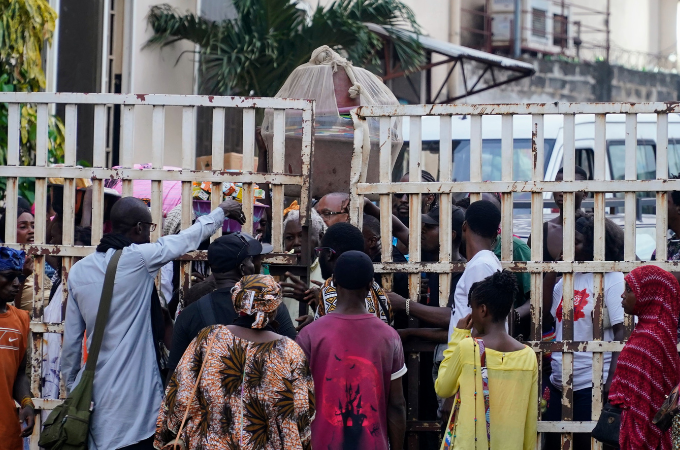
The ferry is same as we go back to Lungi-Town – loud, interesting, and exciting. The woman I saw selling snacks in the morning is still there. Her tray holds fewer snacks. Looking at the sea, everything quiets in and around me. My heart is as calm as the soft ripples I see. I hum quietly in my head as we arrive at Tagrin Bay.
The next day, we set out for Guinea (Conakry), dragging our travel boxes into the long, white bus. On the way, we make a brief stop at the Tomb of the Unknown Civilian located in Lungi-Town. This is where the war was officially declared over in 2002. The president at the time, Ahmad Tejan Kabbah, famously declared, “Di war don don.”
Joseph Kaifala built the tomb using soil from mass graves from the civil war around the country. One of the most prominent quotes on the tomb (written by Kaifala himself) reads: “NEVER AGAIN. WE WENT ASTRAY AND FORGOT BRIEFLY WHO WE ARE. WHEN OUR LIGHT WAS REKINDLED WE SAW BEFORE US A WRECKAGE OF OUR OLD SELVES AND WE PROMISED NEVER TO FORGET EVER AGAIN.”
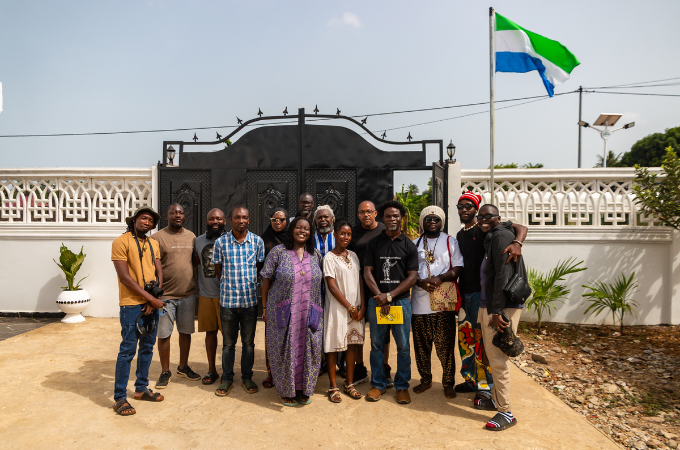
From there, we went to the Sierra Leone Civil War Museum, where we walked back in time – into the Sierra Leone Civil War. The war began on March 23, 1991, when the Revolutionary United Front (RUF), backed by the special forces of Charles Taylor’s National Patriotic Front of Liberia (NPFL), entered Sierra Leone in a bid to overthrow the government of Joseph Momoh. What unfolded over the next decade was not a simple rebellion but the eruption of deeper fractures – colonial legacies, bad governance, injustice, political intimidation and violence, youth marginalisation and unemployment, inequitable resource distribution, tribalism and nepotism, illiteracy, corruption, compromised faith institutions, and the long shadow of diamonds. The war dragged on for nearly eleven years, leaving tens of thousands dead and displacing more than 2.5 million people.
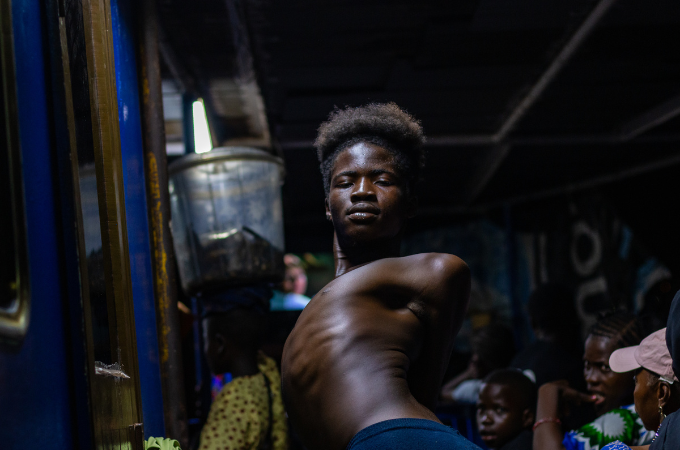
Many Sierra Leoneans are yet to recover from the traumatising afterlife of the war. And yet, for a people who have borne and witnessed such violence, there is a tenderness among them, a quiet, deliberate love for one another and for fellow African brothers and sisters. It feels like a people who have tasted pain but have chosen not to pass that taste on.
The officer at the border was right: love runs through the veins of this country. It is not sentimental; it is practiced, lived. And it is the one thing we, as Africans, must hold on to.
Bound as we are by a shared history of suffering, from the transatlantic slave trade to colonialism and its long aftermath, we must decide to rise above the tragedy. We must learn to make beauty, even glory, out of our ruins. And we must love, love ourselves, love each other, love the soil that knows us by name. Because in the end, it is this love that will bind the Pan-African movement, holding it together when everything else tries to tear it apart.

COMMENTS -
Reader Interactions