

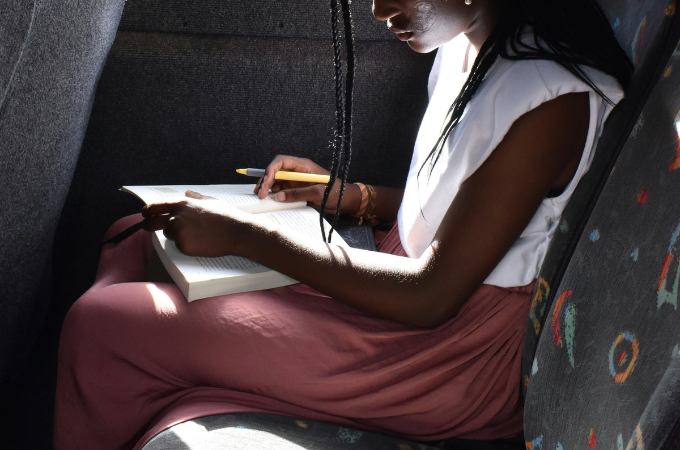
It was a dear friend of mine, a poet and professor living in exile, who pondered whether Black people could find their happy place in a world bent on showing us that no matter where we reside, we could be met with cruelty and uncertainty.
We were having this conversation about finding one’s happy place after I expressed my jubilation at arriving in Johannesburg, where I would stay at a Black-led think tank to work on a creative writing project, while participating in a fellowship exploring global Blackness in the 21st century.
South Africa was the country that had produced one of my favorite short stories, Can Themba’s “The Suit,” the story showing how the emotional toll of apartheid had eroded a personal relationship. I later enjoyed the adaptations of this seminal work that got people thinking and rewriting the original story to consider other possibilities long after it had been published.
This was my happy place, I told my friend.
I was able to do what I loved with the people I wanted to do what I loved with. I had been eager to have a respite from the US after seeing many African and Caribbean restaurants struggle to stay afloat after their businesses became targets for ICE, and many people, people who would patronize their restaurants, had been laid off. I had heard stories from Black women who had lost their jobs and were cobbling together gigs, becoming dog walkers and finding short-term contracts to stay afloat.
Johannesburg, this oasis that I had been welcomed into to write inside a small community, would be where I could grab some joy, however fleeting. But my friend relayed his account of living in South Africa as a student, reminding me of the realities that existed outside my bubble. He had experienced racism and afrophobia in the country, quite often, and this saddened him because many African nations, including his own country, had supported the fight to end apartheid. I would have loved to ignore my friend and stay in my shell, but then what kind of decent human or writer would I be?
The reason why I was writing feverishly during my days—the reason we all were—was to create possibilities beyond what had been given. We know that the tragedies we see every day will eventually make their way into our stories on some level, even if it costs us our safety to speak. In this way, finding happiness on the page feels incredibly dangerous because it comes at a risk. Will you subvert the dominant narrative of how it’s thought that people like you should behave, or will you dare to write something different, something that might bring you joy, but make another person or institution witnessing you so free on the page, quite angry?
Any writer living in exile seems to understand this conundrum deeply, and it was no wonder my friend shared his despair over the state of his own homeland, its political and social upheavals existing for as long as he’s been alive, while lamenting over a well-known journalist who had been killed. It was all compounding, the dirge of calamities, because in his new country, he was also witnessing the ways Black people were being mistreated under the current administration, their rights slowly being snatched away.
Where do we go?
This was the question looming over us as I reflected on what was keeping me up at night: the deaths of Black women due to intimate partner violence, millions without SNAP benefits, another war, and hearing from friends in Nigeria that prices were going up so much that it was best for one to drink garri with avocado and call it a day. The despair between my friend and I was palpable when listing all the tumult we had seen, but then he read me a poem he had written, reminding me why the quest to find joy will always be vital to the Black writer.
Resilience
When we are punched in the face
We stagger about, blinded
By the fury in the bully’s fist
We wince and gnash our teeth
Upon being declared garbage
Fit for the dumpster and the fire
We carve the insults into song
And dance our way to health
For this is how we win:
We dig deeper into the ground
Our roots wider and sturdier
A barricade against evil winds
We bloom in the scorching sun
And thrive in soils
Designed to choke us to death
– Sylvester Danson Kahyana
His poem reminded me of Lucille Clifton’s “won’t you celebrate with me,” her last line being both liberating and haunting when she says, “come celebrate with me that every day something has tried to kill me and has failed.” Clifton and Kahyana’s poetry reminded me that no matter the terror, there’s always a reason to celebrate. And considering the world we have inherited, sometimes it might make sense to occasionally laugh in the face of that which keeps terrorizing you.
The happy place might not be easy to see in our everyday realities, but something is there that is ready to be called forth and shaped into a creation that one day someone will read, remembering that their humanity is not up for debate. And thankfully, Kahyana’s poem—which was spoken to me through the phone—felt like a clarion call to never forget that this quest I’m on is part of a larger phenomenon linked to millions of people searching for something better in impossible circumstances.
The Great Migration in the US was a key moment where Black southerners moved to the North for economic opportunity and safety, considering the daily lynchings and indignities they had to survive. All the stories that came from their courage have been passed down in families, and learned about in schools. Everyone I know who has read Isabel Wilkerson’s The Warmth of Other Suns usually says that they were better humans for reading it. Reading those accounts of people choosing to find a more dignified life elsewhere was hard to forget. Though leaving does not automatically mean one’s material conditions will change substantially, there is something about a story that can show us a piece of ourselves, making us feel a delight we didn’t know was there. It doesn’t solve everything, but it does seem to restore something vital in our emotional life that makes it possible for us to keep going. And maybe that’s why my friend said, “Perhaps there is no happy place. Maybe happy places are in one’s own mind.”
As writers, we conjure worlds on the page, doing our best to imagine new possibilities, whether that’s through excavating that which haunts us or creating worlds where we are at the center of our stories. For all the divisions we see in the world, a great equalizer might be that for Black writers across the globe, if we cannot yet physically find our happy place, then we had better do our best to write worlds that make us come alive to ourselves, maybe not providing a solution, but maybe writing a story or poem that could point in the direction of our well-being. It takes courage, because it usually means that it’s inevitable that while we write to find the happy—whatever that is—we do so against an unrelenting current of tragedy.
Most of us don’t even make enough money to sustain what we do, yet we do it because, well, possibly it makes us happy, or at the very least, we suspect we’d be miserable without writing. In a world like this, what other option is there but to create, or, as Edwidge Danticat once said, create dangerously?
The conditions are never ideal, but when I think of my friend, the intimacy of our conversations and our sharing of words across time zones, I think that happiness isn’t something that is fixed anyway. It shifts and evolves, and when we get to where we think we want to be, it never seems to give us the feeling we thought it would. Moments of laughter and euphoria may occur, but usually these moments can never be captured in the same way again.
This is also true for the Black writer writing, as sometimes we’re not sure where our writing will take us. And when these characters come to life, we think we know what they’ll say, until they start speaking and they spill out their joy and bitterness at having lived a life that they couldn’t always control. And we applaud them for sharing their humanity, because whether the story is made up or not, they have left something real for us to consider. It might not be a “happy” story, but it’s true, and that’s enough because often our characters’ desires ignite our own. Whether we are happy or not, we know that to be alive is to keep living and creating while we continue searching.


COMMENTS -
Reader Interactions