
The Proof
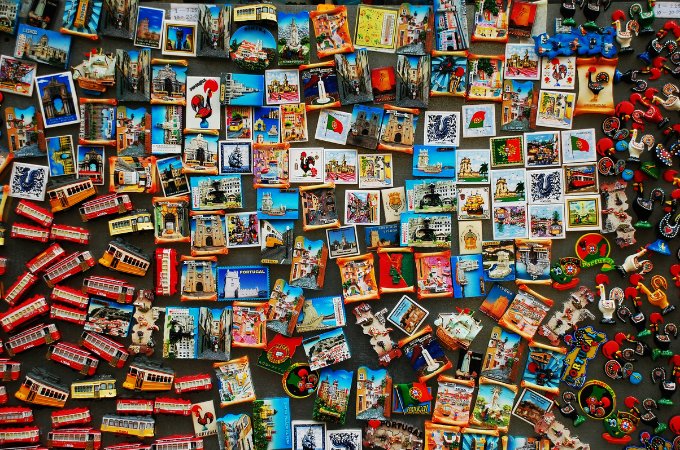
I used to make fun of my best friend’s obsession with fridge magnets. We would be holidaying somewhere humid and expensive, toasting champagne margaritas, and she would pull me into questionable alleyways like she was sourcing black market organs. Except it was for magnets. Tiny, tacky souvenirs from places she barely stayed long enough to pronounce.
I found it deeply unserious and never understood the urgency. Back home, she lined them up across her fridge like achievements. Of islands, countries, beaches, monuments. A life measured in departures. She’d called them proof. I had called them clutter with a passport
Now I hunt them. For her. And unfortunately, I get it now
It has to be the right one. A little inappropriate even. Not the polite, shrink-wrapped version of a place. Not the airport kind either, that look like they were designed by a committee that hates joy. Something slightly wrong that you can only find if you ignore Google Maps and get lost on purpose. Kinda like the nude devils’ threesome souvenir magnets swarming the streets of Athens.
It might be too much to expect a trinket to hold the essence of a whole city. It’s an absurd assignment in fact, asking a two-euro object to summarise an entire city. But still.
So, in Manchester it made sense that I would get her one of the bee magnets. There is bee imagery everywhere. On walls, buildings, bins, pavements, buses, phone boxes – repeating themselves until they stop feeling decorative and start feeling instructional, like the city was quietly buzzing at me; you’re one of us now.
That’s the problem with symbols. If you stare long enough, they start staring back. And once they do, it’s hard to tell whether you’re choosing them of if they’re choosing you.
I found hers in the Northern Quarter on a typical grey Manchester afternoon that felt undecided. The bee was slightly off-centre, printed like it had given up halfway through being important. That felt more honest. I bought it quickly, before my brain could escalate things into a personality crisis. Once I start looking for something, I can’t ever just stop myself.
Birthdays, for example. Since turning thirty, mine isn’t just a day anymore, but a slow indulgent bloom of self-importance. I am the planner, the guest of honor, and the surprise. I book the trips, request flower petals, rally random strangers to sing happy birthday, and still manage to get very delighted as if any of it just happened to me without my intervening.
This year I went to Madeira. Alone, as usual. It felt intentional, clean. No witnesses to dilute the experience. Just me, a copy of Kennedy Ryan’s Can’t Get Enough, my string bikinis, the ocean, and whatever version of myself I’d decided to perform. That week, I had loosely committed to a Zulu persona, something I picked up after binging Shaka Ilembe, moving through the island to amapiano like I had land to reclaim. Naturally.
I booked a room with a sea view in Dreams Madeira Resort. That first night I stood on the balcony watching the dark swallow the edges of the island. The wind whooshing over the vast Atlantic waters punctuated the air. No one to confirm I was having a good time staring into space. No one to perform for.
The next day I went exploring, not for anything specific per se. Just chasing a specific feeling that convinces you to leave well-lit areas and make questionable decisions.
Somewhere in the Valley of the Nuns, which in hindsight should have been my first warning, I got lost. There’s something almost seductive about accidentally ending up in a place named after women who opted out. A valley dedicated to celibacy, just peace, silence and withdrawal. And there I was. On holiday. Alone. Again. God has a sense of humor because really what is my life if not a more expensive, better-dressed version of monastic living – no man, no distractions, just vibes, self-reflection and increasingly elaborate solo itineraries. A nun basically, but with better swimwear and a mini bar.
I found a small shop halfway down a hill I couldn’t retrace if I tried, because there was no sign nor any obvious entrance. Just open enough to feel like a dare. Naturally, I sent my live location to her in Nairobi. Because independence is important but so is being found. Inside everything felt paused. I picked up a magnet without really seeing it at first. It was hand-painted and a little uneven. Not recognisable unless you could translate Portuguese or had local context.
And somewhere between handing over two euros and pretending I understood the Portuguese on it, it hit me that I wasn’t just looking for something for her. I was looking for something that could hold the version of me that existed there. Not because I had suddenly become someone who collects magnets. I hadn’t. I was still, technically, doing this for her.
But for a moment, a whole ocean, a balcony and a personality shift still weren’t enough evidence that I had existed somewhere else over a thousand miles from my flat in Manchester. Which is how you know things are getting advanced and serious. When your memory starts needing documentation.
I didn’t want to post it and splay it across socials. Didn’t want to flatten it into a caption, or filter it into something consumable. I wanted proof without performance. Which is ironic, considering I’ve always said validation is for parking.
That night, after managing to get back to the hotel with help from ladies in the shop, I placed the magnet on the minibar fridge in my room. Just to see. And for a split second, it worked. It looked convincing. Like I wasn’t just a woman in a robe waiting for room service while eating Pringles in bed, curating meaning out of thin air. It looked like I had been somewhere.
In the morning, I took it down and wrapped it carefully. For her. But as I packed my suitcase, I kept thinking that maybe the magnets were never about remembering where you’ve been. Maybe they were always about needing something, anything, to prove that you were there at all.
Because let’s be honest, if I start collecting magnets, that’s not character development. That’s me officially joining the convent.
Read previous chapter here.
Photo by Sunguk Kim on Unsplash


COMMENTS -
Reader Interactions