

They called her Baaba. No “Auntie” needed, unless you were new, or trying to get her to mix you something fast fast; for your heartache, for your fibroid, for your fasting fatigue, your pelvic pain or “spiritual confusion.” She barely ever spoke in tongues, or ever. Her silence was already a sermon. On days when the wind refused to blow through Asylum Down’s rusted rooftops, you could hear her dried neem leaves crackling in a pot before her voice ever announced that deliverance was about to begin.
Auntie Baaba’s fellowship is held every Wednesday evening on her back porch under a blue mosquito net and a banner that reads: “Hearts Can Heal Here.” Next to it, an old tomato paste carton holds bottles labelled “Baaba’s Bouncing Bitters,” “Stop Crying Soap,” and “Holy Protection Pads.”
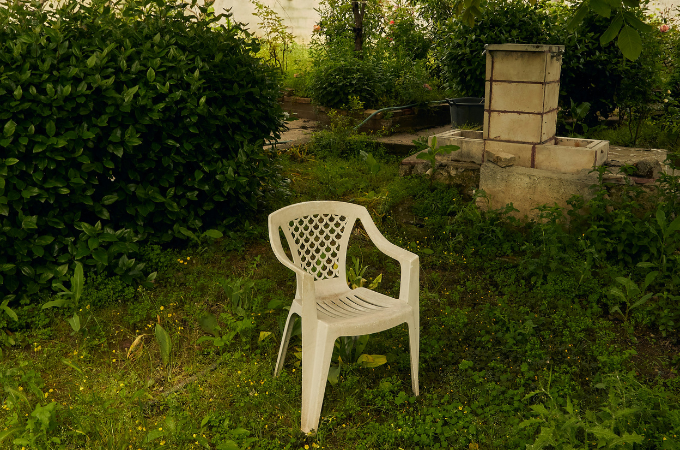
Her backyard fellowship was marked by two things: a crooked wooden cross nailed to a mango tree, and a white plastic chair that no one dared sit on, not even when all the other chairs were taken and your knees begged for rest. That chair was for the Holy Spirit. Or for Baaba’s late husband, depending on how she felt that week. But most days, the real gospel did not come from that mango tree, but from the shelves inside her kitchen, where recycled jars and clay receptacles carried faded labels: Penicillin, Vaseline, Miraculous Peace. Dried hibiscus. Crushed charcoal. Boiled guava bark. Even borrowed whispers from her grandmother’s ghost, you see, Baaba mixed them all.
It would’ve been easier to understand if she named her enterprise, “Revelation Altar of Glory and Prophetic Oil Centre” or Upper Room International Healing Cathedral of Signs and Wonders… or something similarly outrageous to the sort of things you’d see on churches in the crevices of Accra. But Baaba wasn’t a prophetess or a priestess or a pastor. If you ask me, I’d say she was simply a woman who knew a lot. Maybe too much.
On a daily basis, women came quietly, clutching tissue and wrap-cloths laced at the hem with betrayal, reeking of sweat, and smoked salmon and sometimes, just sometimes, dried semen. Then they left smelling of hibiscus and fresh clarity. The story always started the same: “He said he was different,” and Baaba would nod like a slow drumbeat. “And now he’s ghosting me,” or “now he’s blaming the devil,” or-or “he’s refusing to marry me. After I gave him my body… After, after everything…”
“Some men are not possessed,” Baaba would say, grinding moringa leaves between her teeth. “They are just predictable.”
But I tell you, Baaba offered advice and brewed herbal contraceptives strong enough to fool a blood test, peeled garlic like a sacrament, and made a bitter tea that coaxed the truth from your womb. For a simple woman who knew too much, she was powerful.
If I told you Baaba only clung onto her JSS English and had followers in Amsterdam all through to Axim, you wouldn’t believe me. Tithes came via Momo and bank transfer, gossip came on foot.
One Wednesday, Aba, twenty-two, heartbroken, and six weeks pregnant came to Baaba’s fellowship with swollen eyes and a lace pixie wig that didn’t quite fit. She was from around here, Maame Ama’s apprentice at the fashion house. She had met the man, a preacher at a gospel concert on the football park behind the assemblyman’s house: a man whose cologne could cast out doubt, and whose voice made scripture sound like a promise.
“I thought he was the one,” she whispered. “He prayed with me. He said he saw a vision.”
“He did?” Baaba feigned surprise, motioning her to sit. “But it was from under your dress…” The other women snorted. Baaba didn’t do pity. She did healing, but only after you bled honesty, truly.
Aba returned weekly afterwards. Baaba gave her things to drink and things to remember. Neem for regret. Clove for clarity. A slap of truth when she needed it.
Until one afternoon, a soft knock echoed. The preacher stood at Baaba’s gate. He wore a white kaftan and a smirk. Said he came for counselling. Baaba made him wait. She boiled lemongrass slowly, like a warning.
“I know who you are,” she said when she finally let him in.
He smiled, “We’re all sinners.”
Baaba retorted, “And some of you recycle your sins too often.”
He laughed, but it didn’t reach his eyes.
“I want her back,” he said.
Baaba stared. Then nodded slowly, as if translating his words for the mango tree. “She’s not yours to have. And you don’t want her. You want your image back.”
He twitched. “That’s not true.”
Baaba stood squarely, wiped her hands on her wrapper. “You want a blessing, Osofo? Try honesty. Or sit in the white chair and let the Holy Spirit weigh in.”
He looked at the chair, swallowed hard, then walked away.
Two days later, Aba texted Baaba: He proposed.
Baaba sent back one word: Don’t!
But the heart is not clay. It doesn’t always mold to wisdom. The heart is not clay, and the heart wants what it wants when it wants, how it wants, even in blindfolds and thorns in its path.
The engagement photos trended. White doves, scripture in gold cursive, a baby blue satin gown that looked borrowed from heaven and a ring, fat enough to silence doubt. The preacher was redeemed, or so it seemed and Baaba didn’t speak.
For eight and a half fortnights, Aba drifted in and out of the fellowship, appearing now and then like wele in okro soup. A swollen lip, a blister here, an open wound, a black eye there; bruises dressed in foundation and sorrow hidden under layers of concealer that couldn’t quite hold.
Until the funeral.
Because some truths wait until after the rice is soaked, after the face is powdered, after the womb stops pulsing – and then they rise, like rot in still water. The burial was a quiet affair. A bit too quiet for someone so loud in life, if you ask me. No band, no brass, no blasting speakers. Just the heat, the flies, and a kind of mourning that sat in the throat like phlegm no one dared to clear.
Aba’s body lay still and full of dead life. Her stomach was round and high, tight as a drum, like the child inside her had refused to leave first. Delayed rigor mortis had puffed her fingers into knots, her skin caked with layers of makeup; too pink, too polished… just… too much. Someone had stuffed her into a lace dress the color of mushroom, but it bunched at the hips as if to show that even death rejected the fit.
They said, “Complications. Complication o, complications. Hmm…”
Baaba knew better, and so did the preacher, who kept his sunglasses on even indoors, flanked by deacons who guarded him like he was next in line for crucifixion.
The fish women wailed frantically like they’d seen an angel choke. Somewhere behind the pulpit, a fan groaned in kat-kating sounds of friction, crying for some grease, or rest… or justice… for Aba…?
And still, Baaba sat.
Stone. Mouth closed.
Later that day, she stood beneath her mango tree, holding a jar labelled deliverance, and spoke to the warm March wind. She said, “Aba, you came with love in your hands, but love is not enough when the vessel is cracked. Aba… travel well.” She didn’t cry. She didn’t wail. She poured libation with bissap tea and crushed the small empty clay receptacle beneath her heel.
The next week, the white chair disappeared. Some say the Holy Spirit got tired of pretending. Others say Baaba put it away because she’d finally seen enough. But the women who still visit the mango tree know.
That from rib we rise and from altar we burn.
Each wound remembers where to return
To bleed is to name what silence conceals.
And every gospel is carved by what kneels.
Photo by meriç tuna on Unsplash






hookah coal burner near me September 15, 2025 07:25
https://blakksmoke.us/product/watermelon-mint-vape/