

Translated from the original Arabic by Nader Aweti
My mother could not protect herself from the malice of the old woman who came regularly to our house under the pretext of kinship — a kinship whose authenticity I still doubt.
That woman was nothing like my grandmother. My grandmother was all tenderness and generosity, despite the grave illness that had confined her to bed. Nor was the old woman anything like my mother, my aunts, or the women of our quarter.
Kind old women usually press their palms to their chests and pull out sweets to hand to children. But this old woman, if she ever reached into the folds of her clothing, brought out nothing but an old handkerchief with which she wiped the creases and lines of her face.
How painful it was for me to watch her in all her moods, which ranged from boredom and suspicion to irritation, anger, reproach, and grievance. And how often I asked myself: did cunning impose upon its owner’s face those marks of elongation, that lavish yellow pallor tinged at times with blue, that nose stretching farther and farther as if trying to catch up with lips submerged in a lake of gloom? Or were those very features conspiring to strip her heart of its last reserves of goodness and grace?
It is no wonder that face made me a painter. It is no wonder those dispositions made me a writer. Nor is it strange that an old woman should come and go from the big family house from time to time. What is truly strange, is this woman, who knows perfectly well how to manufacture trouble and emerge victorious in the end, simply because she carries in her hand the card that says she is an old woman, and that no one may offend her, whatever the cause. And so our house became fertile ground for all her behavior — behavior the children discovered before the grown-ups did.
The big family house held several families within its walls: my uncle and his family, my divorced aunt and her three daughters, my father and his family, and my father’s mother, who possessed no strength and no power beyond her prayers and devotions, reclining against a cushion. There were also the visitors who came and went from time to time and were met, in their coming and going, with every last bit of welcome and hospitality. The only visitor capable of disturbing the peace was this old woman.
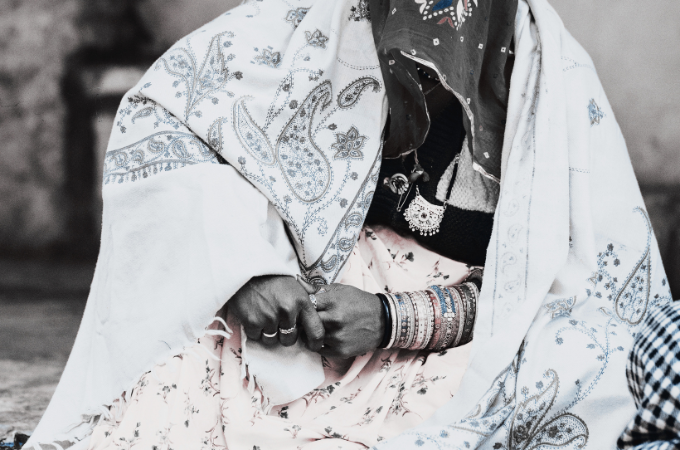
Her visits usually began with a ritual that never varied. The moment she passed through the gate, and reached the end of the corridor, she would claim that the children had failed to greet her in the street. My mother would hurry out to meet her, offer all the necessary apologies, take her farashiya — a traditional Libyan women’s wrap worn outdoors as an outer garment — and fold it carefully before placing it on top of the chest.
The old woman would eat her breakfast slowly, then spread out a colored cloth bundle containing a few garments in need of washing, and wait for one of the women to hurry forward and do the job. The woman who did the washing was never thanked. The one who refused would find her family’s past dragged out into the open, and an opportunity made of it to exhume the histories of people we had never even heard of.
At lunch she would hold herself back from food. In truth, she had little appetite and would content herself with a few bites, though not before listing the faults of the meal — the salt, the pepper, the excess of grease.
She had neither the time nor the inclination to gather the children around her and tell them a story. On the contrary, she had a gift for breaking up their little circles whenever they clustered near her.
Once I came hurrying back to the house to ask my mother for something, and found her struggling to keep her tears from spilling over, silent and composed as always when sorrow and confusion wrestled inside her. The old woman, meanwhile, was muttering and issuing threats, and no one knew what had caused this sudden tension. When my aunt arrived, the situation exploded. I heard the word sorcery and the like, but I could not make out the substance of the accusation.
In the privacy of just me and my mother, I begged her to take the matter to my father and ask him to put an end to this troublesome visitor. My mother shot me a look full of astonishment, disapproval, and fear.
“Men do not interfere in women’s affairs…”
That was how my mother explained it to me.
So, men did not interfere in women’s affairs, and my mother and I were like two little girls standing before this cunning old woman. Surely one of us would have to grow up and do what the other could not. That was how I felt. And that was what I told all the girls in the house.
We put our heads together and tried to think of a way to stop her, though deep down we knew perfectly well, with absolute certainty and conviction, that none of our schemes would succeed, that we would never be able to resist the fate that sometimes creeps into our homes. Our hopes remained nothing more than lovely waking dreams that we exchanged aloud, only to watch them shatter against the hard rock of reality, which told us that this old woman was one of our relatives and could not be insulted, whatever the reason.
On her last visit, the old woman openly accused my aunt of practicing sorcery. She claimed to have found a small paper packet of incense inside her bundle of clothes. But my uncle’s wife, through her sound judgment and strong character, settled the matter and restored the household to its former calm. Toward sunset the old woman prepared to leave for her house, and the women hurried to help her with her things. Then, when she reached the middle of the courtyard and unfolded her farashiya, she noticed a tear the size of a palm at its center. She sought refuge from Satan, invoking the name of the Most Merciful, raised the farashiya, lowered it, then lifted it again to make sure of what she had seen. But the matter was plain for everyone to see: some malicious hand had used scissors to cut a clean piece from this farashiya and no other, for reasons unknown.
Whoever had used those scissors could not have known that, by that single act, a raging volcano had been unleashed, whose burning lava would consume us all for God knows how long. If this old woman had once been the oppressor, she was now the wronged one — humiliated, insulted, and attacked in the most sacred of her possessions, her farashiya, the garment that covered her in the street.
She raised her hands to the sky and cried, “God will judge!” Then she fell to the ground in a movement like prostration and began to let out terrifying sounds, like broken sobbing. My uncle’s wife was sensible and intelligent. She understood that no grown person would dare commit such a serious act and said it must have been the work of children — God guide them. But before she could finish, the old woman rose from her prostration and shouted in a thunderous voice, “No, no, no!” while her finger swung from side to side like the pendulum of a clock. “No, no, no — the children? No, no, no!”
The old woman was convinced that the woman who had planted the packet of incense had gone further and cut a piece from the farashiya so that she could continue her sorcery by using a trace of its owner. Everyone knew the power such traces held in magic.
My mother swore and wept to clear her name, while my uncle’s wife once again insisted that only a child, one too young to understand consequences, could have done such a thing. My aunt remained silent, because she was the weakest element in the house: a divorced woman and the mother of three daughters.
The old woman’s wailing only grew louder, and the cry of “You sorcerers!” flew through the stillness of dusk, from one side of the walls to the other, while the neighborhood women began arriving one after another. At that point the men had to be summoned, because the situation had become too serious.
My father said, “For the Prophet’s sake, peace be upon him, give her a new farashiya and make her feel better.” But his words had the effect of oil poured over hidden embers. Her wailing intensified, as did her appeals to God. My father replaced his suggestion with another, more practical one: he tossed his wallet to one of the boys and ordered him to hurry to the nearby factory and buy her a new farashiya, along with a piece of gold. At that she sprang to her feet, as though an electric current had struck her roots and ordered her to flee at once.
Then my uncle, a teacher of Arabic and religion, said, “Whoever is offered reconciliation and refuses it is a devil. Whoever is offered reconciliation and refuses it is a devil.”
The old woman went on her way, and my uncle’s words continued to ring through the courtyard, while the children shrank behind their mothers’ backs in search of safety and protection.
That night, as the wives finally managed to tell their husbands what they had been suffering at this woman’s hands, I laid my weary head against my grandmother’s tender chest. Despite her illness, she was always armed with sweets, beautiful stories, gentle touches, and blessed prayers.
By morning, a current of relief and release had passed through the women and children. They gathered for a delicious breakfast in the middle of the courtyard — the stage of yesterday’s events — and each of them found comfort in one thing only: that they had escaped that nightmare.
Thirty years later, in my city—
Some lived. Some died. And to this day, I have never dared tell a soul, never dared confess before anyone, that I was the one who used the scissors.
Photo by Darshan Patel on Unsplash







COMMENTS -
Reader Interactions