

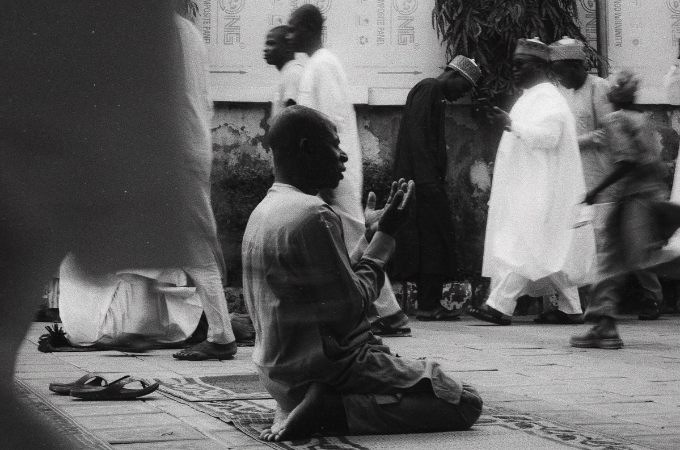
The muezzin at the central mosque in Minna had a broken front tooth, and every morning at Fajr, you could hear the vacancy of it within the call. It was a faint sibilance that salted through the sacred phrases like something that had slipped its sutures and could not be sewn back.
I grew up thinking this flaw was the point. That even the mouth elected to summon the faithful toward transcendence would carry inside it the evidence of ordinary breakage, the kind that belongs to a man who would later be seen at the market quarrelling over the price of onions, who mended his sandals with wire, and whose theology was housed in a body as provisional as anyone else’s.
The call itself moved through a grammar I could not name then; it opened in proclamation, drew inward to personal attestation, then pivoted outward into beckoning, and at each of these three junctures, the muezzin’s voice did something no written text of the azaan can fully represent, which is to expand a single syllable across several pitches, to inhabit one vowel so completely and for so long that the word containing it seemed almost embarrassed by the duration of the attention.
اَللهُ أَكْبَرُ، اَللهُ أَكْبَرُ God is most great. God is most great. x2
أَشْهَدُ أَنْ لَا إِلَهَ إِلَّا اللهُ I testify that there is no god except God. x2
أَشْهَدُ أَنَّ مُحَمَّدًا رَسُولُ اللهِ I testify that Muhammad is the messenger of God. x2
حَيَّ عَلَى الصَّلَاةِ Hasten to prayer x2
حَيَّ عَلَى الْفَلَاحِ Hasten to success x2
اَلصَّلَاةُ خَيْرٌ مِنَ النَّوْمِ The prayer is better than sleep. x2
اَللهُ أَكْبَرُ ، اَللهُ أَكْبَرُ God is most great. God is most great. x2
لَا إِلَهَ إِلَّا اللهُ There is no deity except God.
Growing up in the vicinity of that voice, in a home whose north wall faced the street leading to the mosque, was an education I received entirely without knowing it. The body of a nine-year-old lying on a mat at Fajr, before the mind has reasserted its ordinary dominion over the morning’s textures and residues of dreaming, is permeable to structure in a way that the adult mind rarely manages. What entered me in those hours was not theology but prosody: the knowledge of how a phrase accumulates toward a break, of what the silence after a spoken unit of meaning is supposed to carry, of how long a syllable is permitted to be before it owes the listener a resolution.
There is a word in Hausa, tausayi, which the dictionaries translate as pity or compassion, but which in its lived usage carries something the English cannot hold. It names the feeling of the witness whose seeing has altered them at some structural level, so that the self who finishes the act of witnessing is no longer identical to the self who began it. I think of it now as the word for what the azaan does to the body of the person genuinely present to it. Not merely hearing it, in the way that a sound can exist in a room without anyone in the room receiving it, but attending to it the way my grandmother Hajjah attended to it. Her ablutions already completed before the first phrase crossed the compound wall, and her body already oriented toward the qibla in that hour when the sky could not decide between darkness and the pale anaemia that precedes sunrise. What she modelled for me was a quality of receptivity that I have spent twenty years trying to locate in the act of reading and writing poems. It is the posture of someone who has made themselves available to be changed by what is coming.
***
Rumi opens the Masnavi with a wound and not a proposition, the reed flute’s articulation of its own constitutive displacement, and this choice of opening is not ornamental. It is the most precise possible statement of the epistemological condition the poem is going to be trafficking in, which is the knowledge available only to the one who has been severed from the origin of their meaning and has thereby discovered that the wound is also the instrument, that the music was always latent in the incision.
بشنو این نی چون شکایت میکنداز جداییها حکایت میکند
Listen to the reed, how it tells a tale of separations,
complaining of the time since it was cut from the reed bed.
The muezzin’s voice performs the same argument every morning. The maqam al-hijaz, the modal scale most commonly employed in the azaan, is characterised by an augmented second interval that gives the call its tonal quality of reaching toward a resolution that the scale itself cannot supply. Arabic listeners understand this quality as shawq, a word that names the forward-leaning, appetitive desire for what has not yet been given, a longing constitutively oriented toward the future. The azaan is built from this tonal argument before a single word has been sung. What enters the listener’s body at Fajr is therefore not merely a message but a structured affective proposition, the mode itself making the claim before the semantics arrives to confirm it.
I absorbed this before I had words for it, in the way that children absorb syntax before they learn grammar, taking into their bodies the deep logic of a structure they will not be able to name for years, but which will govern everything they build in the language nonetheless.
***
Abu Bakr Sadiq works in this inheritance without making it his subject. In “Maqtoob,” from his collection Leaked Footages, the poem’s grief accumulates through a liturgical repetition that the azaan also employs: the same phrase, doubled, driven past the semantic into the somatic, past comprehension into something the body receives before the mind has organised a response.
i mumble duas against my desires for what’s gone. a sheikh at the masjid
tells me to accept my losses with faith. says everything had been written
long before i came into existence.
[…] maqtoob. maqtoob. every
word already written.
The doubling of maqtoob does exactly what the azaan’s doubled opening does. The first utterance makes the declaration. The second utterance inhabits the declaration and asks the reader to inhabit it also, to feel the difference between understanding a thing and carrying it. This is the technique of devotional sound mastered long before literary prosody arrived to name it: you say the thing twice because the first utterance builds the vessel, and the second utterance fills it.
***
Zaynab Iliyasu Bobi, whose work moves between Hausa oral inheritance and the fractured grammar of contemporary lyric, has said in conversation that her most beloved poem is four lines long. She called it the one that would save humanity if its depth were received with care.
Oh lord,
Teach us how to be
Humans,
Again.
The formal decision I want to notice here is the line break after “Humans” and before “Again.” Bobi does not write ‘Teach us how to be human again,’ which would be a petition. She breaks the line so that “Humans” arrives as a completed thought, a noun standing alone with the full weight of its meaning, and “Again” begins the next line as a separate temporal claim, a word that implies both loss and retrievability at once. The break is the argument. It is the pause in which the reader is held between what has been said and what is about to be said, a suspension in which the poem trusts the reader to carry the weight of Humans long enough for Again to arrive and change what Humans means.
This is the muezzin’s pause between phrases. This is the silence after “hayya ‘ala al-falah” that does not offer the listener a resolution but asks them to hold the invitation in the body until the next phrase comes to complete it.
SAI Sabouke, the dervish-poet of New Bussa whose entire practice is animated by Sufi epistemology, names this suspended condition more explicitly in “Striking the Chords of Sorrow in a Muharram Morning,” a poem that holds two incompatible truths simultaneously, the grief of loss and the theology that would redeem it, and finds that neither cancels the other but that both are necessary for what the poem needs to do:
I do not know if this is a bad poem
bad poems are hard to name
but these are grey buds of sorrow
blossoming in the heart of a poor man’s son
who lives in a broken home in a nation
suffocating under the grip of heartless beasts
The epistemological humility of “I do not know if this is a bad poem” is the same humility the azaan enacts every morning by calling toward God across a distance that has not been closed. The call does not claim arrival. It performs reaching. And the literary value of that reaching — its capacity to create in the reader a genuine experience of suspension and longing rather than the mere delivery of information about suspension and longing — is what all three of these poets are working in. And this is what I understood as a child, in formal terms only, as the quality of the muezzin’s broken-toothed voice in the hour before the city’s noise came to reclaim the air.
***
Hajjah died in the middle of a year when I was too occupied with the machinery of my own ambitions to visit. When I arrived in Minna, the house had the quality of a room in which an argument had just ended, all the participants gone, the air still holding the shape of everything it had recently been asked to carry.
I slept in the room where I had lain as a boy through those Fajr hours, and the call came, as it always comes, without apology or accommodation. The muezzin that morning was a younger man, a voice without the weathered particularity of the one I remembered, and yet the architecture of the call was identical, the same movement through proclamation and attestation and invitation, the same pause before hayya ‘ala al-falah that I had been waiting for without knowing I was waiting for it.
In that pause, in that held air between phrases, I understood what I had been trying to teach myself to make the white space at the end of a line do. Not to stop the poem. To hold the reader in a condition of structured expectancy, in the same posture Hajjah assumed at her ablutions, the posture of someone who has already made themselves available and is now waiting, with complete and unhurried attention, for what is coming next.
الصَّلَاةُ خَيْرٌ مِنَ النَّوْمِ
As-salatu khairun min an-nawm — Prayer is better than sleep.
This phrase, exclusive to the Fajr call, is the azaan’s most formally audacious gesture; a comparative claim inserted into what has otherwise been a sequence of proclamations, a moment where the call pivots from the declarative into the argumentative, asking the listener to weigh two things against each other and choose.
Every poem I have ever wanted to write is, at some level, making this same claim: that the quality of attention requested here, in this particular arrangement of sound and silence and the calibrated distribution of where meaning accumulates and where it breathes, is worth the cost of the interruption to whatever you were doing before you opened the page. I learned to make this argument not from any poetics I can cite, but from the phenomenology of a specific childhood, from a compound in Minna, from a man whose name I never learned, whose voice crossed a wall before sunrise and entered the room where a child was lying on a mat not yet knowing that he was already in the first and most complete tutorial in prosody he would ever receive.
The line break I work toward is the kind that does not announce itself, the kind that functions the way that Fajr phrase functions, as a site of evaluation, a place where the reader is suspended between what has just been said and what is about to be said, and where that suspension, held correctly, produces a quality of understanding that continuous reading cannot.
Charles Olson wrote that the line comes from the breath. What I would say is that the breath was trained long before any poetics arrived to theorise it, trained in the specific silences of wherever the body grew up. And for me, this means the line comes from the azaan, from the muezzin’s broken tooth, from the augmented interval of the maqam hijaz inclining the ear toward a resolution that will not arrive within the call itself but only in the prayer that the call is asking you to go and perform.
The poem is that prayer. The page is that mosque. The white space at the end of the line is the silence in which the voice, having reached as far as it can reach, trusts the air to carry the rest.
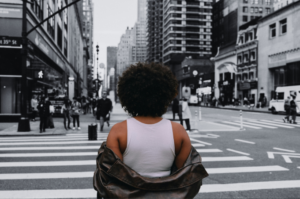
Photo by Abdullahi Santuraki from Pexels




Shanté August 14, 2026 09:44
A beautiful meditation on sound, silence, faith and the architecture of meaning. What stayed with me most was the way this moves from the muezzin’s pauses to poetry, showing how sometimes meaning lives not only in what is said but in the space we are asked to hold before what comes next. A thoughtful and deeply attentive piece.