
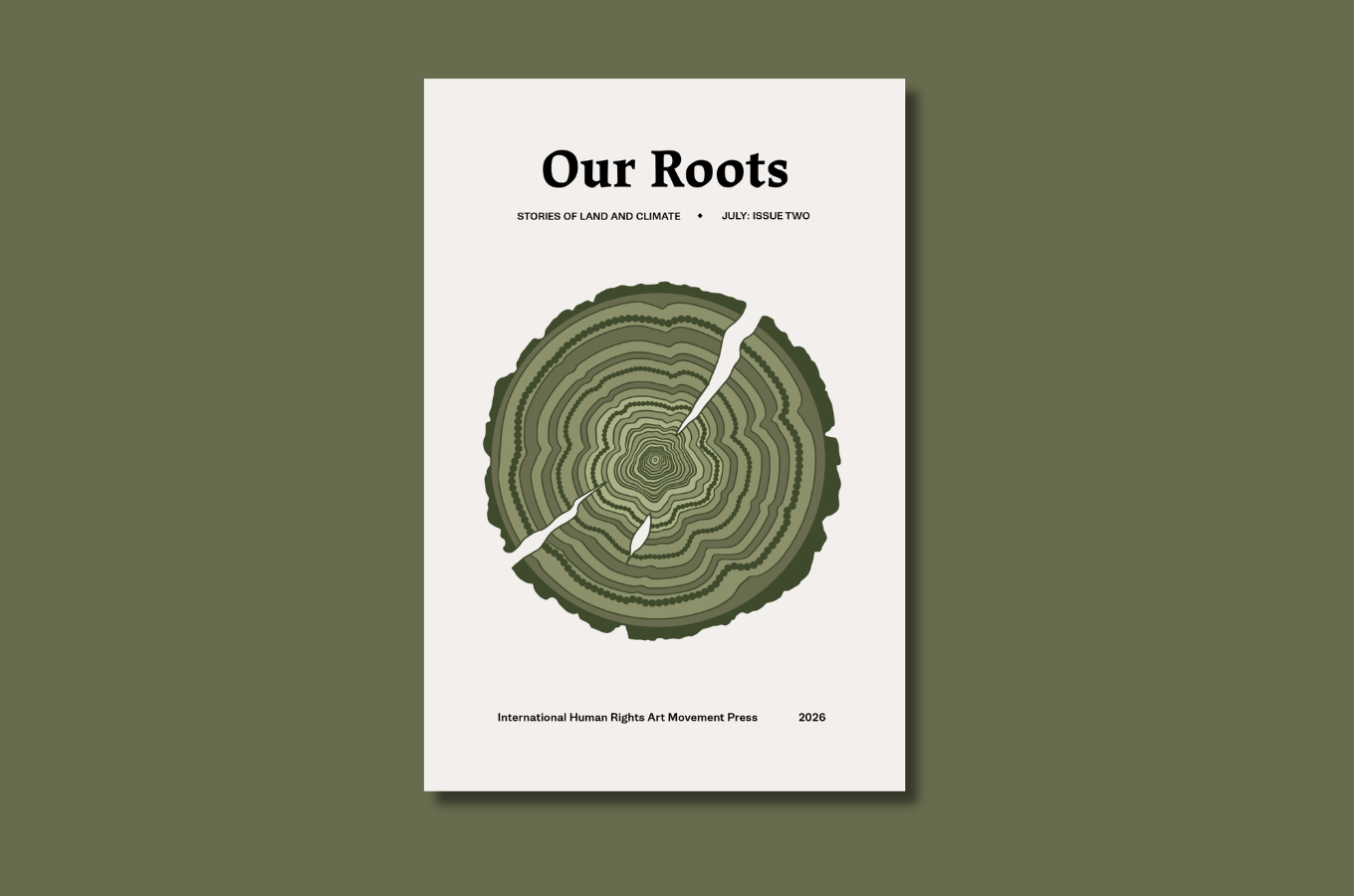
IHRAM Press has released Our Roots, the second issue of its 2026 literary magazine, gathering poetry and prose under the theme “Stories of Land and Climate.” Published on July 30, 2026, the issue arrives as a 137-page paperback from International Human Rights Art Movement (IHRAM) Press.
IHRAM Press is the literary arm of the International Human Rights Art Movement, a Queens, New York–based organization built around the idea that creative engagement is one of the surest paths toward social justice. The press has made a name for itself giving space to artists-in-exile, activists, and writers confronting suppression in their home countries, and its quarterly literary magazine continues that mission on a rolling, open-submission basis, a home for lesser-known and up-and-coming voices working through urgent social issues.
In her opening note, the editor frames the issue around a hard truth: as global warming accelerates, the emotional toll it takes on people goes largely unaddressed by governments, leaving behind unrest and displacement that rarely make headlines. The pieces that follow track that toll in the body and in memory, particularly how an unraveling climate reshapes physical experience, ancestral ties to land, and the rhythms people once took for granted.
The lineup ranges widely in form and geography. Poems like “Magnolia,” “Black Rhino,” and “The Sea Is Warmer Now” sit alongside longer prose meditations such as “Notes from a Body That Was Also Earth,” an essay tracing a coastal European city swallowed by rising water, and “The World We Are Burning Down,” which follows the Philippines’ escalating typhoon seasons through the lens of a childhood spent naming storms. Africa’s landscapes get particular attention: “When the River Swallowed Mokwa” recounts flash flooding through a Nigerian village, “Fire, Fireflies, and Forgotten Rivers” follows a river that failed to return after a brutal dry season, and “Baobab’s Last Witness” mourns a Sahel elder tree stripped bare by drought, its roots once holding memory older than empires. Fiction pieces like “The Herd,” “The Protector,” and “Bitter Waters” lean into fable and speculative territory, while visual art — including the mixed-media piece “Rooted,” built around the metaphor of the knot — rounds out the issue alongside a closing section introducing its global roster of contributing authors and artists.
Threaded through all of it is the throughline familiar to IHRAM’s catalogue: honest engagement with emotion, hope, and the ways identity stays bound to land, even as that land keeps shifting underfoot.
Our Roots is available now through IHRAM Press’s website, humanrightsartmovement.org, and via Zinio, where readers can purchase or subscribe to the magazine digitally.


COMMENTS -
Reader Interactions