

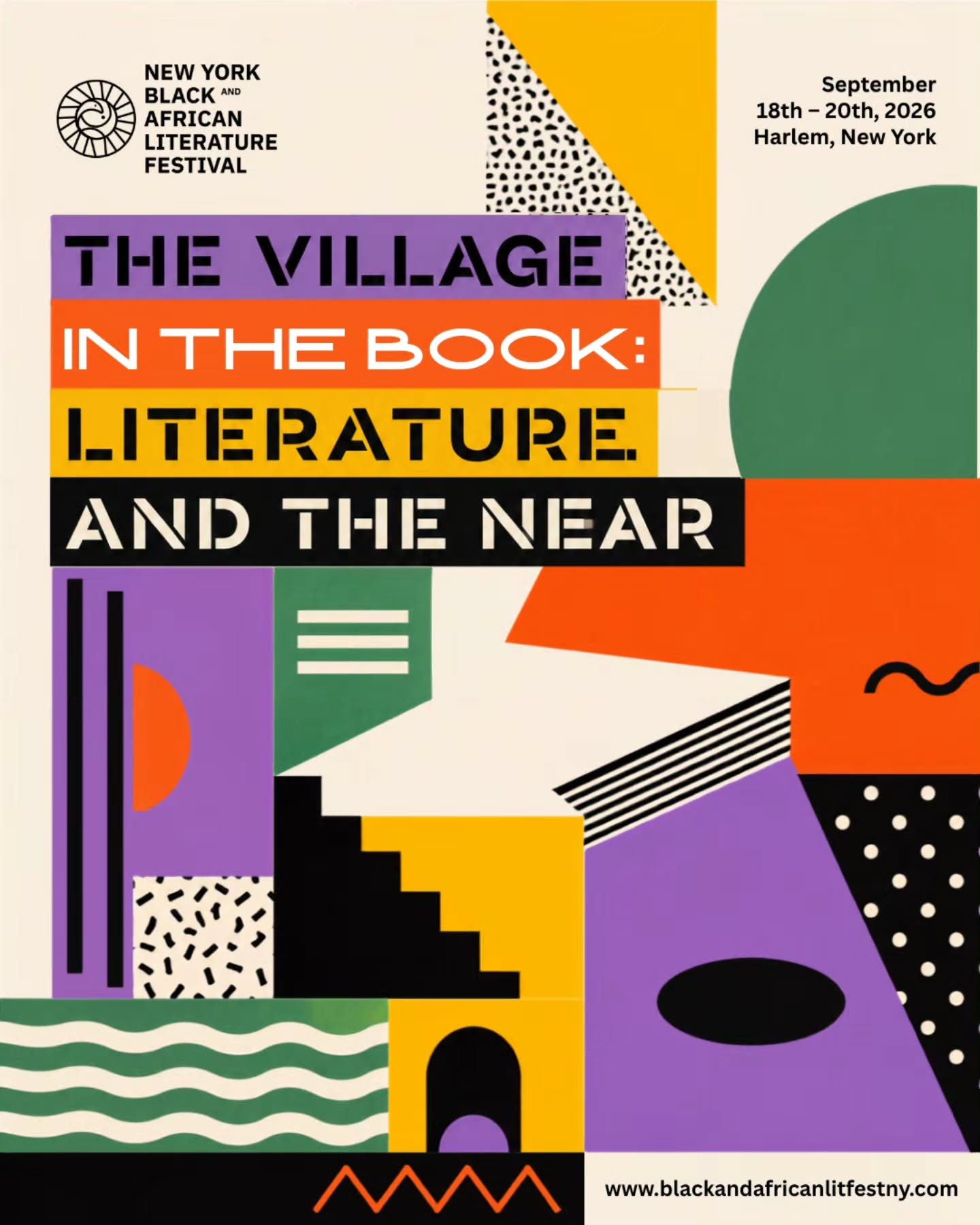
Harlem Stage presents the second edition of the New York Black & African Literature Festival (NYBALF), running September 18–20, 2026, in a new presenting partnership that brings the festival’s three days of literature, performance, and conversation to the historic Harlem Stage Gatehouse at 150 Convent Avenue. The collaboration joins an institution with more than four decades of presenting artists of color to a young festival built around sustained encounters between writers and readers across the Black world. This year’s edition is organized around the theme The Village in the Book: Literature and the Near, asking what happens when the large forces of history — migration, political power, language, race, environmental destruction, memory, belonging — are met at close range, through neighborhood, family, body, and reader. “New York is global because so many worlds are brought into proximity here, without losing their particular histories,” says NYBALF founder and director Efe Paul-Azino, who describes this year’s festival as interested in how literature can remain more accountable to the worlds from which it speaks.
Headlining this year’s lineup are novelist and critic Namwali Serpell, political theorist Mahmood Mamdani, and Brazilian writer Conceição Evaristo, alongside Noo Saro-Wiwa, Patricia Smith, E. Tendayi Achiume, Myriam J. A. Chancy, Camonghne Felix, Ibi Zoboi, Angela Flournoy, Kọ́lá Túbọ̀sún, and Mahogany L. Browne. A wider cast of writers, scholars, and artists joins them across the weekend’s sessions, including Nekesa Afia, Ozoz Sokoh, Uju Anya, and others named below.
Friday, September 18, opens in the afternoon at Columbia University’s Institute of African Studies with The Stranger at Home: Afrophobia and the Limits of Black Solidarity, a hybrid conversation with Sisonke Msimang, E. Tendayi Achiume, Sean Jacobs, and Amaha Kassa, moderated by historian Abosede George, taking South Africa as a departure point for questions of migration, citizenship, and the political limits of Black solidarity. That evening at the Gatehouse, Namwali Serpell delivers the festival’s opening keynote, Toni Morrison and the Black World, returning to Morrison as a writer of neighborhood, ancestry, memory, and return. The night opens outward into Let the Poets Govern, a continuous performance of poetry, music, and invocation featuring Patricia Smith, Camonghne Felix, Canisia Lubrin, Jasmine Mans, Titilope Sonuga, Yaissa Jiménez, and Yacouba Sissoko. It is the one separately ticketed event of the weekend.
Saturday, September 19, is the festival’s fullest day, beginning at 11am at the Schomburg Center for Research in Black Culture with a Wikidata edit-a-thon built around its Transcription Centre Interviews with African Writers collection. Back at the Gatehouse, It Takes a Village: Young Readers in the Age of the Feed brings Candice Iloh and Ibi Zoboi together, moderated by Mahogany L. Browne, to consider what children’s and YA literature can hold that algorithms cannot. Nekesa Afia follows with The Scene of the Crime: A Harlem Mystery, an interactive session that turns the room into a live case file to explore what mystery fiction teaches about place, motive, and attention. The afternoon carries two of the weekend’s most politically charged conversations: The Burning Ground, in which Noo Saro-Wiwa, in conversation with Alexis Okeowo, considers oil, environmental devastation, and inheritance in the Niger Delta thirty years after the execution of Ken Saro-Wiwa and the Ogoni Eight; and Slow Poison, in which Mahmood Mamdani and Kọ́lá Túbọ̀sún discuss Mamdani’s new history of Idi Amin, Yoweri Museveni, and the political forces that remade the Ugandan state. The day continues with Angela Flournoy and Myriam J. A. Chancy, in conversation with Sony Ton-Aime, on friendship, migration, and the families people inherit and build in The People We Make Family, and closes with an evening screening of Tsotsi, the Academy Award-winning South African film.
Sunday, September 20, turns toward literary history, food, language, and adaptation ahead of the closing keynote. The Market and Popular Literature reconsiders Onitsha Market Literature and the pamphlet traditions it belongs to, with Kọ́lá Túbọ̀sún, Kurt Thometz, and Uju Anya asking who literature is made for and what publishing today might learn from writing that flourished without metropolitan permission. At 1pm, Come Chop: Food, Memory, and the Art of Gatheringbrings food writer Ozoz Sokoh and scholar Ashanté Reese together for a literary and sensory Sunday lunch on Black food, memory, and the table as a site of belonging. Black Writing in Portuguese follows, a bilingual conversation between Conceição Evaristo, João Melo, and Dr. Calila das Mercês on what happens when Black writers make an inherited colonial language answerable to their own lives and communities. Later, Arie and Chuko Esiri, moderated by Lovia Gyarkye, discuss Literature into Cinema, using Clarissa — their reimagining of Virginia Woolf’s Mrs Dalloway set in contemporary Lagos — to examine what literature keeps, loses, and invents on its way to the screen. The festival closes at 6pm with its keynote, A Literary Life, in which Conceição Evaristo, in conversation with Dr. Calila das Mercês, reflects in a bilingual reading on memory, ancestry, women’s lives, and escrevivência: writing that emerges from lived Black experience and remains answerable to the worlds that produced it.
Most sessions are free to attend with limited seating and reservation recommended, apart from Friday’s Let the Poets Govern, which requires a separate ticket. Registration and full program details are available at blackandafricanlitfestny.com, and tickets for the opening-night performance are available on Eventbrite.



COMMENTS -
Reader Interactions