

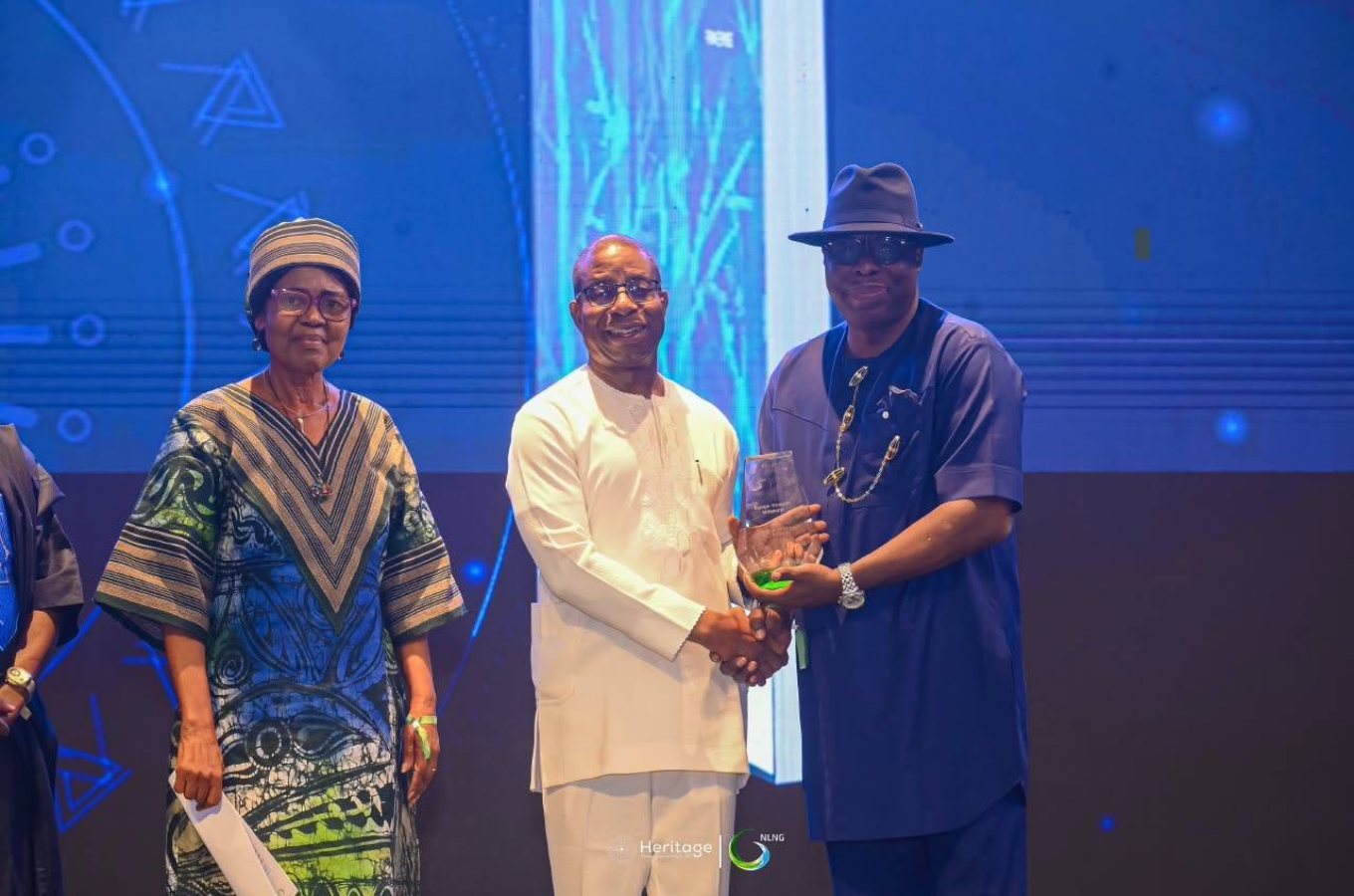
Poet, lawyer, and activist Ogaga Ifowodo has won the 2026 Nigeria Prize for Literature for his poetry collection Why Does God Need a Gun?, taking home the $100,000 prize. The winner was announced at NLNG’s Grand Award Night in Lagos on Friday, October 9. According to LightRay! Media, the collection, published by Masobe Books, was selected from 223 entries, a figure the Energy Focus Report also confirms.
Prof. Akachi Adimora-Ezeigbo, Chair of the Prize’s Advisory Board, described the book, as quoted by LightRay! Media, as a sensitive portrayal of religious and political violence in Nigeria, told through the voice of an imagined victim. That voice belongs to the title poem, “From the Forest of a Million Demons (Leah Sharibu Lifts the Veil),” which forms the spine of the collection and imagines the captivity of Leah Sharibu, the Dapchi schoolgirl abducted by insurgents in 2018. Brittle Paper readers can read six excerpts from the poem here, shared by Ifowodo when the book was first announced.
The win follows a three-stage race. Eleven collections made the longlist in July, and in August the shortlist narrowed to three: Ifowodo, James Ngwu Eze for Unbind Me Now, and Tares Oburumu for Flora’s Love Colony. Ifowodo had been in this position before. BusinessDay notes that he and Tanure Ojaide were both finalists for the prize in 2017.
In September, Brittle Paper spoke to all three finalists in “What Does the Poem Say About Nigeria?”, and Ifowodo’s answers are a useful guide to the book. Asked what it means to write poetry in a country that keeps giving its writers new reasons for alarm, he said the Nigerian writer is required “to be even truer to her calling: to pay closer attention to her immediate environment and bear witness to what she sees, feels, hears and harbours in her soul.” On what happens to a society when violence becomes ordinary, he warned that “the greatest danger is becoming so accustomed to violence that we unconsciously slip back into the jungle from which we emerged,” adding that “the writer must stand against the normalisation of violence.” He was equally clear that urgency doesn’t excuse weak craft. “The medium saves it,” he said. “If one remains true to the demands of poetry and art, one avoids the pitfall of mere agitprop writing.” And on whether poetry can imagine a different Nigeria, he answered, “When the poet affirms presence where power demands absence, subjectivity where there is subjection, and resistance where there is surrender, poetry is already imagining and perhaps enacting a different Nigeria.”
Ogaga Ifowodo trained originally as a lawyer and earned his MFA in Poetry and PhD in English from Cornell University. He has published six books of poetry, including Homeland and Other Poems, which won the Association of Nigerian Authors (ANA) poetry prize; Madiba, winner of the ANA/Cadbury poetry prize; and The Oil Lamp, winner of the ANA/Gabriel Okara poetry prize. His collections A Good Mourning and Augusta’s Poodle were both previously nominated for the Nigeria Prize for Literature, an award he later won in 2026 for his collection Why Does God Need a Gun? LightRay! Media adds that he was detained in 1997 under Sani Abacha’s military regime for his pro-democracy work.
The same night, the inaugural Nigeria Prize for Creative Arts, a new $20,000 category for documentary filmmaking, was awarded jointly to Peter Oghenetega Oke for Beyond Tarkwa Bay and Feranmi Abiola for Mara Mania. The winning films were chosen from 98 submissions, according to the Energy Focus Report. Joel Kachi Benson, Technical Adviser to the Advisory Board for the Creative Arts prize, praised the five shortlisted documentaries for going beyond capturing reality to challenge perceptions and build deeper human connections, and for amplifying voices that are too often unheard. NLNG first announced the new prize at last year’s Grand Award Night, where it was described as open to Nigerians aged 18 to 35.
The Nigeria Prize for Literature, sponsored by Nigeria LNG Limited since 2004, rotates annually among prose fiction, poetry, drama, and children’s literature, and this year was a poetry year. Last year, Oyin Olugbile won for her novel Sanya.
Congratulations to Ogaga Ifowodo!


COMMENTS -
Reader Interactions