


Abuja wasn’t like Lagos at all. In fact, that was Tola’s first thought anywhere he went, how much it wasn’t like Lagos. They seemed to have switched colonisers the further North you got, from a western British understanding to a vaguely Arabic context. Tola found himself saying Wallahi and Inshallah here, wearing airier clothes, jalabiyas. He pulled self-consciously on his suit.
And also, Lagos was flat, or vaguely flat, no hills. Every summit felt like rising out of the valley onto common ground. Abuja’s hills were comically plentiful, almost insistent: yes, we have hills here, and there and here again. Tola had never understood the difference between a mountain and a hill, both seemed equally just as far. But when he’d first seen Abuja’s crests, cliché as half tubers of yam, he’d known they were hills. There could be no other English word for it.
The suit was not only too tight but warm, and he could feel his perspiration soaking through the layers until they stuck to him. He didn’t know if the dust was a smell or a sensation but that was what Abuja smelt like, even inside this sealed off car, under all that sickly air freshener. A tickle, a heaviness. Would it be so silly to ask the driver to stop so he could get out? So, he could climb a hill? Maybe that was the difference between a mountain and a hill, its surmount-ability.
Tola asked him to increase the air conditioning instead, making sure to comically pull at his shirt to let him know that he knew about the impracticality of his clothes. He was in on the joke. You always beat them to the punch, that’s how you show them you’re self-aware. That’s the price of relatability, of realising people were real, just like hills in Abuja. That seemed clumsy and tenuous but no less true.
The increase wasn’t making much of a difference, he stared out of the backseat window. It was way too soon after his AC request but he wished he could wind it down. He wanted to feel movement, the deceptive speed of a moving car. That’s what crossed his mind on every flight, even the one he took coming here, motion, how much he wished he could crack the window just to feel it, just to make air real. And now he was on the way to the airport, on his way home, back to Lagos, stuck in this heat, stuck in the dust, stuck in this car.
“Where are you from?” the driver asked in the rearview mirror, the rosary dangling from it quietly in the still air. His voice was higher than Tola expected. These were the first words the driver had spoken to him, and he couldn’t help feeling there was an accusation there. In fact, it was the first time the driver had directly addressed him. He’d just shown up with his back door unlocked and not asked where they were going.
“Lagos,” Tola rebutted to the back of the driver’s smooth head, part of his streamlined ageless gauntness which meant he could be anything from in his 30s to his early 50s. Tola therefore didn’t know if he should call him sir. He didn’t like this lack of a solution.
There was no rejoinder from the driver, so Tola asked him why, to fill in the silence, deciding not to add the ‘sir.’
“Why what?” the driver asked casually. While Tola couldn’t fully see him from the backseat, the driver didn’t look stupid, even behind the dark sunglasses he hadn’t taken off once.
“Why did you ask where I’m from?”
“Because it’s as if you’re not Nigerian,” was the apparent answer.
This made Tola laugh in shock, “Ahhh Ahhn. As in how? I don’t have an accent, now.”
“No o. It’s not just your words. It’s your everything sha. You dey waka like the whole world is happy to see you. Like say everyone wish you well.” Tola wanted to make some wisecrack about him not wishing him well, but that seemed to be the driver’s whole point. He bit his tongue.
“So where do I seem like I’m from?” he asked instead.
The driver laughed, “I don’t know. America or something.”
He wasn’t sure if that was meant as a compliment or an insult. Did this make Lagos a little less glamorous, a little more disappointing? He felt somewhat sorry for Lagos. It was all he knew, he hadn’t really been anywhere else, talk less of America. Was it really this magical place of well-wishers? Still? He had an uncle that lived there once and could never go back for some ever-changing reason. He’d been home for a while now, but like everyone else who’d gone away, his uncle too had had to put America somewhere, and for him it was in his language. The sly swear word. The driver would be the ‘motherfucker,’ it’ll be hot as ‘shit,’ that will be another ‘fucking’ hill. So, while he could understand his uncle being so easily made – the obvious answer to the question – Tola didn’t believe he was even on the syllabus.
“Have you ever been to Lagos?” he asked the driver.
“No.”
“Never?”
The driver laughed into the rearview mirror, “It shock you?” The smile, the only defining feature on his face.
“Why?” Tola asked, genuinely interested.
“Why, why? No be everyone want go Lagos,” the driver replied.
Tola immediately didn’t believe him. Everyone did want to go. They might not want to stay but they did all want to come. There was nowhere else. It made him less interesting now that Tola knew he was a liar.
They were no closer to the airport. And looking out, Tola was no longer seeing the trees or the hills or the cars, but space. Like that one viral realtor’s TikTok, “Space, space, see space… space.” All the other places they could have put the airport instead.
“Space,” he said absentmindedly.
“What,” the driver asked, again into his mirror. He must’ve heard him.
“I want to climb a hill,” Tola said almost carelessly as a cover-up.
“Pardon?” the driver’s tone friendlier.
“A hill. Before I go, I need to climb one of your hills.”
“You mean hike,” the driver said excitedly. “Na hike they dey call am. But if na hill you want hike, ba? We get plenty hill for here. Even see your mouth like, ‘hill,’ na rock we dey call am for here.”
Tola felt foolish for assuming he wouldn’t know that word, but he wasn’t going to apologise. Admit nothing. After all, hike sounded like another of his uncle’s words. A fucking hike. But worse of all the driver was taking him seriously, suggesting one of these so-called rocks. Rock also felt too literal a word, a child’s definition.
Tola looked up at the hill, its top now mountain high. The driver’s detours had delivered them to this rock he knew, for Tola to climb, sorry, hike, and for the driver to watch. And as it sloped away from him, hill now seemed too silly a word. At its foot, Tola didn’t feel any further from the airport. His flight was many hours away. Surely that was enough time to climb this hill.
Up close it looked untouched. How does one reach the summit? How does one solve it? He surveyed around for the answer, spotting a walking path trodden by familiarity. The driver was sat on the car bonnet smoking. Even with his impenetrable sunglasses, Tola knew he was watching. He made his way over and didn’t feel the angle. His once shiny brogues, interview shiny, already had a layer of dust thin as film on them. It was simple really, one foot in front of the other, each time just a little out of rhythm, the ground rising up to meet him.
He kept going until he couldn’t feel the driver’s eyes, taking the paths that curved away from his mirrored gaze. The ground was a little looser up here, pebbles smooth as sand, smooth as the soles of his shoes. While he couldn’t see him, Tola knew he wouldn’t be able to hide a fall. His clothes will tell. He took his jacket off, and the hill still felt uncertain under him, hardly solid rock. But he wasn’t going to roll down or anything so cartoonish. Each step just lagged due to effort. The hill was getting so steep that he could reach out and touch it. He stood as straight and as strong as he could and saw there was still more hill and more to go.
He was high enough to see more of Abuja than he’d ever seen, all at once. It was distantly beautiful. Ordered in a way that seemed dead to him. Dead was too harsh. It looked sated, set without him, or anyone else to be honest. From up here, Abuja looked like an answer without a question. Lagos could be the wrong answer, but it felt like it grew around and over its people, always on the verge of being reclaimed, by water, by nature, by other people. He heard the peeling of bells, the smoothing of communal voices getting louder, turning the corner. Praise and worship. Tola already anticipating the familiar transitions. But there was a militant edge to their claps and voices, a stomp in the rhythm. A demand, not a plea.
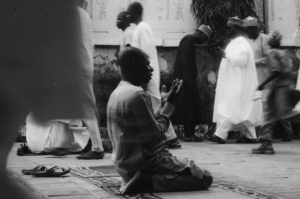
They came to view, smaller than their sound. There couldn’t be more than twenty of them with no uniform. They were so ordinary in their day clothes. He looked at their bare feet that had somehow given enough purchase, the one thing they all had in common. They had decided to follow Jesus, no turning back, and that was all the grip they needed. Their feet on the ground and their hands in the sky trying to make God real. And He was, in the taxi, in the plane, in his interview, so why not on a hill? Surely, they could see him. There hadn’t been a pause in their clapping, no curious furtive looks up to the sky over their shoulders at him. Just their slow march into his gaze, their faces coming into focus. Each distinct, each already forgotten. Their leader, his voice insistently leading the chorus, was a short reedy man whose hands thundered as he clapped against his bible. A rosary similar but bigger than the driver’s swung across his chest.
Was he intruding, his driver one of them? Tola couldn’t spot his sunglasses or short sleeve button up transparent from wash or even his cheap trousers shiny from the iron. They probably didn’t expect a lone climber or maybe they reasoned he too came up here looking for God. Perhaps they didn’t even see him, as an interruption or anything. Or maybe an audience was the point, maybe him being there served as proof to God. But he didn’t want to be a witness just as much as he didn’t want to be American.
In the front seat of the car, Tola had the sense to keep his jacket off this time. His rolled up sleeve resting on the thankfully wound down window, he asked the driver his name as they drove to the airport.
“Simon,” he said, and Tola didn’t like that this gave him no clue of where he was from. Vaguely biblical in an almost anonymous way.
“Shey you reached the top? You were gone for a long time,” Simon said.
“Yes,” Tola lied.
As the vastness of Abuja blurred and Simon’s rosary swayed, Tola sank into Simon’s easy familiarity, his shirt sleeves ruffling in the wind from the car’s motion. He parroted talking points that had always been true, nodded along as Simon listed his scapegoats. That was the secret to being agreeable, you let their yes be your yes and their no be your no. He’d never seen much use in an opinion, honestly.
There was no light in the airport. Tola looked around at all the aluminium, all the panels and recent newness that were already starting to give to time. Lost colour, makeshift replacements, “managing” all around him. Ambitions greater than executions. Why had he booked his flight for so late? Each hour he now had to wait seemed a punishment. One he didn’t want to endure, one he didn’t have to. He turned around and went back outside to the familiar dust, already on the verge of a sneeze, back to the taxi rank.
“Where you want go?” Simon asked.
Photo by victor olamide ajibola on Unsplash






COMMENTS -
Reader Interactions