

I knew it was going to be a long night when the vehicle croaked and coughed black smoke, and the driver wiped his sweaty forehead with the back of his hand and grunted something in the local language. I didn’t speak Kalabari, but I knew it had to be something bad from the way he stressed the words and punched the steering wheel.
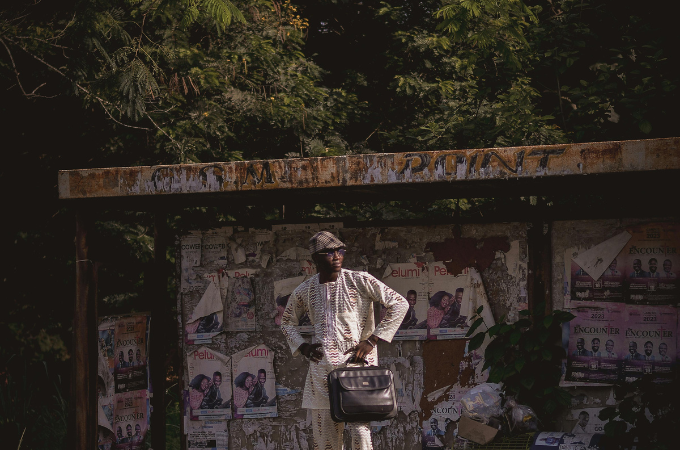
The constant echoes of ‘nawa o’ and ‘see wahala’ and the stoic ‘I think we are going to be stranded here tonight’ — uttered by a white-haired man with dark-rimmed glasses and a brown suit, who looked like the old-school professor type with a newspaper folded on his leather briefcase — filled the air with chaotic anxiety.
He reminded me of a man from years ago, when I was still an undergraduate. The man was the caretaker of the hostel I lived in. Kind man, dark and short, but sometimes strange and quick to anger. He always asked me to buy him a newspaper whenever I was coming back to school. It was strange because he could just find the news on his phone. But then again, I always found a lot of things strange — goats with three kids, people displaying love in public, a madman breakdancing, and stuff like that.
I was the last person to get off the bus. That was me being hopeful; naively wishing the bus would somehow cough back to life and we’d ride down the dirt road and reach the city in time. It was cold outside and very quiet. The road was flanked by dense vegetation, and a slight drizzle, a reminder of the downpour we’d had to endure for the past two hours, continued. Two men stood by the side of the road and pissed into the bushes, a couple of women squatted and draped clothes over their backs as they relieved themselves. It was getting dark very fast — thick dark rain clouds blanketed the sky and snuffed out the pale moon.
I finally stepped out, a stranger in a strange place. The driver was half-buried in the guts of the bus, the smell of oil and petrol swirling nauseatingly in the air. One man stood by him holding a torchlight over his head, the beam directed into the bus. The other passengers chatted in hushed voices. Nobody wanted to say it, but we were stranded in a quiet place, where danger could pop out at any moment. The next town was twenty minutes away, the driver said. He suggested going there to get help.
I fit find one mechanic, time still dey, he said in broken English. But it unsettled everyone. What if this man was setting us up and trying to get his cohorts to come round us up? No, let the driver stay.
Or we can just push the car small, one man suggested. That idea was quickly shut down.
I checked my phone — 15%. My power bank was dead, and my phone was faulty. I’d be spending the night in silence — no music, no texts, no books. Just silence. It didn’t terrify me. I was intrigued by everything. For one, my name was Lucky, and I’d always been lucky all my life. I knew I wouldn’t die here and that nothing would happen. I couldn’t tell this to the others because they wouldn’t believe it, and it’d just ruin the whole magic of it.
I took out a pack of chewing gum from my pocket and walked back to the front of the bus. The yellow and blue paint faded as night approached, and wariness grew in the air. The driver was by the bushes making a call, shouting into the phone for the benefit of everyone trying to listen—they had to be sure he wasn’t trying to get us robbed or kidnapped, and he wanted to assure them.
God abeg! He sighed and lowered his head. I guess help wasn’t coming. I stood beside the driver and asked him what was wrong. He regarded me closely and smiled. I knew why he smiled. See, eight hours ago, before we first started this journey, I’d been the first passenger at the park. I’d sat with the driver while reading a book — Fools Die, Mario Puzo. It was a worn paperback, but I loved it.
You book people sef, the man had said. Abeg buy me Seaman, he also said. I did. I bought him the schnapps. His eyes were red and alive, his body lanky but strong-looking. I knew he drank and smoked, and I knew this was a man who had seen things.
Seeing him now, the way he smiled, I couldn’t help but pity him. This was no kidnapper, and even if he was, I didn’t even care.
I want to go somewhere, I said to him. I’ll be back just now.
He frowned. Where? He asked.
I pointed at the bushes, deep inside. There was a beam of light flickering in there.
They fit carry you go, the driver said with worry. Then he switched to English. This place is a bad place. Not everything is what it is.
I thought about it for a moment and nodded. I know, I said to him. So is everything else.
The driver put his hand in his pocket and took out a piece of kolanut. He bit from it, his teeth crunching it loudly, and offered me the rest.
In case you start to forget, just chew the kola and you will come back. But sha, no waste time.
He dropped the pink bulb of kolanut into my palm. It was smooth with a straight line of brown cutting through the centre, the back side a deep purple.
I closed my hand. Okay, no problem.
The man regarded me again, this time with a slow, sad shake of the head before he sighed. He went back to what he was doing when someone cried out — This man just park us for inside bush!
I moved away from the bus, pulled by something strange… something intense, beyond those flickering lights. The angry voices soon faded behind me, and the world became silent and dark. The air was very cold, and a draft of wet wind blew into my face. After a few minutes, I heard the sound of rain. I stopped and looked around me. My body was dry, and there was not even a drop of water around me. But the sound — the rushing of water, the rumbling of thunder — came to me very strong. It’s raining somewhere. I looked back and noticed a veil of darkness covering the place I’d come from. Not a path in sight, but towering shrubs and bushes and crooked trees with black leaves and birds with red-dotted eyes looking at me.
I kept on walking. The light was still there, growing brighter. The sound of rain is still strong. I wanted to check my phone, maybe call Pearl. See, she’s this girl I really like; the reason I entered road. I haven’t seen her in months now, so it made my heart leap with excitement just thinking about surprising her, seeing her shy smile again, and that sparkle in her eyes.
I met Pearl at her mother’s bukka right beside the compound I stayed in at school. They used to make this hot, creamy yam pepper soup with fat bits of chicken. It was always a hearty meal, you know, especially during that cold harmattan period. When I first saw her — well, okay, she saw me first because I was just sitting alone on a blue plastic chair, silent and not even sure I wanted to eat again — she came to the table and I saw that smile. It wasn’t all those love-at-first-sight kind of things; I don’t even think there was love in that, but she looked at me as one would look at a dear friend. I guess that just pulled me in, you know, especially when you live in a silent world full of echoing emptiness.
Pearl had a birthmark the shape of a cat on the right side of her neck. It was sort of yellow, sometimes brown, and shiny when she sweated in the afternoons — Pearl sweated a lot.
You know that mark looks like a cat, right? I asked her one day. She rubbed that spot on her neck and smiled. Yes, she knew.
Then she giggled and shook her shoulders. I love cats.
I thought about the way she said those words. Me, I hate cats. I find those animals creepy and strange, and almost human in the way they just stood and looked at you. But Pearl loved cats, so I had to change my view. She had that kind of impression on me.
She was taller than me, her skin a glowing, smooth black. Always shining because of the dots of sweat seeping out of her pores. Always in crop tops, Pearl. Her thin waist had three colourful waistbeads around it, jangling and clinking whenever she walked.
The most beautiful girl in the world. Then, I didn’t see her for months, and she stopped taking my calls or replying to my texts.
***
I found the flickering lights. The sounds came to me first — a steady buzzing of voices and the familiar clattering of plates and spoons, and laughter and loud arguments, and the trailing sounds of 70s Highlife playing through dusty speakers mounted on faded blue and green columns. But I think it was the smell that made me walk in.
The place was a wooden shack with an open space filled with blue plastic chairs and tables. Heavy rain poured down around the place, but no one seemed to mind. The rain was outside, and the world inside the bukka was cozy and warm, and filled with the smell of steaming hot pepper soup.
I entered. I ran my hand over a table, pushing away some used plates and swatting away flies. And then I waited. Looking around, I noticed the people filling the bukka — shadows, all of them; silhouettes made out into the shapes of big men with beer guts, and slender ladies engaging them. The people serving the pepper soup floated in the air, their bodies like the perfect contours of young girls.
Then I saw a girl. She came to my table and she smiled. I couldn’t see her face — you know, that whole shadowy thing — but I knew she was smiling. A cat sat on her right shoulder, its tail long and brown and almost a sharp contrast to the deep black of her body. The cat’s tail stroked the side of her neck, and its eyes peered into mine. It hopped onto my table and just sat there.
So, what do you want? someone asked. Soft, playful. Almost shy, that voice. It came from the cat, though. But the girl kept standing by my side, smiling… listening.
There’s this girl. Her name is Pearl. I’m looking for her, I said.
The girl’s smile vanished, and the cat moved back and stood on its hind legs.
Why? the cat asked, eyes glowing green, black slits for pupils.
Why?
Yes, why?
I sighed and looked down. Why was I looking for her? The night before Pearl stopped taking my calls or even answering my texts, we had an argument. It was something stupid. I remember that day because it rained so heavily, and everywhere was flooded.
Can you follow me somewhere? Pearl had asked me, standing outside my door, drenched, holding a black leather bag, and looking afraid.
I don’t feel like going anywhere, I said to her in an angry tone — I didn’t mean to, but I was depressed and angry and hating myself.
I looked at the cat.
She wanted me to follow her to drop something somewhere. She was always afraid of that because her mother would send her to a man’s house alone, and sometimes those men… well, those men can be monsters. She was afraid of monsters. But I didn’t follow her. She said okay and smiled. It was that ‘I understand’ smile, you know. She turned and was about to leave, so I said, Maybe tomorrow?
She only nodded.
The cat set its paws down and circled its tail around the table. The girl walked away and came back with the bowl of pepper soup, steam warping into the air, aromatic.
She’s here, the cat finally said. But you will have to follow me.
I didn’t even look at the food.
But if you follow me, you may never go back, the cat warned gravely.
I dipped my hand into my pocket and took out the half-bitten bulb of kolanut. The cat hissed at it, sort of scoffed. Someone called my name from afar, the voice stretching from the path I came from, filtering through the sound of rushing rain. I looked up and saw a man waving at me, beckoning for me to come. The voice was familiar and rough, but I couldn’t remember it. The cat hopped down from the table, its tail standing in the air, and began to walk towards a door leading to the inside of the bukka.
You will find her if you follow me, whatever your name is.
I knew my name, I wanted to say it. I just couldn’t grasp it or remember clearly, but I wanted to see Pearl. I needed to. I tossed the kolanut into the rain and followed the cat, the voice yelling out to me fading behind.
Photo by Oluwapamilerinayo Ajala from Pexels



COMMENTS -
Reader Interactions