

Each winter in Brussels seemed to settle in more deeply: soaked streets, menacing skies, and the unshakable burden of living between worlds. Conversations about migration, identity, and belonging still echo through Belgian newsrooms and European political halls, yet they rarely lead anywhere. But when I reflect on who we were and who we became, my mind always returns to one vivid, enduring memory: our annual summer drive from Belgium to Morocco.
If epilogue is prologue, then those drives were never mere vacations. They were pilgrimages. Rehearsals of return. A ritual.
Each summer, Molenbeek emptied out, only to reappear pêle mêle somewhere in southern France or Andalucia, reborn as a momentary North African caravan: a procession of packed cars and shared anticipation stretching southward. Different dialect. Same goal: home.
In the gray slush of Brussels, we lived for that journey. The cold, the rain, the indescribable sense of displacement, none of it mattered. Summer held a promise: Tangier. Not just for our parents, but for something buried deep within us that still remembers it from our childhood.
As departure neared, a quiet thrill stirred across Molenbeek and the North African diaspora throughout Europe. It was the great annual summer return from whence we came. It was the moment we told Belgium, au revoir.
School ended in late June, and our old house buzzed with anticipation. My father took his annual leave from the industrial bakery near Porte de Ninove, where he spent long, monotonous days driving a forklift. My mother, ever serene, packed the same simple provisions for the road: hard-boiled eggs, fried chicken, olives, oranges, bread, foil-wrapped cake, and plenty of Douwe Egberts coffee. With six children, including my newborn brother, the food rarely lasted halfway through France. Somehow, the road always made us hungrier.
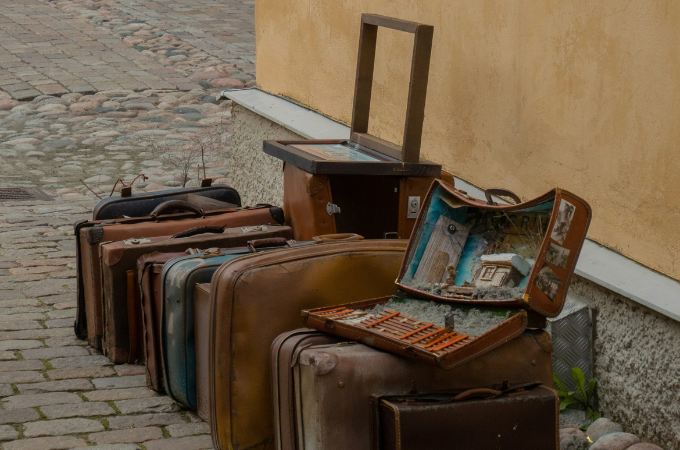
Our weathered 1957 off white Mercedes station wagon, with its unforgettable red on white Belgian license plate, TD 014, and three rows of seats, never let us down. Eight of us were crammed inside: children, blankets, pots, chocolate, and suitcases tied with string.
Every journey began the same way: we set off before dawn, rolling out of Molenbeek along Rue Nicolas Doyen, crossing the canal at Anderlecht, and passing the old abattoir where two fierce bulls stood sentinel atop and on either side of its wrought iron gate. From there, we turned right onto the Chaussée de Mons, bound for Lille via the old Route Nationale long before the Brussels-Paris highway existed. It was the unforgettable summer of 1969, the year humanity first walked on the moon. That’s all anyone talked about. Everywhere.
We always got lost in Paris. My father, proud and stubborn, refused to ask for directions. He’d squint at the signs, muttering under his breath. We circled the Arc de Triomphe more than once before finally finding our way south out of Paris’s tourbillon and toward Chartres and Orléans.
From there, we continued southwest, crossing the majestic Loire River near Blois, a serene moment amid the journey, before passing through the charming town of Poitiers and pressing on toward the rolling hills and sleepy villages stretching beyond the horizon.
France unfolded slowly along the Route Nationale, like pages from a well-thumbed Alphonse Daudet tale. Flat fields gave way to rolling hills, and sleepy villages slipped past our windows like fragments of a dream, lulled by the steady hum of the station wagon’s diesel engine. Often, we were all asleep except for our parents, who kept each other company as they drove further south in the middle of the night.
It is strange to be much older and revisit that time in spirit. It happened, and I remember it clearly, but it also seems like a vague dream.
Sometimes, half asleep, I could feel our old Mercedes drifting dangerously off the road, and I would hear my mother say to my father in a firm tone, “You’re falling asleep, Hamadi, safi! Enough! You need to stop. You can’t drive anymore. You need to rest. We’ll never make it to Morocco if you continue driving like this; you know what I mean.” Even in moments of crisis, my mother always remained calm.
Gas stations became sanctuaries: sardine tins, fries, Coca Cola, Fanta, cheese, and crusty baguettes. At some stops, Edith Piaf drifted softly from the radio; at others, Fernandel’s oversized teeth, always endearing, flickered across dusty café TV screens, filling them almost entirely.
Truck drivers in dark flat caps and grey overalls stood rather than sat, drinking coffee from ceramic bowls. My father, who was not by general philosophy a parochial man, admired them as fellow members of the working class. Kinship. “Coffee cools faster that way,” he explained. “These men can get back on the road sooner.”
For some reason, that detail stayed with me, not because of the coffee in a ceramic bowl, but because it spoke to the lives of ordinary people. My father used to say that countries aren’t defined by salons, scholars, or politicians. They are shaped by humble, often overlooked workers, the working class, like those truck drivers who keep the world moving so others can enjoy its comforts.
The truck drivers were stoic, proud. Like my father and his dear friend and roommate, Si Mohamed. Men whose contributions were overlooked simply because their work wasn’t glamorous. They built Europe. That bowl of coffee became a quiet philosophy: get warm, get going. Go. Serve the people.
We fought for window seats, counted kilometers, invented songs. There was magic in the monotony. We were not just driving to Morocco; we were returning to something we could not name but deeply felt.
My parents were returning to their past. For us, born in Tangier but raised in Belgium, it was more complicated. We belonged, but always somewhere else. In Belgium, we were Moroccans; in Morocco, we were Belgians. That feeling was like a shadow: two cultures, two languages, two homes. Two and two, two parents. Sometimes, nowhere. But that too became a place, a bridge.
We breathed the same recycled air in the car. The smell of boiled eggs mixed with cigarette smoke and diesel. No one complained. It was just part of the trip.
My mother, not formally educated but naturally poetic, gazed out at the endless sunflower fields and murmured, “So many suns.” My father smiled. “Looks like a Van Gogh,” he said, launching into a story about the painter’s madness and genius. He was always teaching, slipping in lessons whenever his mood allowed.
When my father first immigrated to Belgium on his own, he was often the only one in the group who could read and write. That made him the go-to person for other Moroccan men who had arrived in Belgium ahead of their families. He wrote letters for them, messages to wives, children, and parents they had left behind.
My father lived as a bachelor in Belgium for four years before the rest of us joined him in Molenbeek. In those early days, most Moroccan immigrants roomed together to save on costs. Eventually, after finding some stability, many brought their families to join them.
During that time, my father shared an apartment with Si Mohamed, a quiet and deeply intelligent man. Over the years, their bond grew stronger, rooted in trust and shared experience. Their story began in 1964 and endured for half a century until my father’s passing.
When he died in 2014, Si Mohamed came to our home in Tangier to offer his condolences. I had grown up knowing him—calm, self-effacing, and stoic, much like my father and many of their generation. He did not cry, but I could see how hard he fought not to. He said to me, “Your father is not dead. You have the same voice. He lives in you and in all those he touched.” Then, Si Mohamed fell silent. After a long pause, he added, “In your father, I found someone who stood by me through everything,” he said, his expression dignified and composed. It took great strength to suppress his emotion, but he did.
I admire Si Mohamed, a salt-of-the-earth man, another unsung hero who, alongside my father and countless others, helped build post-war Belgium. In these strange and uncertain times, their story feels even more profound. In the early days of our arrival in Molenbeek, Si Mohamed and his family became part of ours.
It’s important to remember this: in the beginning, for most of those bachelor men in Europe, immigration was meant to be temporary. The plan was to go for a few years, earn some money, and return to the homeland to open a business or buy land. No one wants to leave their land. I remember my father saying he’d go to Belgium, work, save up, and come back. But life, of course, takes its own course. And eventually, we all ended up in Belgium.
During those early years of immigration, my father shared a modest apartment near Porte de Ninove with Si Mohamed. Bound by mutual respect and a deep sense of justice, the two of them turned their small home into an unlikely refuge for a steady stream of illiterate Moroccan workers. On weekends, these men would knock on their door, asking for help writing letters to families they had left behind in Morocco.
My father, who had a way with the written word and a patient ear, would do the writing. Si Mohamed was almost always present—quiet, attentive, never one to interrupt, but never missing a detail either. My father liked having him nearby when men came to correspond with their families. Together, they formed a kind of Moroccan Holmes and Watson. Not detectives in the traditional sense, but a perfectly balanced duo, decoding the tangled emotions, half-truths, and raw confessions of men struggling to stay mentally afloat in a foreign land.
They recorded those emotions with care and respect. And in helping others, they helped themselves—not only by momentarily forgetting their own problems, but by feeling the quiet reward of doing something good. No fee was ever involved in the letter writing.
Years later, when my father would recount these episodes, I could never quite tell who was Holmes and who was Watson. They complemented each other so naturally that the distinction didn’t seem to matter.
Some of the stories they heard were tender, others drifted into the absurd. But one stood out for its striking crassness and total disregard for tact.
A man once came to them with a simple request: to write a letter to his wife and children in Morocco. My father agreed and began writing, while Si Mohamed sat silently, listening as the man poured out his heart. Just as he was finishing the letter, the man’s tone shifted. He leaned in and asked, “Can you write a second one?”
“For who?” my father asked.
“For my girlfriend,” the man replied casually. “I have one on the side in Marrakech. Desperate, you know.” The man clearly didn’t know my father or Si Mohamed. Without a word, the two men exchanged a glance and stood up. My father quietly tore the letter he had just written in half.
“Find someone else to write for you,” he said.
The man, startled, tried to offer money to smooth things over. That only deepened the offense. Si Mohamed, angry, opened the door with a calm but firm hand and said, “Get out!” And that was that.
Later, when they both decided to bring their families to Belgium, my father and Si Mohamed rented a house by the railroad track at West Station together, at 201 Chaussée de Ninove in Molenbeek. It was in that house that we children grew up and became close friends with Si Mohamed’s sons. The bond between our fathers extended naturally to us, not just as neighbors under one roof, but as a kind of extended family, shaped by shared history, values, and the quiet strength of their friendship.
A well-known North Moroccan musician, a contemporary of my father, occasionally toured Belgium in the early 1970s, bringing the sounds of Morocco to rented venues across Brussels. My father, an amateur oud player, always attended his concerts and knew him personally.
They partied together, smoking, eating, singing, and talking. The musician enjoyed the occasional beer; some of the men enjoyed the occasional kif. During one of their get-togethers after a concert, the musician joked to the group in his inimitable Tetouanese accent, “Brothers, stop smoking kif. You should drink beer, it’s better for you.”
The remark, absurd on its face, drew laughter from the group. They were all Moroccan Muslim men, fully aware that both alcohol and cannabis are forbidden in their religion. The irony was not lost on them. Their gatherings often ended with a sincere and earnest refrain: “Merciful God forgive us, we are weak.” They believed in God’s mercy, and it was that belief that allowed them to navigate the contradictions of their lives with a kind of spiritual grace.
Though usually serious, my father liked to share this story, revealing a lighter, self-deprecating side and the contradictions they all lived with.
Near Poitiers, something happened that became family legend. I was the original Home Alone kid.
We stopped at a crowded open-air market. My parents bought apples, bananas, and oranges. In the swirl of color and noise, I got separated. I stood still, trusting someone would notice. They didn’t. The car drove off. But I wasn’t quite sure.
Ten kilometers later, someone asked where I was. My father turned back in a panic. When he finally found me, I was still at the fruit stand, watching people pass by. He knelt beside me, breathless. “We left without you,” he said. That was when I realized something profound: not that I was afraid, but that even the strongest man I knew could falter. His hands trembled. His voice cracked. I had never seen that before from my father.
“What would you have done if I didn’t come back?”
“I would have gone to the police.”
He nodded. “Good. Good.”
That moment became a turning point, a reminder of how easily we can be lost to each other.
For years, the family joke became:
“Where’s Mohamed?”
“In Poitiers,” someone would say, and we’d all laugh.
My father was once a union activist in Tangier, working shoulder to shoulder with his older brother, Hadou. He was an orphan, self-taught, multilingual, an oud player, and a partial memorizer of the Quran. In countless ways, he was a brilliant man. Yet in Belgium, he scrubbed machines and hauled sacks for men half as capable. His name and accent made him invisible. He never complained. He endured. “All work is noble,” he’d say again and again.
But I saw the toll, the structural injustice. Being supervised by men less kind, less qualified. The racism was quiet but constant. He knew his place in Belgium’s hierarchy. It was made clear at every job, every form, every glance. Yet he carried himself with dignity. He refused bitterness. He was not a victim; he was a survivor.
Today, on this Friday in September 2025, I regret to say the patterns persist. The names may change, but the outcomes remain the same. Accent. Religion. Skin. Still the standards by which judgment is passed. We tell ourselves we’ve evolved. But the truth is, we haven’t. Or not enough. Not enough to live up to what Dr. Martin Luther King envisioned: a world where people are judged not by color or creed but by the content of their character.
Plus ça change, plus c’est la même chose.
Night fell before we reached Spain. We slept roadside; our makeshift Hotel Charlie. My father and siblings under the stars. My mother and the baby inside. At dawn, he rose, faced east, and prayed by the roadside. Confused French drivers stared. Then: baguettes, cheese, maybe dates. No coffee. Back on the road.
South of Madrid, the N-IV — known and understood as “Inee-Ovee” — became a caravan of cars like ours. Families from Belgium, France, the Netherlands, Germany, Sweden. Each vehicle a packed memory: blankets, bicycles, plastic containers tied with rope. For a brief time, we became a moving village. Waving across lanes. Sharing bread and glances.
The road had a way of bringing people together because we were all doing the same thing. There was a quiet joy in seeing so many families with the same purpose, the same hope reflected in their tired but eager eyes. Our family was bound for Tangier, but many of our compatriots had much farther to go: Fes, Meknes, Casablanca, Marrakech, Agadir, even the tucked-away villages hidden deep in Morocco’s mountainous backcountry.
There were dangers on those long roads: stories of travelers robbed in remote stretches were not uncommon. But in that rolling and intermittent caravan, we found a kind of protection in numbers. It was unspoken, but understood: together, we were safer. The presence of others — familiar faces at gas stations, shared nods on the highway — was comforting. More than just company, it was solidarity. We weren’t just passing through, we were part of something larger. A collective return. A fellowship of the road.
This wasn’t just travel. It was migration of language, of longing, of belonging. Europe was distant, but not so far as to sever the roots of origin.
At a gas station near Ocaña, something beautiful happened. Moroccans rested in the shade. Some prayed. Children played barefoot on dusty grass. I joined them — soccer kicked between strangers. French boys joined in. For a moment, we were just kids. No borders. No barriers. Just joy. It was fleeting. But it stayed with me.
The closer we got to Morocco, the lighter we felt. My mother told stories as she repacked the bags. My father was more talkative. We searched the horizon. And then it appeared, white and low against the blue sky: Algeciras.
The port was chaos. Vendors shouting. Luggage heaving. Families reuniting with tears. We boarded the white and yellow ferry Ibn Battuta and found seats on the open deck as the Spanish coast and the Rock of Gibraltar faded from our view. We were just travelers passing, like so many before us have done for thousands of years in this part of the world.
Then: Morocco. First, Jebel Moussa on the horizon. Then the harbor. The giant crane — Titan — towering over Tangier. My mother exhaled. My father smiled. We had made it. And something inside us settled.
What once took four long days now takes less than thirty hours. But something is missing. The long road made us feel the distance in the time as we experienced it then. Morocco felt far, so far that arriving meant something. We learned by doing: the journey mattered as much as the destination.
Today, people still make the trip. But now it’s done with speed. And speed doesn’t let you see — or feel — the road. Or the people along the way. We have become strangers to each other, buried in phones, detached from the passing world. They call that progress. But it feels like another world entirely. And maybe another people altogether.
Often, whether I’m in Tangier, Brussels, or Boston, I feel like a stranger, as if gently deposited by a long-ago storm. Perhaps that is the traveler’s fate. Ibn Battuta once said, “Traveling — it gives you a home in a thousand strange places, then leaves you a stranger in your own land.” I understand that feeling. I’ve found homes in many places, only to realize that home is not a place at all, but a moment in time. And if that’s true, perhaps you can be at home anywhere because, like the universe, it is within us.
The long journey to Tangier was never just a drive. It was a return. A remembering. A quiet, persistent assertion of who we were. My family and I were not just immigrants traveling in a crowded car. We were threads in a larger story of stories, woven through exile, return, and everything in between. Simply, humans.
Even now, as a grandfather walking Brussels’ rainy streets, I still carry those long-ago summers with me. They remind me of where we began and how far we still have to go.
At summer’s end, the return from Morocco to Belgium always carried a trace of melancholy. But over time, that too began to change. Belgium, with its bewitching duality, held on to us like an unexpected lover we never meant to fall for — but did.
Goedendag, België.
Bonjour, Belgique.
Photo by Marius Girard on Unsplash


Clerveus aravna November 08, 2025 08:20
Good