

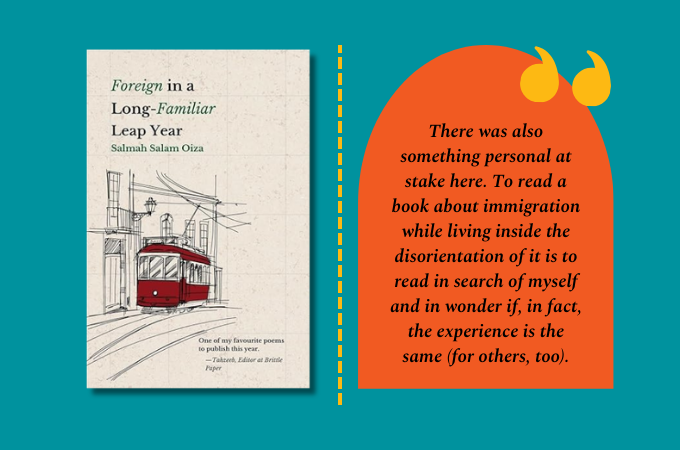
I just finished reading Salmah Salam Oiza’s debut poetry pamphlet, Foreign in a Long-Familiar Leap Year, and I have a lot to say.
As a recent immigrant — a japa’d, as they say — I was looking forward to this collection. What drew me to it, beyond the subject of migration it promises to explore, was a recent encounter with Salmah Salam Oiza’s work on Brittle Paper. The work in question, January Is a One-Way Ticket (also the opener to this collection), stayed with me long after I’d finished it. Naturally, I was curious to see whether an entire collection could sustain that same intensity, or whether the strength of the individual poem would thin out over a longer stretch.
There was also something personal at stake here. To read a book about immigration while living inside the disorientation of it is to read in search of myself and in wonder if, in fact, the experience is the same (for others, too). I knew I had to approach it not only as a reader, but as someone standing at the threshold of elsewhere, wondering and asking, ‘again and again what it means to begin, to endure, to return, to become.’ Then, right from the Note to Reader, I get a sense of why I might relate to the poems in there.
I blame Netflix. And the friends who said, “just go, have fun, worst case you’ll come back with stories.” I thought moving abroad would be a magical production. Snow, Christmas lights, themed festivals, a tall lithe man bumping into me at a winter market, followed by an extraordinary journey of love, self-discovery, and glowing skin. Immigration, it turned out, was none of that. Rude, wasn’t it?
Oiza describes, in many different ways, what I have come to recognise as my current disposition. I felt seen before I even turned the second page. So, there I was, book in hand on a bus ride to work, crossing my legs in that small ritual of readiness, pulling out my pencil and highlighter, I took a deep breath like a diver before submerging into the deep blue, and surrendered myself.
January Is a One-Way Ticket
This is a strong way to open the collection. If Tahzeeb Akram said this was “one of [her] favourite poems to publish [in 2025],” I understand why. In nine well-crafted stanzas, readers are invited to share the emotions and journey of a voyager on her way to an unknown land, laced with uncertainties.
There is a foreshadowing in stanza 1’s lines 2-5, and stanza 3’s lines 5-6:
Three lies told before dawn—
I swear, I won’t cry
I promise I’ll call from London
This doesn’t mean forever
[…]
What’s left of that country, she says,
will wear you thin
And this prediction of the foreboding is encountered in later poems (like “Mother Calls On the 29th”). Hence, the opening poem plants an emotional seed whose roots spread throughout the entire collection, and this is why it succeeds so powerfully as an opener.
Additionally, Oiza manages to give us a setting and atmosphere throughout the poem. From Abuja, “the tail-end of a prayer fraying through mist / a woman in rollers coaxing flame from coal / a plastic chair titled from last night’s goodbye,” to on board the airplane, “three rows down come a wailing baby / an airplane full of spectacles and second guesses,” and finally to Heathrow “a slick cathedral of runway and ice.” This feels grounding. It gives reality to the piece, and with this knowing that it is not some abstract situation described, comes a closeness that the reader feels with the persona. Then the reader becomes complicit in the ache that will follow long into the journey.
Once this poem picks up its momentum from the very first line, it keeps rising, reaching different emotional highs like “over Chad” when the persona “[wants] to scream / Wait! / I think there’s been a mistake” or “By Algeria” when “[she] rehearses [her] reasons.” The only place I find this force declining is in the last two stanzas when the writer tells us about the last mint tea that wasn’t packed and later addresses ‘the reader,’ or I suppose people who usually comment on japa chronicles as not being ‘that deep.’ While I get why those stanzas are there, I feel they water down the great build-up from the preceding stanzas.
This is Why I Hate February:
In this poem, there is a clear creative use of juxtaposition, and I love it. I like the comparison of February and its indecisiveness to the lover Basquiat (and I hope I am right), which is fitting because February is also supposedly the month of love. This is realised in stanza 4, lines 5-6, “The street is red / but I feel blue,” the ‘red’ alluding to the colours of Valentine’s which fill ‘the street.’ She also successfully uses colours to evoke organic imagery—red being the colour of romance, and blue being that of melancholy or sadness. I enjoy the fact that we are made to believe we are reading about the weather in February and how it makes the persona feel. However, we witness a possibly failed love story and eventual heartbreak. That is conceit in its beautiful, magnificent self. It is here, in this realisation, that I start to form my opinions about the writer.
Mother Calls on the 29th:
This is one of my favourite poems in the collection, and if you haven’t realised yet, the poems highlighted in this review are some of my favourites. What you don’t see here, perhaps, didn’t make as much impression on me. Anyway, when I first encountered the poem on the pages, I had words like structure, form, style… stylistic analysis looping around in my head, and I knew it was a good sign. I have always made known my love for intentional poems. Poems that have clearly been moved around, earned their white space and line breaks. I love it when the visual arrangement of a poem is already in conversation with the subject matter. That is what this piece does. And you also see this in poems like “Spaghettification” and “October: A Portfolio of Lies.”
Beyond that, I also love how the piece laid siege on me. I didn’t expect it to be so devastating, so haunting. Maybe it hits too close to home because I pictured my mother and I having this same conversation. The poet does such a good job conveying the emotions with deliberate use of diction. There is a progression from hope when the mother calls, “so when do you come back home?” to hopelessness nestled in loss, “say it / that i may start grieving,” to an understanding and making the hard decision to let go, because she knows that is what is best for the daughter.
I enjoy the cultural and liturgical imagery. This feeds into the warmth of home that the mother brings on a plate and offers to her daughter, “But here, we held you / here, we prayed you into existence,” and the effect of that adds to the emotional core when the daughter reveals that she may not be returning. It hits deep.
May, as in Maybe:
This poem captures the dilemma of almost every immigrant, the paradox that is this life of living in another person’s land—the promised land. This is well-knit in stanza 2:
May, as in maybe I wanted to go,
but clung to what felt most secure.
Where nothing bloomed, but the ache to bloom.
Maybe I’ve learned to lie,
and called it for peace.
Most immigrants have — I know I have — more than once, when things got really hard, contemplated packing their bags and heading home, a place that wouldn’t churn them out. But then you get reminded of your dreams, the possibility of this being the most ‘secure’ choice, even if it takes everything from you. Even if you it for peace. Even when it breaks you. Oiza, through this poem, presents this paradox and lets the reader sit with it, without the need for a choice on ”his half-lived life / tender, almost-when.”
June is for Leaving:
This is one of the most exceptionally written poems in the collection. And I say this based on its craft and literariness. Reading this piece, I am suddenly teleported to one of my many literature classes in high school and university, a Wordsworth or a Shelley or a Senghor or an Awoonor poem in front of me, peeling them apart, layer after layer, stanza by stanza, line by line, each punctuation accounted for, each word considered thrice, searching for the meaning behind the meaning, each literary device noted.
And here, I attempted some peeling of the first stanza.
yet London once groaned
beneath sun’s amber lash (Stanza 1, lines 2-3)
London is personified as a suffering body. ‘Groaned’ makes the city vulnerable. London—culturally imagined as grey, temperate, rain-soaked — ’once’ endured unusual heat. The word ‘once’ is crucial: it implies rarity and abnormality. The phrase “sun’s amber lash” is striking, ‘lash’ evokes violence and ‘amber’ softens it with beauty. The heat is both brutal and golden, discomfort aestheticised. Which then links back to the opening line, “How absurd to complain of swelter.” That self-rebuke to complain about the heat in Florence establishes a tone of mild shame.
now Florence scalds my
lips with citrus juice (Stanza 1, lines 4-5)
The pivot to Florence marks both a physical relocation (or, as I think, does the job of telling the reader we have been in Florence from the first word and not London) and a tonal alteration. The heat here is no longer punishment. It becomes intimate and embodied: ‘scalds my lips’ brings sensation into the mouth. Then ‘citrus juice’ introduces taste. So, the violence of ‘lash’ (as told before) transforms into sensual touch.
each piazza a chalice
brimming with laughter (Stanza 1, lines 6-7)
Here, the ‘piazza,’ which is a public square, becomes a ritual space, a ‘chalice.’ In this comparison, the poem sanctifies everyday life. Heat in Florence, thus, fills communal spaces with vitality. Laughter becomes the ‘wine’ of this secular sacrament. And I think each tourist in places like that feels it.
Generally, the lines in these poems are rich and beautifully worded. In some sense, and this is not a criticism, it procures the form of an English poem as opposed to many of the poems in the collection that you could tell were from an African poet. Now, this is not an invitation to go into the debate on whether or not there is such a thing as African poetry. It is merely a literary observation. The fact that this piece is draped in ‘foreignness,’ perhaps, is because the poet, at this stage, is settling into this new culture, the assimilation already happening. And it happens. Your tongue changes. You, somehow, do not think in the language of home. The persona is changing, which fits perfectly into the themes of the collection.
The Turning:
By the time I made my way through this poem, my earlier resolve about the poet became conclusive. Salmah does know her way around poetry. Unlike some of her contemporaries, she doesn’t just operate on vibes and free verse. In a time where people often mistake laxness in poetry for depth, she reminds us that control can be just as intoxicating as freedom. That free verse doesn’t also mean free of poetic depth.
There’s Almost Never Snow in December:
This poem mimics the form and structure of “January Is a One-Way Ticket.” It is a full circle moment once the reader realises this. I didn’t until halfway through the poem. So, I flip back, and then I see what the poet has done. Again, this is what I mean when I talk about intentionality in poetry. I do not know the creative process behind having the collection end the same way it began, albeit being in sharp contrast and juxtaposition. That is peak William Blake. With that structural decision, it is clear that a journey has taken place. That there has been some metamorphosis. You feel the trajectory of change, and it helps bring the overarching concept of the collection together.
I went into this book knowing that one does not write a poetry collection about the same subject and/or themes without risk of repetition. A collection can easily collapse into thematic redundancy. But this poet side steps that, and I believe the structural decision to chronicle the journey through months greatly contributed to it. No two months are ever identical. Again, the opportunity presents itself in the fact that this is about migration — there are so many things that can happen in such a journey. You never read a poem and feel like you have read it before — not even the first and last poems, which mirror each other in form and style.
In the end, these memoir poems offer you a seat in the poet’s journey from when she was this anxiety-laden young lady dragging her bags in Abuja, to this person who [becomes] fluent in survival / eating sandwiches in moving vehicles / carries umbrellas, a Tesco club card / an ugly brown scarf [which] knows [her] throat.
I cannot wait to see what Oiza does next. I believe she has what it takes to be one of the important voices of contemporary African poetry. There is evidence in this collection that she has a good understanding of poetics. And that is what sustains a body of work — an understanding of craft, and the discipline to honour it.




COMMENTS -
Reader Interactions