
“I have learned and dismantled all the words in order to draw from them a single word: Home.”
Mahmoud Darwish, Palestinian poet and author
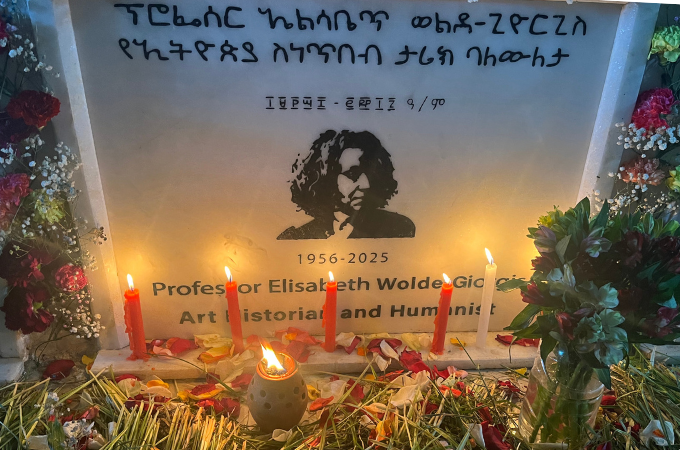
You would not have disapproved of your new home. The early morning sun streams through the open window at pace with the murmurs of Qidasse from the adjoining church. You would have liked that Teferi lies a few steps away – you had sent me a link to a tribute concert for him when he died a few months before you – “beautiful jazz for Teferi,” you had captioned it. Another loss in a year like none other. I see a former TV personality buried close by too, and I almost reach for my phone to tell you. Further afield is the grave of a former colleague of mine, dead from cancer in his twenties. I tell you about him, and I can hear in my head your sweet, “ኸረ?” part compassion, part gossip.
You would have been in nodding acquaintance with a few of your new forever-neighbors, and I was relieved to see that there was no one buried in this long room of a funereal neighborhood whom you would have disliked. You could turn your nose up at anyone you thought was silly, and you could swear down an Addis Lada driver. “Here comes the Nazareth School,” I used to tease you, “and here was New York.” Blunt to the core, but you never held a grudge and could not understand the simmering resentment of many a male colleague. “ሽማግሌ እኮ ነኝ!” you would quip, comically confusing the terms for female and male elderly. “She wasn’t even nice,” I tell myself now, a useless attempt to dull the echoing sadness of your loss. But you were good to me, if not always, then when I needed it.
I think of you every single day.
I rummage among my memories, of your smoking pipe, expensive perfume and distinctive expressions, to find in your voice a “ምን ይደረጋል?” – “What are you going to do?” – to help myself get over this recess of grief. I haven’t started to really miss you yet, because I haven’t figured out that you are gone.
“ላለው ይጨመርለታል፣ ከሌለው ይወሰድበታል።” – “Those who already have little lose what they have,” grumbled the candle seller outside the church as she rummaged in her purse for my change. She was complaining about her lot, but she could have been talking of my loss lying right here in the church compound, I said to myself. I feel robbed of the one sister-figure that I had. You grew up with sisters, so maybe you don’t know what it meant to me to gain one in my thirties, and the magnitude of becoming un-sistered now, nearing fifty.
Alone again, I said to myself when you died. Bereft and un-moored. The first time that I had told you what my marriage was like, you had called the next morning to say that my words had kept you up all night. I felt cared for, less alone in the world. You had taken it upon yourself to monitor my healing since, noting on any weight loss, or a new outfit. “You look good, my sister” was a consistent refrain of yours. You would now have laughed at my tears; your laugh part derision and part joy, because for all your sophistication, you loved being loved. You basked in the well-earned affection of people you loved back.
I had been looking forward to a talk by a well-known artist from the diaspora, and I was happy to attend it a few Saturdays ago, late as always and miserably cold but there, nevertheless. She was eloquent in pristine Amharic that betrayed limited contact with our messy current realities. As she spoke both of a harrowing youth in Ethiopia and of critical success in the arts in Washington DC, her voice dulled in my ears as she meandered to the many instances where you must have interacted. She spoke of your person too, him of international acclaim but dead now over twenty years, never mentioning you. You had been gone for four months, and I expect public events to at least acknowledge your absence, but there was none here, only dirt thrown over your contribution and your spirit, and me in the back, smarting over the dimming of your light.
I left the talk in pain deeper than I had been carrying, throwing a glance at the speaker as she received her flowers, resenting her, quite childishly. I hated that she had stayed so pretty, although she must be close to your age, and even though you had taken your unlined skin and perfect white teeth to the grave, you had never aged. My mother, surprised that you were nearly seventy when you died, had said, “ባል ስላላቃጠላት ነው?” – “No husband wore her out, huh?” Then, to only limit her own wit, “Don’t tell anyone I said that!”
I would have only told you. I would have loved to call you after the talk, and to complain that no one had acknowledged your departure, although I knew that the speaker was a frenemy at best, and that you had snubbed her on her last visit. You had complicated relationships with women of comparable achievements while you were unreserved in your support of strivers. “Forty is not young to start publishing,” was your kind greeting of my milestone birthday, and I had taken the message to heart. Your unreserved happiness at my small achievements had lit me up from the inside, amazed that you viewed our contributions on a similar footing. You taught me so much of the big things in life, of literature and modernism, while I taught you the less celebrated arts, of mothering a child wired with magic, of endless patience that you came to realize was strategic all along, and of fortitude that often surprised you.
You picked every single one of our arguments. You had screamed in my ear after reading Adam Retta, your rage suddenly feminist at his portrayal of women, and I had laughed, “It’s just words in a book, Elsi. He humanizes his whores.” I tried to cut the conversation short to get back to my daughter’s tennis game, but you would always be heard. “I will not be rage-baited again,” I would promise myself when I felt a storm coming, but you demanded a stand. Everything was personal to you, and good prose often meant more to you than humans with their capacity to disappoint, to fail you. You had adored Darwish, with his words ever more poignant in the year before your death, and when I picked a hard copy of Ocean Vuong’s first book a few days ago, a rare treat in Addis, all I wanted was to read you a passage. You would have closed your eyes at the scene where the character’s mother, a humble manicurist, massages a client’s phantom leg after she removes the prosthetic one, with no questions asked. You would have sighed at the aching sensitivity of the story, and at the spare choice of words, with your permanent soft spot for the immigrant narrative. You went to battle over storylines, and over art which you deemed colonized, and on another occasion, I had you reduced to a sputter at my defense of a new author whose work you had just critiqued. Even when we couldn’t stop fighting though, we could always settle on the irreplaceable idea of home. We shared a deep love for our country, Ethiopia the parent when siblings could find nothing else to bridge their differences. Home that for you, was rooted physically in a ninety-year-old house.
I felt defeated by the talk on that grey afternoon, and after it ended, I drove by your old home to remind myself that it too is truly gone. I got disoriented and passed the hill it had looked down on in Kes Sefer, a lonely expanse now where a vibrant community had once lived, on land given to the clergy by the Emperor. The stump where your house had once stood proudly reminded me of the phantom leg in the Vuong story, a gaping hole flanked by what was once living. They took away your home to build a wider road, Elsiye, an ugly new road terraced by pseudo-modernist art that you would have hated, and you died of sadness. Unwilling to leave the home of your birth if not on your own terms, if not to never come back.
Thank you, እሺ? ኤልሲዬ I had murmured out loud, sneaking a hand to touch your coffin, clad in the deepest purple, on your final journey home. I immediately lost my bearing when it left my sight, somehow finding a ride to the service but morphed into a little girl again. Alone on the playground with her sister leaving her behind, perhaps for a larger purpose, to a better place for sure. You had held doors for me to enter places where I didn’t trust my footing. You had bullied and hollered until I was included, and when I had been hurt at deliberate exclusion, you had listened patiently until I was spent, and delivered a perfect response. They did it to me too. No condescending lectures from you, just a clear line of empathy that it happens to the best of us.
I’m a natural flirt, but the smile sours on my face as I remember that you didn’t like a well-known poet and author I recently ran into. I tell him he looks good, but then I remember that he didn’t attend your service. While I make vague coffee plans, I know that I concede. Your people will be my people, as the biblical phrase goes. You win. A man I had once defended to you and called a friend, I will now shun. You are gone from me, so for now, I hold on to your grudges.
To this day, I write to impress you. I will read over a particular phrase and wonder what you will make of it and then shrink in shame when I remember that you’re not here to read it. To tell me that I write beautifully, or to let me know that it’s utter shit and that I need to do better. “What’s wrong with you to write this garbage when I know you can do so much better?” you would have said. My sentences run-on unchecked.
በጉዴ ወጣሁ I would say to you now in Amharic. I am naked in my grief.
የምነግረውም የለኝ። No one to tell, no way to really explain the way the fissures show, like the hairline cracks on the walls of your old home. I missed her today. Elsi would have loved to meet you. We would have argued over this. Un-sistered me, navigating my way to the loss of you.
Even this piece here – you would have scoffed at ‘homage’ – I wonder what you would have made of it. I’m reaching for Amiour standards, of course, another essay on love and loss and one that I had been embarrassed to show you after its publication three years ago, for it to only send you into a tailspin. You read it out loud to friends who didn’t even know me, and you started a WhatsApp group to dissect the words, the tone. Amiour took on a life of its own because you willed it, because when you loved something, you elevated it.
If this gets published, I tell myself now, it will make my last email to your address. Better yet, I’ll print it out and take it your new home, as I play Teferi’s music on my phone. I would bring the white church incense that you had always burned at your old house, and the Peruvian lilies that I used to bring you. I will read you the words on these pages. I would cry again, and I would leave the paper at the foot of your grave. Your new home. May it become truly yours, Elsiye, and may you never again lose another one.
May you finally be at peace.
Image from pixelshot



COMMENTS -
Reader Interactions