
I hate being in the market, which is probably the most un-African thing I have ever said. As a black girl, voluptuous, with unruly hair that defies whatever Sir Isaac Newton was on about, this should not be an opinion I hold so deeply.
But I do. Soko demands too much of me, from me, bringing things to the surface I had no intention of uncovering in such an open-air environment.
I have tried to tell myself that it’s fine, that I can take this as an opportunity to step out of the shell that I call my house, that there, the concept of community will embrace me tightly, giving me the warmth I so desperately seek, lakini wapi? Instead, I find myself shopping in bulk, buying enough to feed a little army of pre-schoolers, preferring to watch the vegetables wilt and rot slowly from disuse, disgusted at my own waste but preferring this over having to go there again and again.
See, the thing with community is it strips you naked. It forces you to be as you are, so when the lady I buy tomatoes from asks me if I’ve been okay, with the kind of inquisitive care in her eyes that reminds me of a parent’s, I cave in. The smile I had plastered on so hard it hurt my cheeks melts away, and I stand there, vulnerable, pouring out my all to her, my frustrations with feeling like I am too young and too unstable to be living through a recession, and how I am lost in the brokenness of it all. When she says a prayer for me, closing her eyes for a moment, I choose to believe. I choose to believe that this lady knows it all, that her prayers will go on an expressway that has no speed limits straight to heaven, and that this will be my turning point. The hope tightens around my heart, sealing the cracks together even just for a bit.
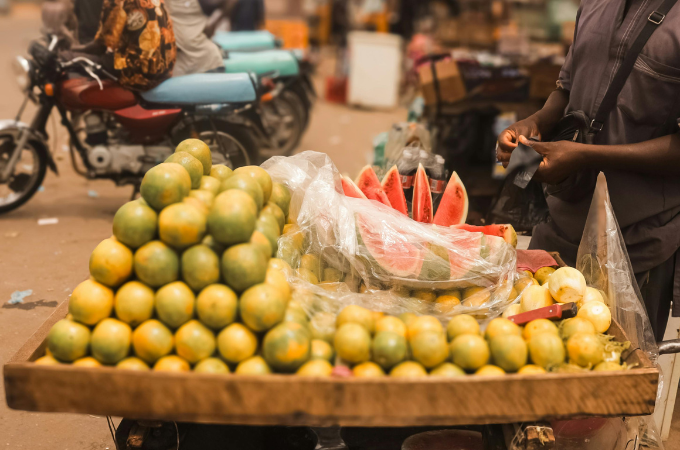
Then I go to my fruit seller. This man, who is somehow always energetic, eyes glancing around, hoping for a new customer to lower the mountainous pile of fruits he has and fatten his thin pockets. He always offers me something: a banana that’s a bit too ripe and belongs more in a banana bread recipe, an orange I found him eating, or a watermelon that lacks the integrity to remain firm and crisp in my mouth. Still, I take the generosity and tell myself it’s better than none.
Again, back to community. If you take the tomato lady’s full-on generosity, you have to accept that the banana man cannot give it as freely as she. Instead, what he gives you is motivation to keep pursuing whatever it is you are already chasing.
I check what he has in store and buy a few from him, even though I can spot fresher produce at the stand next to him. As we negotiate and pack, we talk politics. See, this is the thing about being in the market, a place that is packed with so many people from so many walks of this thing called life. We will talk about leadership, or the lack thereof. We promise that we will not vote for the person we said we would not vote for last time, we crease our faces and agree aggressively that the economy has never been this bad before, we sigh in the exasperation of being called ‘third world’ yet funding all the first world’s first-class rides. In the midst of this conversation, I ask if there are better mangoes, and he tells me mango season is over; this is the best I will get.
It’s the beginning of March; I know this. The rains are here, and mangoes do not do well in this weather. Mangoes, bright and yellow like the sun, reminiscent of happy days, rare, but happy. Days that come about once a year, just like the dry January heat that offers you the succulence of this fruit that can quench your thirst, coating your lips and throat with the kind of sweet they tell you is good for you, but you doubt it because the stickiness of it all feels almost sinful.
But still, my heart breaks. Reminds me that even with the eager hope in this conversation, we have been trapped in this loop as a nation for over half a century. This naivety when election period comes around, the belief that there can be better, that this better will last, and have a bit more permanence to it. He scuttles off to another customer, his attention already shifted from independence dreams to making a few more coins, so he gets to see said day. I move on to another vendor, ticking off my list, hoping to finish it and get back to the familiarity of the walls I call home.
My lady of bitters is next. I call her this because I get my limes, chillies and ginger from her. She’s tucked in her booth, comfortably in the middle of all her wares, wrapped up in a jacket and scarf that are trademarks of someone whose job involves a lot of sitting, which means she is generating zero heat, and explains the always full cup of tea steaming next to her. She responds to greetings with a slight smile and nod of her head. I try to minimise conversation, only asking the price when I confirm that it’s not written on a placard that might have tipped over.
Her silence would ordinarily have scared me away, me who understands silence as a thing that’s too loud, shining a light on my loneliness and need for fill. But this is calm, not the kind of silence a lot of African children grew up to know means that punishment is around the corner, silence that served the purpose of letting you stew in your perceived mistake and the anxiety of it all. Sometimes, though, when I am brimming with energy that I need to let out, joy that I need to share before it swan dives into a deep depression, I am forced to grind to a halt in the hush that is her ordinary. I find myself shifting from one foot to another a bit too often, feeling the discomfort ooze out of my pores, and I worry that she can smell it, and my desperation will repel her. Still, I go to her. I wonder if it is because she lets me pick limes from the sack instead of the ones on the stand that are a few days old, this act that makes me feel accepted into the inner circle that is her.
You, see? The market demands of me. Demands me to be me, refuses to accept the versions that I have so well crafted to fit perfectly in scenarios that do not take the time to know better. The market calls me, and I have to answer, and it does not accept me declining but instead requires me to consider. It calls me to see, and these calls sound like an old woman asking me to buy her potatoes, even when I politely shake my head no because my bag is already carrying the weight of what will soon be chips bubbling away in oil. It still demands me to see. To see. Whether to see myself or that which points a mirror at me.
And so again, when I go to the market, I will buy more than I need, as a way to escape the universe’s demand for me to look within. I will choose rot and gooey decay over the never-ending errand of healing. The market asks too much from me; I am afraid that it will make me the mad person that is never absent, roaming around in it.




Nimũ April 29, 2026 02:49
This was such a pleasure to read; the vulnerability of being your authentic self & also noticing others’ authenticity