

Day 3: Ghana
As I stepped off the plane in Accra, the first thing that surprised me was the air. It didn’t feel foreign. It felt like home wearing a different perfume — warm, slightly humid, carrying the promise of rain. The time zone had shifted, but my body recognized something deeper. Something that said, “You have been here before, even if your feet have not.”
Immigration was seamless. The officers were elegant, fit, and professional — no potbellies, no whispers of ‘Hajiya, do weekend for me nah’, no unnecessary stress. For the first time in a long while, I moved through an airport without bracing myself. Testimony Odey, the Gen Z writer from Nigeria who flew with me, held my hand the whole way. Someone at the airport mistook me for her mother because of how tightly she clung to me. I laughed inside. My head was stuck on the fact that I don’t usually like people touching me, but maybe this small act of holding on was the first lesson of the journey: Pan-Africanism begins with allowing yourself to be held.
Seth Avusuglo, the library/residency manager and curator of the residency, had already prepared for our arrival. One call, and a calm driver named Patrick appeared. My box got stuck on the baggage carousel, and Patrick had to help before it finally came free. Inside the car, the air smelled of old paper and roasted groundnuts.
The streets looked strangely familiar — Obasanjo Avenue, Madina — and I joked that I might as well be in a neighbourhood in Lagos. The laughter that followed felt like the first stitch in the fabric we would weave over the coming days.
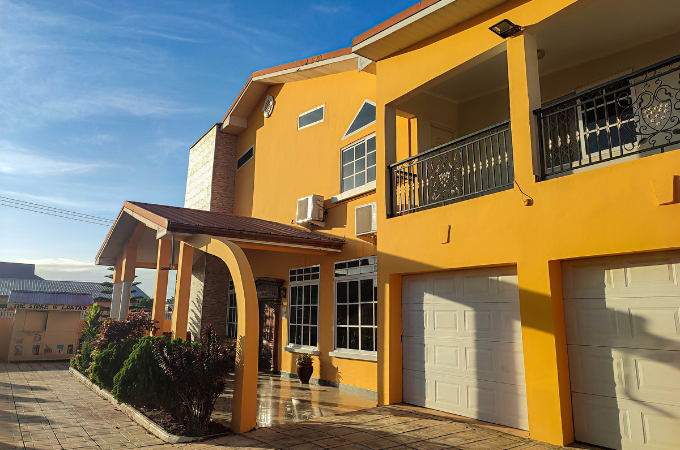
When we reached the Library Of Africa and The African Diaspora (LOATAD) in Adenta-Frafraha, something in me exhaled. From the outside, it looked like a rich man’s house in Kebbi — grand, intentional, rooted. But the moment I stepped inside, it smelled like heaven. Books. Ink. Ancestral whispers.
The walls were alive with photographs and quotes. One stopped me cold: the lion and the hunter. “Until the lion tells his side of the story, the tale of the hunt will always glorify the hunter.” That line sat in my chest like a prayer. I had come to collect stories, to find similarities between the North and every border I would cross, to find ways to bridge our divides. That quote felt like an affirmation — the journey would be worth every dusty mile.
There was a book that caught my eye immediately: The Dilemma of a Ghost and Anowa by Ama Ata Aidoo.
Christopher Armoh and other LOATAD residents were just rounding up their own residency, and we bonded quickly. We joked about Tinubu and how Nigeria needs to decide if it wants to be a giant or a squealing mouse. The laughter was easy, the kind that makes you forget you just met someone only hours ago.
Before I knew it, it was time for Zuhr. Christopher quietly gave me access to his room so I could pray and rest. The room was spacious, with pictures of Nobel laureates on the wall. I couldn’t help tapping into their ancestral wisdom. The entire library felt like that — books and photographs not just on shelves, but breathing on every wall. It was the most beautiful library I had ever seen. I moved through the collections like a child in a sweets shop — touching spines, reading titles, hungry for more. I absorbed the souls, spirits, and wisdom of Africa — from ancient histories to buzzing realities, from innovations to poets, academics, and artists of every calibre.
Kwame Nkrumah stared back at me from an entire bookcase dedicated to him. It made sense — I was in his homeland, the birthplace of modern Pan-Africanism.
Chimamanda’s portrait watched me too. I stood longer than I expected, letting the mystic tales and whispers of Chinua Achebe wash over me. There were even books about Sir Ahmadu Bello, the Sardauna. It felt heavenly, like the continent was whispering, “You are home.”
Surprisingly, the first meal I had in Ghana wasn’t the famous boiled egg and yaji I expected, but a plate of white rice with amazing cabbage sauce, fried ripe plantain, and fried fish. It was mind-boggling how comforting it tasted.
Other residents started arriving, and the networking began. T-Ben, the rockstar with a magnetic spirit. Sena — oh my God, Sena, was an energetic ball of light, magnetic, funny, yet deeply matured. The introvert in me admired how he balanced all those different sides so effortlessly. He kept cracking jokes and asking questions. When he asked me for an interview, my stomach did a flip — it felt like stepping on stage with all the nervousness I usually carry.
Later that evening, we watched Dahomey, the film about the return of stolen artifacts from France to the Benin Republic. I fell asleep midway from sheer exhaustion, but the little I saw stayed with me — the idea of things stolen finally coming home.
Seth moved around like a quiet conductor, making sure everything flowed. There was also the library’s cute baby, whose firm grip on a boiled egg made me laugh and affirmed, yes, I was truly in Ghana, not just another corner of Nigeria.
*
Morning came. I was properly introduced to the other residents: Orake, Ursula, Megborna Bodzo Badzaa, Badji, Sagou, and of course, Testimony. There was also Prof. Kehinde Andrews, author of Nobody Can Give You Freedom, the book about Malcolm X that we would read together on the road, reflect on, and find wisdom to apply to our own Pan-African struggle. And then there was Nana S. Achampong , the awesome novelist with warm energy that felt like meeting my dad in a different place: we connected instantly, gisted, and held deep respect for each other.
Bodzo Badzaa introduced us to his signature call-and-response: “Bodzo Badzaa!” We were to reply “Badzaa Bodzo!” Till today, I still do it, and we all have no idea what it means, but we spread it like a quiet cult everywhere we went. It became our little movement.
We stepped out and officially entered the spirit of the library by reading aloud in unison the Mbella Sonne Dipoko poem “The Tenderness Manifesto.” These lines stayed with me:
…
We shall assemble regardless of race,
We shall be egalitarians,
We shall be socialists,
Concluding the first meeting with the dimming moon and stars
And sleep through the morning,
Rising at noon for next debates
We were powerful. Here I was — a poet from Kebbi State, northern Nigeria — connecting with souls across the continent. That moment was awesome in a way I can’t fully explain.
After the round of introductions, we received a proper orientation. Seth handled the books like they were his little babies. I haven’t seen that kind of devotion to literature in a long time. It reminded me of how I handled my thesis — though mine came from fear of losing what I worked hard for. With Seth, it was pure love. Love for the books, for the arts, for the stories. It showed in his intentional African dressing, the charm around his neck, and the beautiful embroidery on his Fugu — the symbolic cloth worn by Nkrumah and his colleagues during Ghana’s independence. The Fugu has since become political wear in Ghana. Recently, their president wore it to Zambia, causing quite a stir between the two countries.
One thing that enthralled me about Ghanaians was their intentionality — their unapologetic Africanness. It wasn’t just in the accent or the Fugu they wore, but in the carvings on buildings, the materials used in their architecture, the way they honoured their history. I saw it clearly when we visited the historical sites: Kwame Nkrumah’s mausoleum, Padmore’s, and W.E.B. Du Bois’s resting places. Ghanaians didn’t just bury these global Pan-African heroes; they carved what they represented into the landscape itself. It was not only historical; it was culturally alive and intentional.
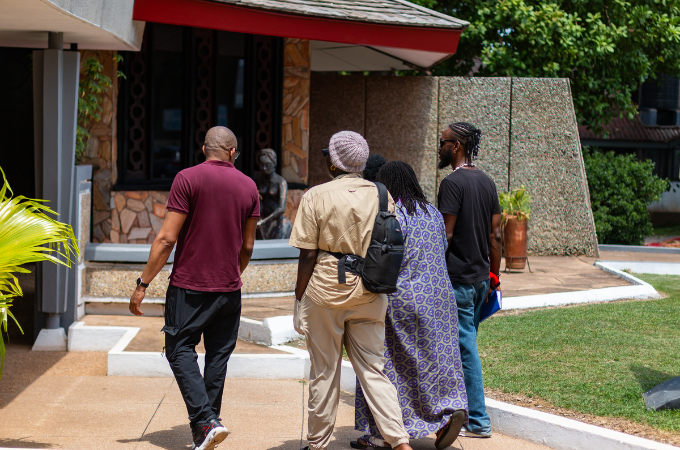
Seth played tour guide and historian as we drove through Accra, pointing out the “Pan-African Triangle” — the area that holds the remains of three giants: Nkrumah, Du Bois, and Padmore. We passed the presidential palace (not a villa like in Nigeria), and I learned how Nigerian soldiers once intervened during protests in Ghana. I kept noticing how unapologetically cultural Ghana felt compared to home — the traditional Adinkra symbols on walls, the Big Six on the cedi notes. They invited Nkrumah to give Ghana his spirit and soul. And he did.
We visited the University of Ghana, the national library, and then the George Padmore Research Library and resting place. Imagine being loved so deeply that even in death, your space is preserved with care. There, in a poetry book, I saw a quote that stopped me:
I wonder where we’d be if the masses knew just what a poem could do.
— Darius V. Daughty
As someone who believes fiercely in poetry for social change, those words felt like another affirmation. Poetry didn’t just choose me; I chose it back, every single day.
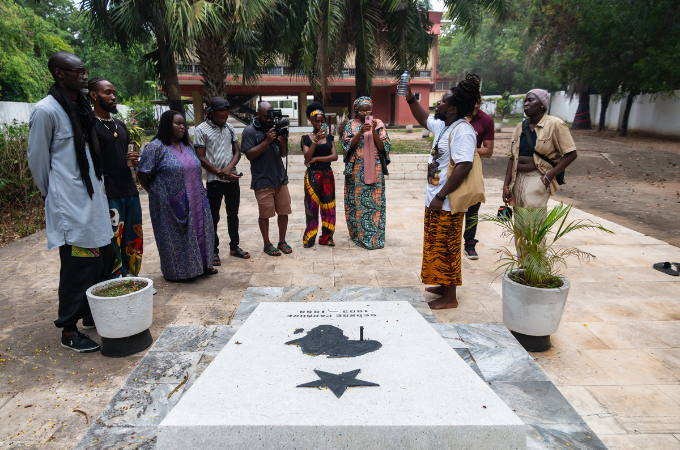
At Padmore’s resting place, palm kernel trees dropped seeds in red stains on the ground. It felt symbolic — like Padmore was still feeding us in death, offering the resilience of the palm tree. I picked up stones and palm kernel seeds. We observed a minute of silence. Bodzo Badzaa performed a quiet ritual, stepping shoeless onto the soil, blessing it with water, connecting spirit to earth.
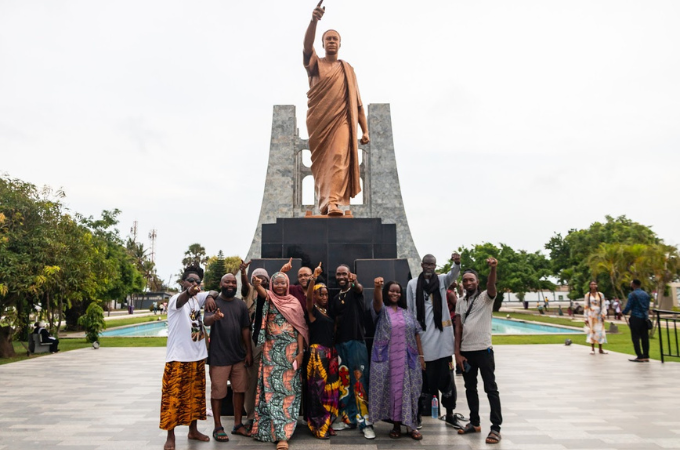
We visited Black Star Square, took pictures at the Black Star Gate monument, and later went to Kwame Nkrumah’s memorial park. A woman sat at the gate selling boiled eggs and yaji. That small moment grounded me again — the Ghanaian spirit alive in everyday things.
I learned the history of Osagyefo (1909–1972), how he earned the title, how he lived and died for his land. From the blue Cadillac gifted by President John F. Kennedy in 1961, to the monument standing above the pool where he declared freedom, Ghanaians preserved their history with love and intention. As a poet, symbolism matters to me, so I found it deeply poetic that chains lay in the water and figures of men bent as if still blowing the horns of freedom.
To top it all, a beautiful peacock appeared and danced for us, adding poetic elegance to the place.
The tour guide was fun and knowledgeable. After an exhausting but educational day, we ate kenkey — a Ghanaian delicacy made from fermented corn, served with fried proteins and pepper sauce. It was too sour for me, but satisfying in the way only shared food after a long day can be
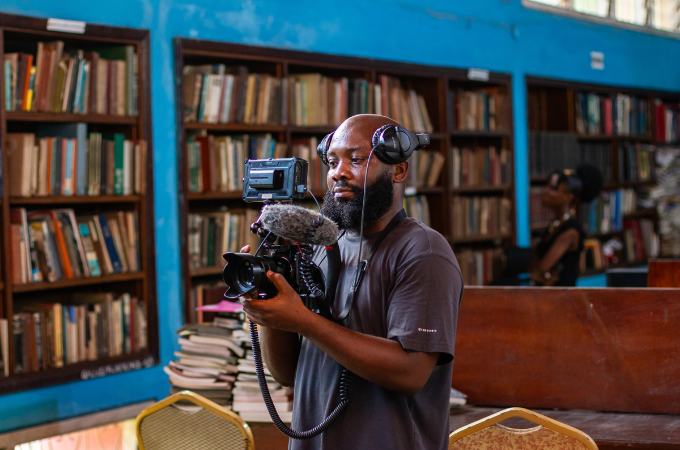
We returned to the library for interviews with Sena (the resident filmmaker) and Sagou. They asked about the journey so far, and I tried to put words to feelings that were still forming.
*
The next day, we left Accra at dawn on our 4,000-km journey to Banjul for the Convention of Afrikan People (CAP26).
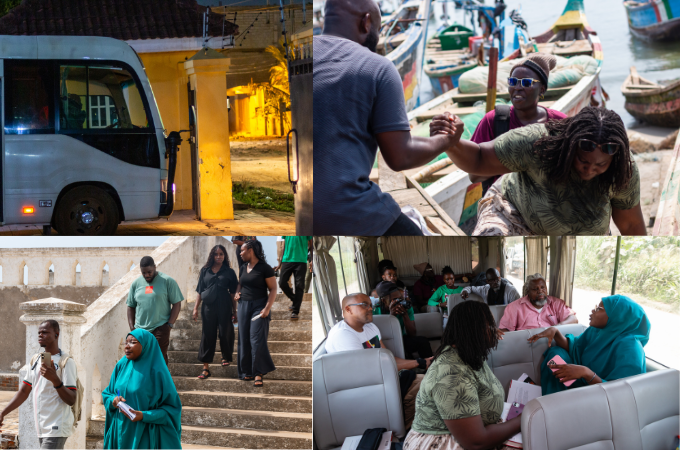
Our first rest stop was the former capital of Cape Coast. We visited the Cape Coast slave dungeons. Standing where our ancestors were chained, raped, and bundled onto ships across the Atlantic was soul-shaking. Learning the details — the hypocrisy of a church built right above the dungeons — left me quiet for a long time. Walking through what the British called “The Door of No Return” made me put myself in my ancestors’ shoes: months in darkness, then stepping into a future that tried to erase their roots, names, and languages. But then we walked back through the “Door of Return.” I was moved by how intentional Ghana has been — renaming and reopening that same door to welcome back families from the diaspora. I learned that Michelle Obama traced her roots here and walked through it. That moment felt like a full circle — from pain to reclamation.
Then we moved past the University of Cape Coast, one of Ghana’s biggest, where I learned Ama Ata Aidoo once lectured. Cape Coast was green with palm trees, the sea smelled of return, reclaimed memories, and wet sand. I can still hear Bright (the driver)’s voice as he teased Orake, the resident who became the bus’s waitress, assisted by Ursula, passing cups of hot tea, coffee, and bread slices.
We crossed the western Ghana border at Elubo. The Nigerians among the group of 15 travellers were charged “extra fees” while the diasporan with us, Professor Kehinde, enjoyed a seamless experience. I wondered why Africans still follow the logic of white supremacy. Some of the residents didn’t have the meningitis vaccine on their yellow cards, so Seth, bless his soul, had to step in. That was when we jokingly named him our “Big Daddy”.
On the road, Sena found ways to make us laugh through the expected unpleasant experiences, until we crossed the first Ivorien border!
Ghana taught me that we don’t have to wait for others to write our stories. We can carve them into our landscapes, our libraries, our monuments, and our daily lives. We can choose to remember loudly. And that is what I carry with me as I continue this road: the quiet power of intentional memory, the softness of people who open their hearts without being asked, and the deep knowing that we are not so different after all.
We are writing our own stories now.
And the pen feels lighter when it moves with love.
From Ghana, the road continues. I am not the same person who stepped off that plane. I carry this country in my chest now — its library, its peacocks, its doors that open both ways. And when I write, I will write from that place.


Rabiu Badia Idris May 28, 2026 00:47
This so so so mashaallah ❤️. So proud of you sis