
Dear You,
I am looking at you through a fog of harmattan on a December afternoon. The living room is a shadow of itself. Some corners are covered in Christmas decorations your mother bought before she even had you. The others are covered in grains of rice, some in shoes. The air is thick with the smell of fried chicken and the warmth of family you haven’t seen in years.
Everyone is loud and sweaty. Plates and spoons collide at a pace that is almost perfect. Every now and then, the hiss of a bottle being opened greets you. It’s a kind of dissonant symphony you find soothing. Your cousins are a riot on legs. Their voices clash like waves slapping onto rocks—a comforting chaos. They busy themselves with colorful catalogues and recount promises made to them by parents who are either already on the far left of exhaustion or too engrossed in their meals.
Then there is you. You are sitting on the edge of the sofa with your knees pressed together. Why do you feel the need to occupy as little space as possible? Why do you fold like a flower afraid of blooming?
You are a child with a brimming mind. Your thoughts overflow and spill into your eyes—the reason they have a glow. Even as you sit quietly, your thoughts are a marketplace. You are talkative but everyone thinks you enjoy retreating into yourself. You do not have the zeal to prove them wrong.
When he calls your name, a sack of stones settle in your chest. You cannot help the phlegm that builds in your throat. It is sad that—for someone with so much to say—you do not look forward to conversations with family.
Your uncle leans back and your eyes settle on his stomach stretching the fabric of his lace buba. He is a man who enjoys the power of being the giver. You see that in the way he raises his voice as he speaks. He asks the question like he’s handing you a blank check. “And you? What do you want for Christmas?”
You can feel your mother’s gaze from the kitchen doorway. You recognize it not as a look of pride, but as a silent warning. The ones African mothers give before you make a mistake. I think you should tell her you have a list. It is buried under your tongue. I see it.
You want the music set your cousins boast of so you can have a concert in your room. You want fanciful erasers, the ones that smell like grapes and cherries. You want a Barbie wristwatch that glows in the dark. You want to be the kind of girl who can point at a thing and say mine.
Instead, you say, “Anything you give me is fine, uncle.” The words are dry. They taste like ash and grate against your throat. You say it, and the tremor is so small only I can see it now, years later.
I want to reach through the years and catch that sentence before it hits your lips. I want to see the relief on his face and call it what it is—an insult. He nods with a smile that is a mockery of all the things you didn’t say. He turns to his own children then, and sharpens his gaze into a reprimand. “Do you see your cousin?” he asks, gesturing to you as if you are a trophy. “She is a good child. She is content. Not like you two, always demanding the whole world.”
You are the model child and for some reason, it hurts. It hurts even more to watch your lies weighed against your cousins’ honesty. They, who had the courage to ask for the dolls with the golden hair or the bright toy cars. You don’t blame them for the flash of resentment that lurks beneath their gaze, do you?
Do you know that you eventually get nothing from that uncle? Do you know that he still goes ahead to indulge his children—the ones who are brave enough to demand? He blames it on memory. He blames it on you for not having a preference. You should know that he praised you for being convenient, not because he was impressed.
Dear You,
I am watching you in the quiet hours after the guests have gone. You are in that small, cramped bedroom. You lie on your back and ignore the beads of sweat pooling round your eyebrows. You focus on staring at the ceiling. Only those who know you know that you are committing the crime of imagination.
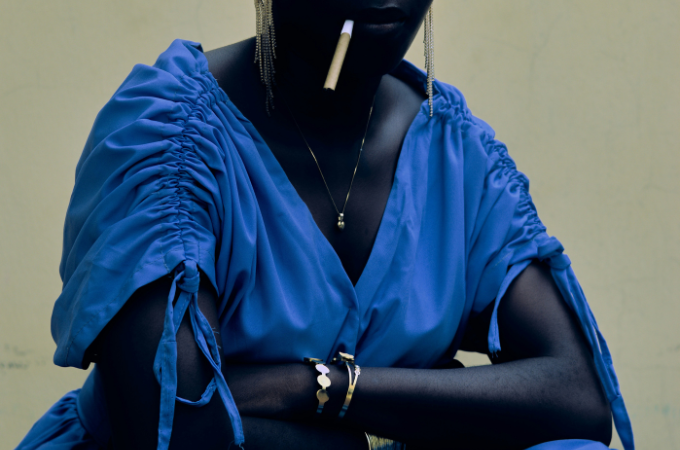
You aren’t just thinking of a dress. You are building one. In the dark, your mind is a needle and a thread, your desires—a fabric. You aren’t reaching for the dull cottons your mother buys in bulk. No, you are reaching for a blue so deep it looks like it may have been dyed in the middle of the ocean. A blue that sings until your heart explodes.
I want you to feel the weight of it in your hands. It isn’t light chiffon; it has the heavy drape of raw silk. When you move, the fabric should make a sound like a secret being hushed—a soft shhh against your skin.
But the audacity sits on the neckline.
You see them, don’t you? The crystals.
You don’t want them scattered around in sloppiness. You want them sewn with strict precision along the collarbone. Small, glass shapes that catch the sun when you play outside. You want them to be cold against your throat. You want them to be sharp enough that if someone dared to lean in too close, they might be cut by the brilliance of your choice.
But when your mother asks you later that week, “What kind of clothes do you need for the new term?” the blue drains. The crystals dissolve.
“Just a dress, mummy,” you say. “Something simple.”
To want a dress is a request. She can bring home a sack of brown polyester, and you can pretend you aren’t disappointed. To want a blue dress with crystals on the neckline is an exposure. It gives her a target to hit—or to miss. If you ask for that and she says no, or worse, if she brings home a dress with the wrong shade of blue or plastic beads instead of glass, it would cut deeper.
So, you keep the anatomy of the dress locked in your mind. You let the simple dress hang in your closet as a reminder of the little girl you are too afraid to be.
You should know that the crystals you dreamt of aren’t vanity. They are how you express the beauty inside of you. They are the way you tell the world exactly where you begin and where you spill.
Dear You,
You are sixteen today. You are standing in the center of the parlor, waiting for someone to offer you a gift you can finally press to your chest. You are worn out from the “Happy Birthday” and prayers you’ve received all day. Still, you widen your smile and bow your knees till they touch the floor when yet another one comes.
You look at your parents. You see the way they navigate the space. You notice the way they move through it by making themselves small instead of making room for their fullness. You have inherited their flaws. You have worn it like a hand-me-down that is three sizes too big, yet somehow manages to choke you.
In your house, desire is a luxury you cannot afford to articulate. To want is to be difficult. To desire is to be a burden. For a moment you think all hope is lost. Then the money is presented to you.
It sits on the side table—five crisp one-thousand-naira notes. Next to the money sits grandma.
Her skin is slick with too much shea butter and coconut oil, shining in the rays of sun that spill through the window. Each wrinkle draws a map that tells you of her survival. You love her—you truly do—but today, she is the alternative to your hunger.
“5 thousand naira,” your mother says. Her voice drops into that low, testing register, “or prayers from your grandma.”
You look at your father. You look at your mother. You do not look at yourself.
Wanting is a silent form of audacity. It’s simmering just underneath, not too out of reach, but not close to the surface either. It’s a discipline you haven’t mastered yet. You don’t know that you must want just enough to get. Instead, you feel the weight of wanting like a cardinal sin.
“The prayers,” you whisper.
Grandma’s hands move immediately. They are heavy and smell of Aboniki as they press onto your scalp. “You shall be the head and not the tail,” she cries. “You shall find favor in the eyes of men.”
You are kneeling there, the rug pressing marks into you, listening to her pray a future into existence while your present is empty. You are being blessed for your own austerity. You are being told you will find favor in the eyes of men, but the favor you want is right before you in the form of bank notes.
If I could reach back and pull you up off that floor. I’d tell you that the shame you wear like a cloak is a lie. I’d tell you that what you feel when you look at those notes is want, and want is human.
Dear You,
The shame has matured now. You are sitting on a peeling sofa with a man who claims to love you, watching a vox pop on your phone. A girl on the screen is asked a simple question: “Money or love?”
She doesn’t hesitate. She chooses the money. The comment section erupts in a kind of anger you do not understand. They call her shallow. They call her a gold-digger. They don’t ask if she has siblings whose fees are stacking. They don’t ask if her mother’s kitchen is a graveyard for dead feasts. They just judge the audacity of her appetite.
Your boyfriend scoffs. “See this one,” he says, shaking his head. “So cheap. All these girls do is suck men dry without offering any value.” You feel a cold prickle of sweat. You realize that the vox pop girl is a mirror held to you. Yet you scoff too and snap your fingers across your head.
“Thank God I’m not like that,” you say.
Later that night, the atmosphere in the room is heavy with his affection. He pulls you close and blows warm kisses down your neck. “I was thinking,” he whispers. “I could take the whole month’s salary. We could go away for a weekend. I don’t mind a trip together, no matter the cost. ” He senses your hesitation then adds, “or… if you’re not up to it, we could find somewhere here in Lagos. Better still, we can just have dinner at home. You can cook us something special. What do you say?”
You sigh and shut your eyes. You want to see a horizon that isn’t boxed into four walls. You want to bury your feet in sand on another land. Suddenly, you are the girl on vox pop. You remember the word cheap, and you are the little girl shrinking in your living room once again.
“You’re all I need, babe. Let’s figure that out later,” you whisper into his chest.
I like to think that life was teaching you then—giving you opportunities to take up space. Every time it presented you with options, it did so with purpose. Every time you shrunk, it brought another. Why couldn’t you see? Why didn’t you learn?
Dear You,
I am writing this from a room where the light stays put. There is a door behind me that locks, and a floor beneath me that does not belong to a stranger. I am sitting on a chair made from fine mahogany wood—I made sure of that. I finally have a blue dress, maybe not the type you imagined, but it’s mine. I am sitting on the audacious side of want, and I am finally living.
I want you to look at me—at us. We have stopped being small. We have learned that the concrete and the abstract were never enemies. It was a lie told to us to stifle how far we reach. They told us that if we wanted the dress, we couldn’t have the virtue.
One grounds you, the other gives you wings. Neither is more important, but neither—not a single bit of it—is shameful.
I am comfortable now. There is no holiness in deprivation. There are no medals for being the person who needed the least. I look back at you and I see how much courage it took to want nothing. I want you to channel that courage into wanting.
So dear you, I will be the first person in your life to ask you this without an answer already projected onto you. I am asking because I actually want to know.
Tell me. What do you want?
This time, for the love of everything we have survived, don’t say ‘anything’ because anything is nothing where we come from.
Photo by seyi adekola on Unsplash






COMMENTS -
Reader Interactions