

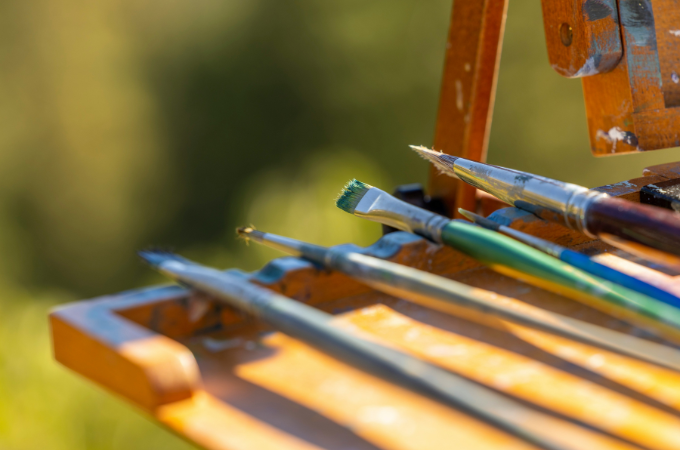
At the public park every Saturday, I find myself wavering between the traditions of esteemed painters and maintaining my own cool detachment in this open-air gallery. The park feels like a living canvas, stretching beneath the morning sun, the grass shining with dew and hope. Painters arrive one by one, their steps leaving faint marks on the earth, their bags heavy with brushes, paints, and the weight of another week’s expectations.
The easels are not set close enough for conversation, but not so far apart that you cannot overhear the fourteenth dramatic explanation of why Tola’s clouds are always blue. Each artist claims a patch of grass, staking their territory with stools and paint-stained cloths. Some greet each other with a nod, others with exuberant hugs.
There is a rhythm to the arrivals, a choreography that repeats itself every weekend, and I have learnt to spot the regulars by the way they set up: Tola with his slow, careful unfolding of a battered easel, Madam Kiki with her plastic bag of snacks dangling from one wrist, and Aunty Bisi humming gospel songs as she arranges her sunflower references. I can tell who has arrived by the scratch of their charcoal on canvas, a language of sound that is oddly comforting, sharp, determined, and full of intent.
I have learnt that when the park falls silent, it means someone is about to declare that their “abstract” truly has “deep meaning.” In those silences, the air grows thick with anticipation, as if the trees themselves are listening in, waiting for the next pronouncement about art and life.
The park is always a living thing on Saturdays, breathing in with the arrival of painters and families, and out with the sighs of trees and the wind’s restless commentary.
There are children chasing kites and footballs, their laughter colliding with the gentle hum of brushes on canvas. Sometimes, a dog will charge through the circle of easels, causing a chorus of good-natured grumbles and hurried rescues of paint pots. Once, a pair of lovers stumbled into our midst, startled to find themselves surrounded by artists mid-sketch. They blushed, apologised, and wandered away, leaving behind a ripple of amusement.
I like these interruptions; they remind me that art, like life, is rarely neat. No matter how carefully you plan your composition, there is always the possibility of chaos, a spilt jar of water, a gust of wind flipping your canvas, or a child’s sticky handprint in the corner. The unpredictability is part of the charm.
Whenever I end up beside Mama Ifeoma, the woman in Ankara aprons who somehow gets burgundy on her forehead every week, my mind falters. She is the sort of person whose presence fills the air, even in silence. Her laughter is rich and full, a sound that seems to warm the air. She often starts her mornings with a song, sometimes highlife, sometimes a hymn, sometimes a tune of her own invention.
Should I smile and say, “Good morning, ma”? Offer to share my water jar? Or simply pretend to be absorbed in my sketch of the sky, letting her laughter wash over me? Last time, I muttered, “Morning, ma’am,” and focused on my palette. These things ought not to trouble an adult with bills and data to purchase, but when you grow up where omitting “ma” can summon a committee of aunties with opinions, you never truly recover.
I have learnt to swap “no” for a polite “yes, ma,” nod when the elders correct my brushstroke, and suppress the urge to roll my eyes when my “modern art” receives side-eyes. Even now, with all my knowledge, I cannot shake the slight anxiety that accompanies painting near the older women. Their eyes are sharp, missing nothing. Their stories, traded back and forth between brushstrokes, are heavy with history and laughter. They remember when the park had more trees, when paint was cheaper, when children respected their elders without having to be reminded. The aunties are a gallery unto themselves.
There is Madam Kiki, the first woman I saw with three nose rings, who brings fish rolls for everyone and never attends art exhibitions, yet somehow knows every artist’s favourite colour. She is a legend, moving through the crowd with easy grace, dispensing snacks and jokes in equal measure.
There is also Aunty Bisi, who paints only sunflowers, and whose voice rises above the rest whenever someone dares to suggest that abstract art is “not real painting.” Sometimes, she presses hard sweets into my palm, whispering, “For inspiration.” I have a growing collection of these sweets, their wrappers bright in my bag, a secret stash of encouragement.
Still, get too close and you are being matched with a “talented niece who just wants to learn.” Remain aloof and you will miss out on the best tips, the stories, and the unexpected, “oya, take this brush, it’s lucky,” pressed into your hand. I have collected three “lucky” brushes so far; all of them are chewed at the end and stained with colours I never use, but I keep them anyway. Each brush has a story, a history, a small claim on my artistic journey.
There are rituals here that no one explains, but everyone follows. Arrive too early and you will be roped into helping set up the folding chairs and sweeping stray leaves from the path. Arrive late and every head turns, some with amusement, some with silent reprimand. The elders always occupy the central shady spot beneath the jacaranda, their skirts fanned out like petals, their palettes arranged with military precision.
The rest of us scatter ourselves around them, orbiting like planets, close enough to bask in their wisdom but not so close as to be drawn into their orbit entirely. Today, I watched Tola argue about his blue clouds. No one remembers when he started painting them, only that one day, every canvas he brought was crowned with impossible, brilliant blue.
An aunty, perhaps emboldened by the morning sun, asks, “Tola, do you dream in blue?”
Tola grins, shrugs, and taps his brush against the easel, blue paint splattering onto the grass. “Maybe I just see rain coming before everyone else,” he replies, and everyone laughs, the tension dissolving.
There are moments when the park falls silent, and the only sound is the wind sifting through leaves and the rhythmic scritch-scratch of charcoal. It is in those moments that someone, usually a newcomer, will clear their throat and announce, with trembling pride, that their composition is “truly abstract” and “deeply meaningful.” The aunties will nod, some sincerely, some with the indulgence of people who have heard it all before, and then the circle resumes its quiet work.
My own canvas is half-finished today: a sky, a single tree, and the suggestion of children at play. It is not what I set out to paint, but the park has a way of imposing itself on you, slipping its colours and sounds into your hands. I add a splash of green where there was none before, a streak of yellow that catches the light. I hear Mama Ifeoma beside me, humming softly, her brush moving in slow, deliberate arcs.
Then, Mama Ifeoma laughs beside me, a rich, rolling sound that startles a flock of pigeons. She wipes her brow, leaving a fresh streak of burgundy paint above her eyebrow. “You need more yellow,” she says, nodding at my canvas. “The sun is shy today, but you can coax it out.” I smile and dip my brush into yellow, dabbing light onto the leaves. The gesture feels like a small surrender, but also a joining, an acceptance that my art, like my presence here, is stitched together by the influences around me.
As the afternoon wanes, the aunties begin to pack up. There are goodbyes, promises to bring more snacks next week, and gentle ribbing about unfinished paintings. I linger, cleaning my brushes, hoping for one last exchange. Mama Ifeoma pauses beside me. She looks at my canvas, then at me, her gaze soft but appraising. “Next week, bring more blue,” she says. Her tone is gentle, but the request feels like a secret handshake, an invitation to return. “And do not forget, the sky is never just one colour.”
I nod, feeling a warmth bloom inside me that has nothing to do with the sun. Around me, the park exhales, the last rays of light stretching across the grass. A child runs past, squealing, his laughter echoing through the trees. Somewhere, Tola is still packing up, humming to himself, his blue clouds drying under the open sky. Tomorrow, if I find myself near Mama Ifeoma again, I shall brace myself, not to bow, but to steady my hand as I greet her properly, with words this time. And perhaps, with a little more blue and a little more yellow, I will belong here in the way only practice and a few lucky brushes can teach.
For now, I walk home with paint-stained fingers and the memory of laughter stitched into my heart, already looking forward to another Saturday, another chance to paint, to learn, and to belong.
Photo by Leo_Visions on Unsplash



COMMENTS -
Reader Interactions