
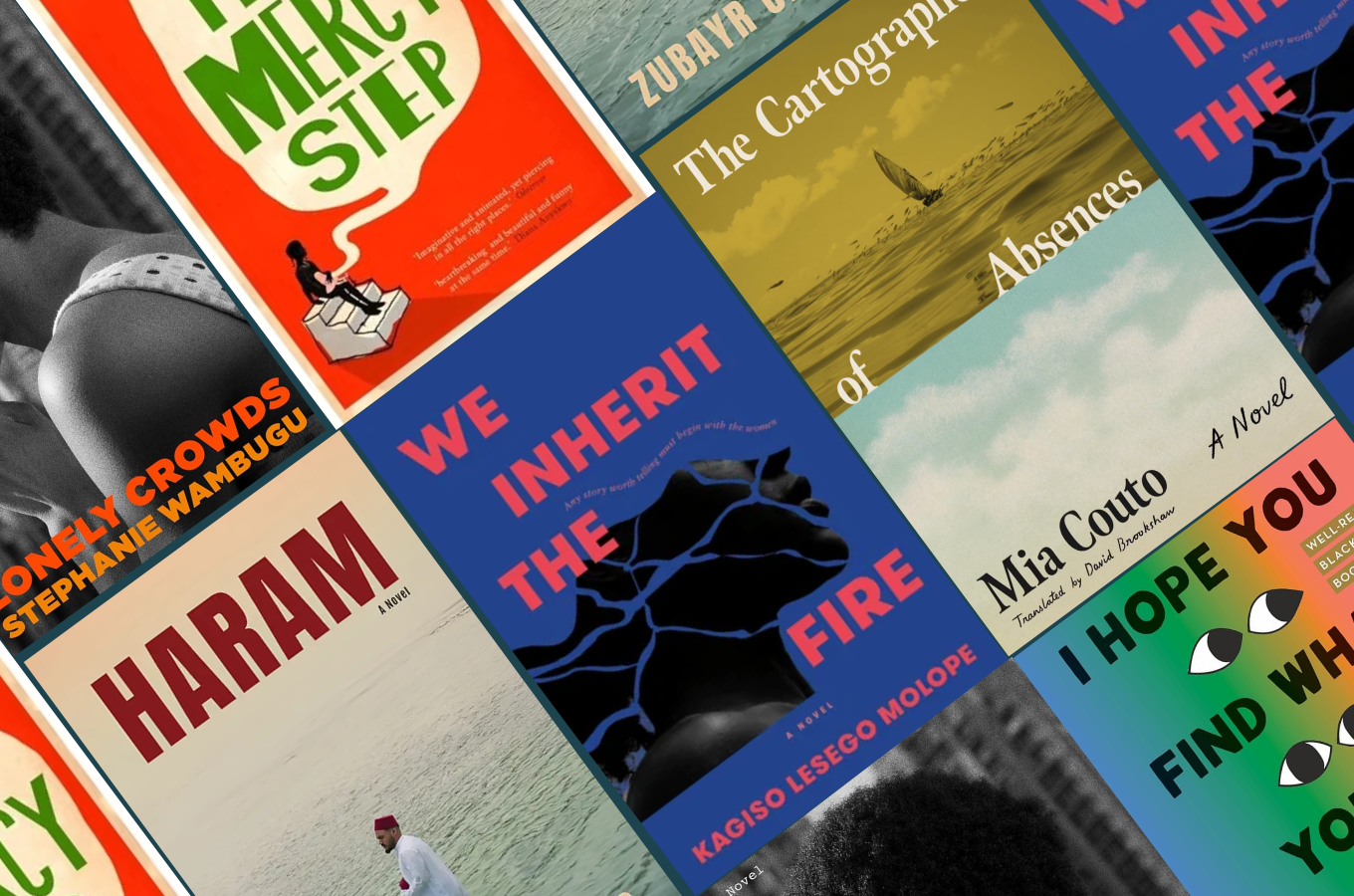
The nominations for the 2027 Dublin Literary Award are out, and among the contenders for the €100,000 prize are five writers from Africa and its diaspora: Zubayr Charles, Kagiso Lesego Molope, Mia Couto, Stephanie Wambugu, and Bsrat Mezghebe. South Africa’s Kwela Books and Nigeria-founded Cassava Republic Press also feature on the list.
Announced on November 18, this year’s selection comprises 71 novels put forward by 90 libraries across 41 countries. Among the nominated works are 22 debut novels and 30 books translated from 21 languages. The Dublin Literary Award is particularly exciting because it gives libraries around the world the opportunity to determine which books enter the competition. This year, nominations for African and diasporic fiction have come from libraries in South Africa, Canada, Portugal, the United States, and Jamaica.
Here is a closer look at the nominated titles.
Haram by Zubayr Charles (South Africa)
South African poet and playwright Zubayr Charles makes his novel debut with Haram, published by Kwela Books, an imprint of Jonathan Ball Publishers. Set within Cape Town’s Muslim community, the novel follows Muhammad, a young man struggling to reconcile his sexuality with his religious upbringing and the expectations of those around him. Charles draws on English, Kaaps, and Arabic to bring the linguistic and cultural textures of the community into his fiction. In its nomination, the City of Cape Town Library and Information Services commends Charles’s sensitive treatment of social isolation, sexuality, and mental health among young people.
Nominated by the City of Cape Town Library and Information Services, South Africa.
We Inherit the Fire by Kagiso Lesego Molope (South Africa/Canada)
Published by McClelland & Stewart, Molope’s fifth novel explores the personal consequences of political resistance through the relationship between a celebrated anti-apartheid freedom fighter, Kewame “Dolly” Malaka, and her teenage daughter, Kelelo. Set during the final years of apartheid, the novel considers what children inherit from parents whose lives have been devoted to collective struggle.
We featured the novel in January, examining Molope’s longstanding literary interest in the lives of young South African women growing up during periods of political upheaval. Brittle Paper readers may also remember Molope as the inaugural recipient of the Pius Adesanmi Memorial Award for Excellence in African Writing in 2019 for her novel Such a Lonely, Lovely Road.
Nominated by Ottawa Public Library, Canada.
The Cartographer of Absences by Mia Couto (Mozambique), translated by David Brookshaw
In The Cartographer of Absences, published in English by Farrar, Straus and Giroux, Mozambican novelist Mia Couto takes readers to Beira in 2019, shortly before a devastating cyclone strikes the region. A poet named Diogo Santiago returns to his birthplace, where his investigation into his father’s past brings him face to face with the violence of Portuguese colonial rule. Drawing on elements of Couto’s own family history, the novel explores the difficulties of recovering a past marked by political repression and historical silences.
Couto is no stranger to the Dublin Literary Award. His novel Confession of the Lioness was shortlisted in 2017, alongside works by Chinelo Okparanta and eventual winner José Eduardo Agualusa. Woman of the Ashes made the 2020 longlist, and The Drinker of Horizons was longlisted in 2024. In 2025, he received the prestigious PEN/Nabokov Award for Achievement in International Literature.
Nominated by Almeida Garrett Municipal Library, Portugal.
Lonely Crowds by Stephanie Wambugu (Kenya/United States)
Kenyan-American writer Stephanie Wambugu continues to enjoy a remarkable reception for her debut novel, Lonely Crowds, published by Little, Brown and Company. The novel traces the friendship between Ruth, the daughter of Kenyan immigrants, and Maria, from their childhood in Rhode Island to their pursuit of artistic careers in New York. Their increasingly complicated relationship becomes a means of exploring the demands of artistic ambition and the inequalities that shape who gets to succeed.
We included Lonely Crowds in our 100 Notable African Books of 2025. Since then, Wambugu has been named a National Book Foundation 5 Under 35 honoree, won the Edmund White Award for Debut Fiction, and emerged as one of the ten finalists for the 2026 VCU Cabell First Novelist Award. In June, she joined Sudanese-American poet Safia Elhillo and Zimbabwean novelist Siphiwe Gloria Ndlovu among the 2027–2028 Civitella Ranieri Writing Fellows.
Nominated by Chicago Public Library, United States.
I Hope You Find What You’re Looking For by Bsrat Mezghebe (Eritrea/United States)
Eritrean-American writer Bsrat Mezghebe’s debut novel, published by Liveright, takes us into an Eritrean immigrant community in the Washington, D.C., area in 1991, as Eritrea approaches independence following decades of war. Against this historical backdrop, Mezghebe examines the relationship between family histories and the aspirations of a younger generation growing up in America.
In March, we published an excerpt from the novel featuring a fascinating exchange between thirteen-year-old Lydia and her cousin Berekhet. What begins as a disagreement over Lydia’s reading habits becomes a conversation about the authority of the English language, education, and the possibilities available to young people from immigrant families.
We are truly moved by the novel receiving its nomination from a library serving the very community whose experiences Mezghebe brings into literary fiction.
Nominated by DC Public Library, United States.
The Mercy Step by Marcia Hutchinson (Cassava Republic Press)
Cassava Republic Press’s extraordinary year continues with the nomination of British-Jamaican writer Marcia Hutchinson’s debut novel, The Mercy Step. Set in Bradford, England, in 1962, the novel follows Mercy, a young girl growing up in a Jamaican immigrant household where her father’s violence and her mother’s religious convictions shape her childhood.
The nomination is particularly significant for the African publishing industry. Earlier this year, The Mercy Step made Cassava Republic the first African-owned, Black, and woman-led independent publisher to reach the Women’s Prize for Fiction shortlist. The novel went on to win the Discover Prize at the 2026 British Book Awards and was subsequently longlisted for the $20,000 CANEX Prize for Publishing.
Just this November, Hutchinson received the award for Best International Fiction Book at the 2026 Sharjah International Book Fair. For a manuscript that was rejected by more than 50 publishers before Cassava Republic acquired it, the Dublin nomination offers yet another testament to the importance of independent African publishing in expanding the possibilities of world literature.
Nominated by Jamaica Library Service, Jamaica.
Established in 1994 and sponsored by Dublin City Council, the Dublin Literary Award recognizes novels originally written in English as well as those translated into English. Should a translated work win, the author receives €75,000 and the translator €25,000.
The judges will announce a longlist of up to 20 books on February 16, 2027, followed by a shortlist of six on April 7. The winner will be revealed on May 20 during the International Literature Festival Dublin.
Congratulations to all the nominated authors, translators, and publishers! We look forward to following their progress.
See the complete list of nominations here.






COMMENTS -
Reader Interactions