


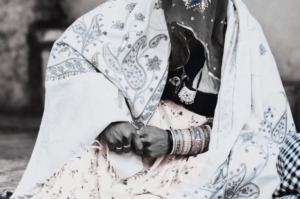
They said Mama Eno never cried when her husband died. Not once. Not even at the funeral, where mourners flung themselves onto the red earth like uprooted trees. Instead, she stood tall in her faded wrapper and broken slippers, holding a small calabash filled with shea butter and kola nuts, whispering to gods only she remembered.
I was eight then, crouched under the mango tree with a straw of zobo in my mouth, watching her with the kind of awe that clings to children like dust on sweaty skin.
Now, ten years later, I’m standing in her compound again, sweating in my school uniform, holding a folded letter in my hand that feels heavier than it should. The letter says Papa has disappeared. Vanished somewhere along the Ibadan highway. No witnesses. No accident report. Just his Toyota Camry, doors open, engine humming quietly near a ditch. A plastic water bottle rolled under the passenger seat. His glasses on the dashboard.
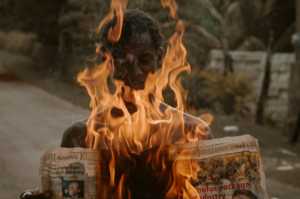
Mama Eno stares at me with eyes that look like they’ve watched fire burn backwards. She doesn’t ask what’s in the letter. Doesn’t ask if I’m hungry. She turns slowly, like someone who doesn’t obey the world’s normal rhythm, and walks into her mud-walled kitchen. I follow. She boils water with dried lemongrass, adding slices of bitter kola and something I can’t name. The air fills with the sharp smell of memory and old grief. I sit on the low stool, watching her. She doesn’t speak for a long time, not until the steam begins to rise like spirits returning.
“Your father,” she says finally, “has not disappeared. He is hiding from his shadow.”
I frown, “What does that mean?”
“It means he crossed into a story he didn’t understand. And now the story won’t let him go.”
Later that evening, I sat outside, watching the sky bruise into evening. The sun is heavy with regret. I remember what they say about her — how she talks to trees, how the lizards in her compound do not blink, how her husband once turned into a yam during the war and she roasted him whole before he became human again. Children said these things with half-laughter, half-fear. But the strangest part was that no one ever proved her wrong.
When it’s fully dark, she brings me food — plantain pottage with smoked fish and slices of boiled egg. The taste is strange but warm. I eat in silence while she hums a song I don’t know, something that sounds like a lullaby sung to a world already asleep. When I ask her again about Papa, she says only, “If you want to see him, you must walk through the place between forgetting and truth.” I think she means dreams. I think she means madness.
But I say nothing. Because part of me remembers a story Papa once told when he thought I was asleep: how, before he married Mama, she warned him never to betray her, never to dig up the tree in her compound, never to eat a certain fruit. He laughed when he said it, but there was something tight in his voice, like someone remembering a fire too close to the skin.
That night, I slept on a mat that smells of mothballs, ash, and eucalyptus. I dream of rain falling on dry earth, of footprints that lead nowhere. I wake before dawn to find her squatting beside the fire pit, feeding it dry palm fronds. Her eyes catch mine.
“Come,” she says. She places a clay bowl in my hands, warm and round like a sleeping bird. Inside is oil — thick, greenish, and smelling of herbs.
“Rub it on your chest, your temples, and your feet. Speak no lies while doing it.”
I do as she says. The oil is cold on my skin. It makes my breath shallow. The world tilts a little. She throws something into the fire. It flares green, then blue, then white.
“Close your eyes,” she says. When I open them again, the compound is gone.
We are in a place that feels like memory stretched too thin. A wide expanse of red earth, cracked like a broken mirror. A sky with no sun, only a pale blue that never deepens. In the middle of this dry land stands a tree — blackened, leafless, humming with something that isn’t wind. Under the tree, a man sits.
It’s Papa.
But not the Papa I know. This one has white in his beard. His shirt is torn. His hands grip a machete stained with something that isn’t rust. He doesn’t look at me. Just stares at the ground like it’s speaking to him in a language he barely understands.
“Why is he here?” I ask.
“He was warned,” Mama Eno says. “But pride makes men deaf.”
“What did he do?”
“He broke a promise. A very old one.”
She steps forward and places a leaf on the ground. It shivers, then dissolves into light. The air changes — grows heavy, like a truth pressing on your chest. The tree begins to creak. The ground cracks further. Papa stands up slowly, as though waking from a deep dream. He looks at me now — his eyes hollow but widening with something like hope. He mouths my name. Then the vision blurs.
I wake gasping. The fire is gone. The mat soaked with my sweat. Outside, the roosters are crowing. Mama Eno is already awake, sweeping the yard.
“Was it real?” I ask her.
She doesn’t stop sweeping. “Everything is real somewhere,” she says.
Later that day, we got a phone call. Someone found Papa near the Osun River, disoriented, barefoot, murmuring names of people long dead. He was holding a drawing — a tree with black leaves and a red sun above it. His palms were cut, bleeding lightly.
When we get to him, he doesn’t speak for a long time. Just stares at me like he’s trying to remember what I look like. Then he says, “I thought I was alone there.”
I nod, gripping his hand, “You weren’t.”
In the weeks that follow, Papa changes. He walks more slowly. Smiles less. Sometimes, he wakes in the middle of the night, whispering things in languages I don’t know. Once, he tried to dig up a patch of land near our compound before Mama Eno appeared, whispering prayers that sounded like thunder disguised as lullabies.
One day, I asked her what she did to bring him back.
“I didn’t bring him back,” she says. “I only opened the door. He chose to return.”
“Could he go back?”
Her silence is louder than any answer.
Months pass. One day, Papa gave me a carved wooden box. Inside are letters — written in his handwriting but addressed to no one. Some are confessions. Others are dreams. One is a warning:
If you ever see the black tree in your dreams,
turn away. Do not eat its fruit.
Do not listen to its song.
I keep the box hidden under my bed.
Years later, after Mama Eno dies quietly in her sleep, we find no grave to bury her. Just her wrapper folded neatly on her mat and a note that says:
I have gone to sweep the place between worlds.
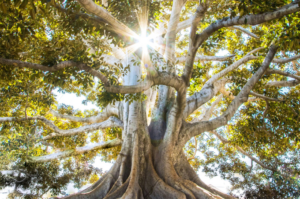
We leave the compound as it is. The tree in the center grows tall and full again — green leaves, sweet-smelling bark. But birds never perch on it. Not even once.
Photo by Warren Griffiths from Pexels



COMMENTS -
Reader Interactions