

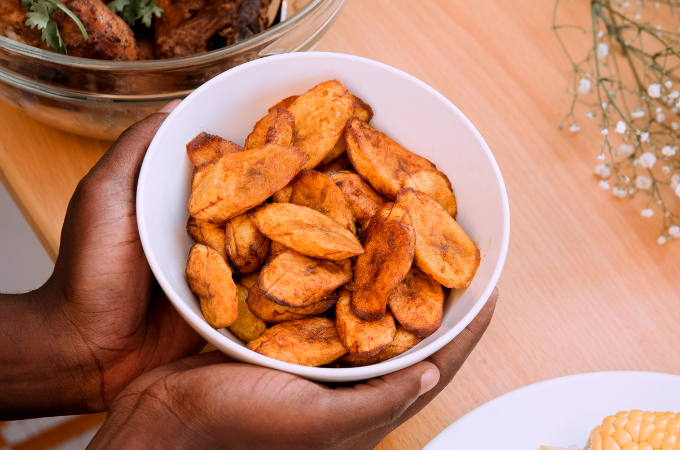
Some people remember the year 2000 for the Y2K bug, low-rise jeans, or the Sydney Olympics. But in the eighteenth arrondissement of Paris, the African epicenter, the year 2000 is best remembered for one thing: the year that the price of plantains fell to one franc per kilo. Yes, you read that correctly. One franc per kilo. Converted to euros, that’s fifteen cents, which amounts to seventeen US cents, or one hundred West African CFA francs—a price reduction the neighbourhood had never seen before.
At first, most people thought it was a joke. Ma Charlotte, who did her shopping every Friday afternoon at the African market in Château Rouge, was the first auntie to notice this good deal. When she saw the price sign, she initially thought her eyes were deceiving her or that surely, the sales assistant had made a mistake. But when she went to check the price with the Asian owner of the small shop on Déjean street, he confirmed that plantains were now selling for one franc per kilo. Not one franc seventy-five, or one franc fifty. Nope. Just one franc, a round number. And therefore, an irresistible price. Ma Charlotte didn’t need to be told twice. She was the type of woman who knew how to seize opportunities. So, she bought five kilos on the spot and rushed home to share the good news with her neighbor and friend, Ma Brigitte.
To tell the truth, Ma Brigitte was reluctant to believe her at first, because Ma Charlotte was known for making up stories. For instance, she’d claim to be one of the sisters of the president of the DRC, when everyone knew that she was the third cousin of his main driver at best. Or she’d often say that her eldest son lived in Washington, DC, and had two master’s degrees, when everyone knew he was a bum who was couch surfing in Brussels after repeating his first year at university. So, when Ma Charlotte stated that plantains were now selling for one franc per kilo at Château Rouge, Ma Brigitte had every reason to doubt her.
To make sure it wasn’t a hoax, she asked her son Popaul to go check the price sign on Déjean Street, and when the teenager came back confirming the bargain, Ma Brigitte clapped her hands, said, “wow, wow, wow,” twice, and then decided to act quickly. She, too, was the kind of woman who knew how to seize opportunities. She gave Popaul a few bills and asked him to go buy eight kilos of plantains immediately. After that, Ma Brigitte shared the news by phone with her sister-in-law, Ma Clémence, who then called her cousin, Ma Valentine, who then called her hairdresser, Ma Jocelyne. In less than forty-eight hours, thanks to Congolese word of mouth, all of Paris learned that plantains were now selling for fifteen cents per kilo at Château Rouge.
People rushed from all over the city and its suburbs to take advantage of this low price. This was the beginning of an episode of Parisian Black history that some still refer to today as “Plantainmania,” or “Lisolo ya bananes plantains.” And here’s what happened next…
Ma Henriette, Ma Brigitte’s sister-in-law, owned a nganda, a small African restaurant, in the Château Rouge neighborhood. Every Sunday, Congolese men would come to have a beer, share news from back home, talk politics, and gossip a little bit at her place. Often, some of them only had enough money to pay for a single drink, but that didn’t stop them from spending the whole day at the restaurant. Ma Henriette never turned them away. She had a huge heart. She would even offer those men a beer on the house when the end of the month was approaching and people were trying to stretch their last few francs. “Your good heart will cost you your business one day if you’re not careful,” her younger brother Hippolyte would warn her, but Ma Henriette refused to listen to his arguments. “God will provide,” she’d reply. And she was always right.
When plantains started selling for one franc per kilo on Déjean Street, Ma Henriette decided that from now on, there would be plantains with everything on her menu. Plantains could no longer just be side dishes; they had to take center stage. Flambéed plantains. Plantain papillotes. Cream of plantain soup. Every day, Ma Henriette would come up with a new recipe. Plantain spring rolls. Plantain salad. Plantain cassoulet. There was no limit to her creations. Patrons loved it, and thanks to her culinary innovations, Ma Henriette’s nganda enjoyed growing success. It was fully booked every day for lunch and dinner.
Among Ma Henriette’s regulars were two Congolese men, Papa Edmond and Papa Célestin. Every weekend, they drank beer after beer, then argued about politics and the state of the world. The new price of plantains provided them with the perfect excuse to start one of their epic and endless discussions. Papa Edmond was an optimistic capitalist. He had read Milton Friedman, Adam Smith, and Karl Marx for good measure. He had studied economics at UNILU, the University of Lubumbashi, but unfortunately had to leave the Congo before obtaining his doctorate. He firmly believed that these new low prices were a good thing, that they would help develop entrepreneurship in the eighteenth arrondissement, and keep people well fed. Papa Edmond equated the price of plantains with an indicator of happiness in Paris, just like the yen and the pound sterling were financial market indicators in Tokyo and London. He also believed that the price would remain the same for a maximum of three weeks before the market would push for a new price change, according to the universal law of supply and demand. He was sure that the price would decrease even more and that plantain-nomics would continue to thrive.
Papa Célestin had a completely different view. He was a pessimistic communist. He had read Ngũgĩ wa Thiong’o, Walter Rodney, and Karl Marx for good measure. He had studied in the USSR at Patrice Lumumba University, before the fall of the Berlin Wall and the collapse of the USSR had caused him to lose his scholarship and forced him to flee before obtaining his doctorate, and he had ended up in Paris. Papa Edmond thought that the drop in the price of plantains was a bad thing. That it was destabilizing Château Rouge, that soon, people would be miserable and sick because of too much greed and gluttony. He was a supporter of conspiracy theories, wondering who was behind this price drop and what their goals were. Was someone trying to poison the African community through their favorite food? The whole thing was suspicious. As for him, he preferred to follow a varied and balanced diet rather than the new trend of eating plantains in excess. In fact, he was certain that soon everyone in the neighborhood would follow suit, realizing how bad it was in the long run to over-consume plantains. He gave it three weeks at most before the plantain economy crashed and the price returned to its previous level.
The two men argued for hours, each claiming that the other had been brainwashed and was talking nonsense. Then, one thing led to another, and they ended up betting five hundred francs and various family heirlooms on the accuracy of their predictions. They asked the customers present that day at the nganda to be their witnesses. Mama Henriette was not in favor of this kind of bet, but there was nothing she could do to change the minds of these two Congolese men in their late forties, as they were very stubborn. So, she simply sighed and, like everyone else, waited to see how events would unfold.
During the first week and a half, Papa Edmond’s prediction proved accurate. Instead of being a simple occasional treat for weekends or family gatherings, plantains became a staple food throughout Paris and beyond. Forget rice or fufu, there were plantains on every plate. And their price became the main topic of discussion in Château Rouge. In phone shops, in music stores, in cargo services like Kin Service Express. At any time of day, you could hear, “Makemba are selling for one franc per kilo. Did you know that?” “I just ordered five boxes, my brother. Glory to God.” In no time, all the stores in the neighborhood had to lower their prices too to stay in business. Congolese musicians even started writing songs praising the magnificence of plantains. It was a total takeover. Papa Edmond was jubilant.
But as the saying goes, all good things must come to an end. After a week and a half, things began to change. Congolese people began to suffer from plantain fatigue. There are only so many plantains one stomach can eat before being full, even for true aficionados. Plus, since people were not consuming their supplies quickly enough, the plantains began to rot in their boxes. That was enough for conspiracy theories to take hold. How was it that plantains were turning black quick quick? Wasn’t that unusual? These plantains were going to give children cavities and the elderly diabetes. People had to be careful. The low price wasn’t such a good thing after all. Maybe it was a trap. For what purpose? No one knew. But everyone was talking about it. The end of the plantains was near. People had had enough. Papa Célestin looked triumphant.
Finally, a group of aunties decided to ask the neighborhood’s main store owner for answers. They walked to his store on a Friday afternoon, exactly three weeks after the historic drop in prices. But to their surprise, when they arrived on Déjean Street, the price of plantains had doubled. The aunties heard the reason directly from the store owner. There had been a surplus production of plantains in West Africa over the past few weeks, hence the temporary low prices. But now, deliveries had returned to normal, and prices were expected to increase. Such was the nature of plantain-nomics. The aunties were in shock. No more cheap plantains? Their world was falling apart.
Throughout the eighteenth arrondissement, people were stunned. Despite Papa Edmond and Papa Célestin’s warnings, no one expected the price to change so radically and so quickly. The same people who, just the day before, had been telling each other to be careful about those plantains were now suffering from severe withdrawal symptoms. They were going through the five stages of plantain grief.
First, there was denial. Some aunties refused to believe that the price had gone up, even after being shown receipts. Then came anger. Some aunties who shall remain nameless threatened to kick the butts of the owners of the Château Rouge stores if they didn’t lower the price of plantains again. Of course, there was also bargaining. Some uncles tried to get together and negotiate lower prices, but it was too late. The store owners stuck together. Then, there was depression. Suddenly, everyone in the neighborhood felt sad and withdrawn. And finally, after a few weeks, acceptance came. If that was Nzambe’s will, so be it.
Some Congolese pastors even preached sermons on this theme. They remixed Ephesians 5:18 to say, “Do not eat too many plantains, for that is wickedness, but be filled with the Spirit and constantly guided by Him.” The congregation loved it and burst into applause.
Life began to return to normal throughout the neighborhood, except at Mama Henriette’s. Things got ugly between Papa Edmond and Papa Célestin. Papa Edmond argued that people were still fond of plantains and that prices had followed the law of supply and demand, so he had won, while Papa Célestin claimed that low prices had caused chaos in the neighborhood and that prices had risen after three weeks, as he had predicted, which meant he had won. In a way, they were both right. Therefore, Mama Henriette declared that they were tied and that they could both keep their money and family heirlooms. This did not stop them from arguing every weekend at her restaurant, but after a while, the theme of their discussions changed to follow international news. There were embezzlements to discuss, electoral fraud to comment on, dictatorships to denounce. The topic of plantains slowly faded away.
Meanwhile, in Château Rouge, the price of plantains continued to rise. After the transition to the euro, the fact that plantains used to sell for one franc per kilo became something of an urban legend. Today, younger generations and new residents of the neighborhood are largely unaware of this. Fortunately, there is still a trace of this bygone era at Mama Henriette’s nganda. Even though her menus have returned to traditional African dishes, photos of her old creations are still hanging on the walls of her restaurant. And, on Fridays, plantains are half price, in memory of the good old days.
Château Rouge and the entire Goutte d’Or neighborhood have become gentrified in recent years, often filled with American tourists who venture there on weekends. From time to time, one of them walks into Ma Henriette’s to sample her famous dishes, and when they see the photos of her old menus on the wall, they start asking questions in their adorable New York accent, “Plantain tiramisu? What’s that? Why isn’t it on the menu anymore?”
“Oh, that’s from the old days,” Ma Henriette usually replies. “Back when plantains sold for one franc per kilo.”
And when said tourist opens their eyes wide and inevitably asks, “One franc per kilo? How is that possible?”
Papa Edmond, whose hair is now completely grey but who is still a regular at Ma Henriette, says, “I can tell you all about it.”
But Papa Célestin, who is now bald but still likes drinking beer, interrupts him and says, “Don’t listen to that old fool, let me give you the real facts.”
However, Ma Henriette still doesn’t like people arguing in her restaurant, so she interrupts them both and sends her brother Hippolyte, who is now her full-time assistant, to go find Ma Charlotte.
Ma Charlotte, now a grandmother of four, still lives in the eighteenth arrondissement of Paris, next door to her friend Ma Brigitte, and both still enjoy going to Ma Henriette’s restaurant. People love it when Ma Charlotte tells the “Plantainmania” story, “Lisolo ya bananes plantains,” because she can tell it like no one else. After all, she was the first auntie to notice the legendary price drop. Oh, and every time Ma Charlotte tells that story, she gets to eat plantains for free at Ma Henriette’s. So yes, she exaggerates certain details here and there, adds a few Congolese lies to embellish the facts, but that’s what adds a little spice, a little pili pili to the story, right? And frankly, who doesn’t love pili pili on their plantains?
View more by PICHA from Pexels






COMMENTS -
Reader Interactions