

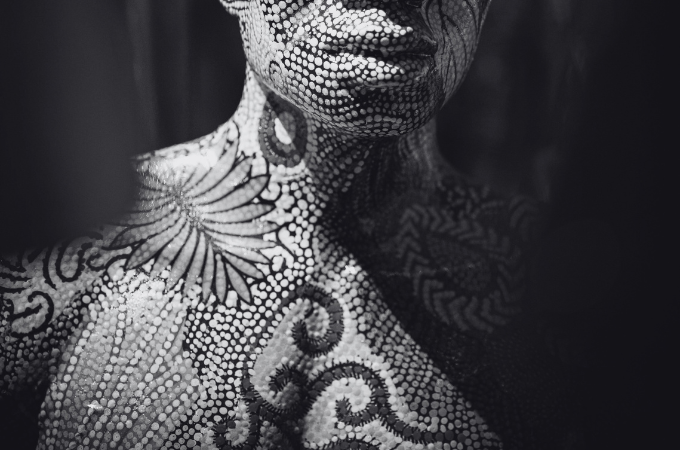
The palace of Benin City rose like a red-walled citadel from the heart of the kingdom. Bronze plaques caught the afternoon sun, their carved warriors frozen in mid-charge, while the air pulsed with the drumbeat of the Oba’s guards. Inside the compound, behind a curtain of ivory beads, Dokpa sat bare-chested on a low wooden stool, his skin gleaming with palm oil.
Before him lay the marking kit — a shallow calabash of soot-black pigment, a bundle of sharpened fish bones, and a strip of cloth for binding the wound. But this was no ordinary pigment. It was mixed with the ground shells of river snails and the sap of the ogbono tree, a blend known as Udi-Ase, “the root that remembers.”
Every royal scribe bore it beneath his skin. Each stroke cut into the flesh became a living record — a mark that could not fade, could not be hidden. The elders whispered that the ancestors themselves shaped the designs, guiding the hand of the mark-keeper so that the kingdom’s truth could never be lost.
Dokpa had been the Oba’s mark-keeper for twelve seasons. His torso and arms were a living chronicle of Benin’s reign: victories, oaths, treaties, births, deaths. The marks began at his collarbone and flowed down his arms like black rivers, curling into spirals and knots that told a story only trained eyes could read.
That afternoon, the bead curtain swayed and Chief Ezomo entered. He was tall, with a leopard skin draped over his shoulder, his wrists heavy with brass manillas. Behind him stood two guards carrying a chest bound in rope.
“Dokpa,” Ezomo said, his voice low and deliberate. “The Oba commands that the victory at Udo be carved upon you before the sun sets twice. It will be shown to the court and to the white men from Portugal when they arrive.”
Dokpa set down the fish bones. He felt the thrum of the war drums in his chest. “A victory,” he said quietly.
Ezomo’s eyes were sharp, “That is the story the kingdom will remember. You will carry it.”
But Dokpa knew the truth. The battle at Udo had been no triumph — it had been slaughter. The fields were still heavy with unburied warriors, the smell of smoke still clung to the night air.
“The marks remember more than we choose,” Dokpa murmured.
The chief’s gaze hardened, “Then make them remember what the Oba commands. Or the next marks carved into you will be those of a traitor.
***
That night, Dokpa prepared the pigment. He ground the shells until they were fine as dust, mixed them with soot and sap, and whispered the invocation his mother had taught him.
Marks that outlive breath,
Marks that speak beyond my tongue,
Carry the glory into the unborn days.
He took the first cut at the top of his chest. The fish bone pierced the skin, and the pigment bled into the wound. He shaped the strokes for “Udo” — a sweeping arc, a half-sun, a spear. He carved the symbol for “victory” beneath it.
But as the pigment settled, the lines shifted. The arc bent, the spear drooped. New shapes emerged unbidden — a broken wall, a body lying face-down, the curling smoke of a burning hut.
Dokpa stared, his breath shallow. He tried again, cutting the shapes for “triumph” along his right arm, but the curves warped into “loss,” the dots scattered into “fallen warriors.” The ancestors were inscribing their own account.
By morning, the palace servants were whispering. They claimed the marks moved like living things under Dokpa’s skin. Some swore they could hear them hum when they passed his chamber.
***
Two days later, the Portuguese arrived — pale-faced men in broad hats, their long coats heavy with gold embroidery. They brought bolts of cloth and brass bracelets for trade, and their translator walked close to the Oba’s side.
The great hall of the palace was filled with chiefs, courtiers, and envoys. Ivory tusks towered in the corners, the air fragrant with camwood smoke. The Oba sat upon the bronze throne, coral beads draped around his neck, his gaze fixed on Dokpa. “Show the marks,” the Oba commanded.
Dokpa stepped forward. As the guards untied the cloth around his torso, gasps rippled through the room.
The fresh marks blazed black against his skin — not the symbols of victory, but a stark, unflinching story: warriors cut down, huts ablaze, women weeping, the symbol for “retreat” curling like a shadow across his ribs.
Ezomo’s face darkened, “This is not the tale you were ordered to carry.”
Dokpa bowed his head but did not kneel. “Oba, the Udi-Ase does not lie. The ancestors have spoken through my flesh. To cut their truth away would cut away my life.”
The Portuguese watched closely. The translator murmured to them, and one envoy gave a small, knowing smile. The Oba’s gaze swept the room, “You stand before your king wearing shame upon your skin. Do you think the ancestors will shield you from my judgment?”
Dokpa raised his eyes. “The ancestors shield the truth. And the truth shields the kingdom, even from itself.”
The hall fell silent.
***
That night, Dokpa was taken from the palace. He expected the execution drum to sound before dawn, but it never came. Instead, he was led through the city gates and told he would never serve as mark-keeper again.
The Oba did not order the marks destroyed. Perhaps he feared the power of the ancestors, or perhaps he knew that to erase them would be to admit their truth.
Years passed. Dopka lived quietly beyond the walls, his skin a map of the kingdom’s hidden history. Travelers came to see the man whose marks defied a king. In the markets, storytellers traced the shapes in the air as they told of Udo — not the victory carved in bronze, but the loss etched forever in living flesh.
And sometimes, when the harmattan winds blew dust through the night, Dokpa would touch the oldest marks on his body and feel them pulse faintly, as if the ancestors still breathed beneath his skin.
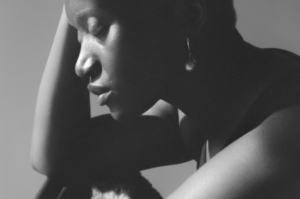
Photo by Florian Göpfert on Unsplash




COMMENTS -
Reader Interactions