

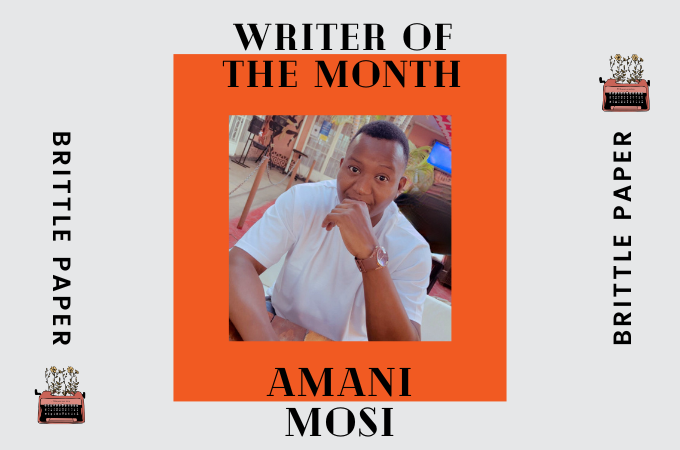
Brittle Paper’s Writer of the Month for November is Amani Mosi!
Amani Mosi is a Zambian writer and a Chartered Accountant, whose work explores identity, memory and the quiet resilience of the human spirit. His stories weave African traditions with modern reflections, revealing the beauty and complexity of everyday life.
Known for his lyrical storytelling and emotional depth, Amani brings to life characters caught between heritage and change, silence and song. Amani draws much of his inspiration from his late father, Mr George Chikosaula (God rest his soul), who loved reading novels but was not a writer himself. His father dreamed of writing, and that quiet passion now lives on in Amani’s stories.
At the start of his career, Amani’s stories were often side-lined or rejected. Determined to improve, he focused on mastering grammar and refining his written voice, which led to his first major publication in the African Writer Magazine in October 2024 with the story Seventy Kola. Since then, his work has been featured in All Your Stories (UK), Brittle Paper, Ubwali, Omenana and others, marking him as a rising voice in African literature. He was also shortlisted for the 2025 African Writers Award – Short Story.
He lives in Zambia, where he continues to write stories that celebrate African identity and human connection in their most authentic forms. He is currently working on his debut short story collection, Between Kola and Dust, exploring themes of belonging, masculinity, faith, and transformation through interwoven narratives set across the African landscape. Beyond his fiction, Amani is the founder of Christian Amani, a minimalist luxury fashion brand inspired by African pride and modern artistry.
Please join us for a conversation with the talented Amani Mosi!
***
Brittle Paper
Amani, congratulations on being our November Writer of the Month! Your fiction publication, “The Recipe Atlas Forgot,” was my absolute favourite piece from October!
Before I go off about all of the things I loved about it, we need to start from the beginning. So, tell us about who Amani Mosi is and how he became a writer?
Amani Mosi
Thank you so much. It’s an honour to be Brittle Paper’s Writer of the Month.
I became a writer because I’ve always been fascinated by how stories can capture the truth of human experience. I first came to understand the works of George Orwell and Chinua Achebe back in 2012 at Roan Antelope High School, while doing my literature class. Their writing opened my eyes to the power of words and the courage it takes to tell stories that matter. Around the same time, I also fell in love with Okot p’Bitek’s Song of Lawino, which deeply inspired me to explore African voices and perspectives in my own writing.
For me, writing is a way to explore life in all its contradictions, joys, and struggles, and to share those experiences with readers. It’s about capturing moments that feel real, imagining worlds that could exist, and giving voice to stories that often go untold. I’m drawn to the small, often overlooked moments that reveal who I really am. Much of my writing explores memory, identity, and that blurred space between what’s real and what we imagine. I’m fascinated by how people hold on to hope, how they endure, and how they find meaning in the ordinary rhythms of life.
Brittle Paper
Finding meaning in the “ordinary rhythms of life” is beautifully captured in your work!
The WotM tradition is that, before we chat about your work, I have three questions to help us get to know your literary personality a bit more. First up, did you have a story or book from your childhood that you still remember fondly?
Amani Mosi
Absolutely. The story from my childhood that I still remember most vividly is Animal Farm by George Orwell. I first read it in High School, and even as a teenager, I was struck by how a story about farm animals could reveal so much about power, corruption and human nature. It stayed with me because it was clever, clear and unafraid to speak truths that matter. Around the same time, I also came to appreciate Achebe’s Things Fall Apart, which showed me how African stories could carry the weight of history, culture and identity while still feeling alive and immediate.
These books didn’t just entertain me [smiles] they shaped the way I think about storytelling and inspired me to explore African voices in my own writing.
Brittle Paper
Is there a book, for good or for bad, that you think is not talked about enough?
Amani Mosi
I would say The Old Man and the Sea by Ernest Hemingway is a book that is not discussed nearly enough. I read it when I was twenty-two, and its quiet, unassuming power left a lasting impression on me. The prose is deceptively simple, yet it carries thoughtful truths about perseverance, dignity and the human spirit. Despite its literary significance, I find that it’s often overlooked in discussions of modern classics, and I believe more readers could gain both inspiration and insight from Hemingway’s mastery of restraint and depth.
Brittle Paper
The last question is always the same. If you could have a dinner party with your favourite artists, who would they be?
Amani Mosi
If I could host a dinner party with my favourite artists, [giggles] it would include Guy de Maupassant, for his mastery of the short story; George Orwell, for his piercing insight into society and politics; Chinua Achebe, for his unparalleled contribution to African literature; J.K. Rowling, for her imagination and ability to create worlds that captivate readers of all ages; and O. Henry, for his wit and brilliance in crafting surprising, memorable endings. I imagine such an evening would be filled with stimulating conversation, laughter, and an exchange of ideas that spans both time and geography — truly a gathering of minds that inspire me as a writer.
Brittle Paper
Amani, let’s talk about your intricately woven piece, “The Recipe Atlas Forgot.” I am a huge fan of short stories, and there is nothing I love more than when you can tell from the very beginning that this writer knows what they’re doing, and you can just fall into the story without knowing where it is going. You have such a wonderful knack of making the mundane seem interesting, and making the chaotic feel calm. I don’t know if this is making any sense, but it’s what I loved about reading this story!
What made you want to write this story? And how does one even begin weaving a tale like this?
Amani Mosi
Thank you for your kind words about “The Recipe Atlas Forgot” [smirks]. The story began with a fascination for the ordinary and overlooked — the quiet gestures, the unnoticed routines, the small acts of kindness that often go unrecorded. Atlas, as a character, came to me as a figure who carries both mystery and generosity, someone whose life is almost entirely private, yet whose presence can transform the world of those around him.
I wanted to write this story because I was curious about how observation, memory, and empathy intersect. The narrative grew from asking myself: what happens when we pay attention to the small, seemingly mundane details of other people’s lives? How do ordinary acts accumulate into meaning? In a way, Atlas embodies that accumulation — he is the quiet, unnoticed force that shapes his environment without ever seeking recognition.
Weaving a tale like this begins with patience and attentiveness. I start by imagining the textures of the environment — the sights, the smells, the subtle rhythms of everyday life. From there, the characters emerge, often in fragments at first, and I allow their actions and choices to guide the story. I pay attention to repetition, to small patterns, to silence and noise alike. Ultimately, it is a process of layering observation, memory, and imagination, letting the story find its own cadence rather than forcing it into a predetermined shape.
In essence, the story is an exploration of presence, perception and the quiet impact we have on one another — what we notice, what we leave behind and what we choose to carry. Atlas, and the apartment block he inhabits, allowed me to explore all of that in a single, contained world.
Brittle Paper
I like highlighting my favourite part of the work, to show the writer what grabbed me and what I want them to talk about. But with this story, I’m kind of overwhelmed because there are so many favourites, but also, I don’t want to take anything out of context because it all works so well. But the piece below is top of my list of favourites:
At some point, the game stopped being about the article. I wasn’t going to write about Atlas. Not really. This wasn’t reporting. It was obsession. The third week, he knocked on my door. Two short taps. I froze. You know that moment when you realize the monster in the story knows you’re reading about it? That.
I chose this excerpt because I like that it gives an idea of what the story is about, but it mainly explains what I mean when I said, you make the chaotic feel calm.
Amani Mosi
I’m really glad that excerpt resonated with you. That moment in the story was crucial for me because it marks the shift from mere observation to personal entanglement; the point where the narrator’s curiosity becomes something deeper, almost obsessive, and yet the scene is grounded in ordinary, almost quiet actions. I wanted the reader to feel the tension and the weight of discovery without it ever becoming frantic or overwrought.
Making the chaotic feel calm is exactly what I was aiming for there: Atlas’s presence is unsettling, mysterious, and disruptive, but the way the scene unfolds — the measured taps, the narrator’s frozen moment, the almost silent acknowledgement of what’s happening, creates a controlled, intimate space. It’s the interplay of suspense and stillness, the juxtaposition of what’s happening in the mind versus what’s physically occurring, that gives the story that sense of quiet intensity.
I’m thrilled it worked for you, and that it captured that balance. I think that’s the heart of the story for me, too: observing the extraordinary through the lens of the ordinary.
Brittle Paper
So, “The Recipe Atlas Forgot” was an October publication, but I was also privileged to publish another one of your stories earlier in March this year. That piece, “Sands of Redemption,” was also a remarkable story, and I’m in awe of how you craft such complex stories that you can read over and over again, simply out of curiosity that you might find another aspect to it the second or third time around. Can you talk to us about what inspired “Sands of Redemption”?
Amani Mosi
Thank you very much for your kind words. They mean a great deal to me — not only as a writer striving to refine his craft, but also as an individual continuing to grow through every story told. “Sands of Redemption” grew out of a fascination with dislocation and the fragility of memory. I wanted to explore what it feels like to inhabit a world that is at once familiar and alien, where the environment itself seems alive, testing and transforming the protagonist at every turn. The desert in the story is more than a backdrop, it’s a character, one that shapes the journey, challenges perception and mirrors the inner turbulence of the mind.
The story allowed me to examine the interplay between reality and imagination, loss and redemption. I was particularly interested in mirages, both literal and metaphorical, as reflections of desire, fear, and the truths we struggle to face. Walking the protagonist through these shifting sands gave me the opportunity to explore resilience, vulnerability, and the small gestures — like footprints, notes, or a fleeting presence that anchor us even when the world feels unmoored.
In crafting the story, I wanted the reader to feel the protagonist’s disorientation, yet also discover moments of clarity, intimacy and revelation. The repetition, sensory detail and subtle shifts in perspective are intended to immerse the reader in the rhythm of the journey, so that each rereading might reveal a new nuance or connection.
In the end, “Sands of Redemption” is a story about navigating the extraordinary while seeking traces of the ordinary; a meditation on survival, memory, and the quiet, often unseen ways in which we are guided, sustained, and redeemed.
Brittle Paper
Besides the two Brittle Paper publications, I’ve also read some of your other works, such as “Dust and Echoes,” published by Omenana. Do you often focus on speculative fiction and mystical elements in your work, or am I just picking that up from these three stories? And are there other forms and genres you love experimenting with?
Amani Mosi
You are quite right in noticing the speculative and mystical undertones that permeate much of my work. I have always found that such elements allow one to engage with the human condition from a slightly oblique angle — to examine memory, guilt, or redemption through an imaginative lens that transcends mere literalism. The surreal, when handled with restraint, can often reveal more truth than the plainly real.
That said, I do not consider myself bound exclusively to speculative fiction. My literary interests are varied, and I have often gravitated towards realism when a story demands emotional precision and quiet introspection. A good example of this would be my story, “Nine in the Morning,” published by African Writer Magazine, which unfolds within the confined moral space of a man confronting his own failures. It is a domestic narrative without any trace of the mystical, yet it explores the same enduring concerns that preoccupy my more speculative works — guilt, choice, and the quiet erosion of self.
In essence, I see genre as a vessel rather than a boundary. Whether through the surreal desolation of “Sands of Redemption,” the psychological labyrinth of “The Recipe Atlas Forgot,” or the unflinching realism of “Nine in the Morning,” my intent remains constant: to explore how people navigate the fragile terrain between their desires, their delusions, and their truths.
Brittle Paper
For readers like me, who absolutely love your stories, the exciting news is that you are currently working on a short story collection. What can you tell us about Between Kola and Dust?
Amani Mosi
Indeed, I am presently compiling a collection of my published short stories under the title Between Kola and Dust. The project is, in many ways, a culmination of years of writing and observation, bringing together works that have appeared across various literary platforms, including Brittle Paper, Omenana, Ubwali and African Writer Magazine.
The collection traverses a range of tones and settings, from the speculative and mystical to the quietly realistic. What unites the stories, I hope, is a shared concern with memory, human frailty, and the small yet thoughtful moments that define our lives. The title itself — Between Kola and Dust — is emblematic of this: a nod to both the cultural textures of everyday African life and the ephemeral, sometimes fragile, nature of existence.
In assembling this collection, my aim has been to offer readers a coherent experience that both surprises and resonates, allowing them to traverse the familiar and the uncanny, often within the span of a single short story. It is, in essence, a reflection of the worlds I have been privileged to write about and the voices I wish to honour.
Brittle Paper
Before we go, apart from all of the wonderful literary worlds you share with us, Amani, what is one thing about yourself that you want to share with our readers?
Amani Mosi
Before I take my leave, I must first extend my gratitude — to God for His light, to my mother and brother for their unfailing faith in me, and to myself for not surrendering when the odds seemed insurmountable. Between Kola and Dust is not merely a collection of stories; it represents years of graft, of picking myself up after setbacks, of turning the ordinary and overlooked into something worth committing to the page.
To emerging writers, especially those from corners of the world not often celebrated, I urge you to hold your head high, trust your own voice, and never let doubt creep in to steal your courage. The road may twist and turn, and at times it may feel like you are shouting into the void, but with persistence and belief, doors will open; sometimes when you least expect it.
It has been a tremendous privilege, and truly a dream come to fruition, to be interviewed by Brittle Paper as a Zambian writer. I hope that my stories offer readers a mirror to their own experiences, a spark to ignite their imagination, and a reminder that even in quiet corners, remarkable narratives are waiting to be told.
As for something personal to share: I have always found that writing is as much about listening as it is about speaking. I tune into the world around me — the silences, the half-heard conversations, the fleeting gestures and shadows of everyday life, and I try to give voice to what might otherwise slip through the cracks. That habit of observation, coupled with a stubborn refusal to give up on my own imagination, is what drives me forward, and what I hope will encourage others to keep their own fires burning.
Brittle Paper
Amani, thank you for sitting down to chat with us, and for sharing your gorgeous work with Brittle Paper’s readers! We can’t wait to read Between Kola and Dust!
To read more interviews with our writers, check out October’s with Salmah Salam Oiza here.




COMMENTS -
Reader Interactions