

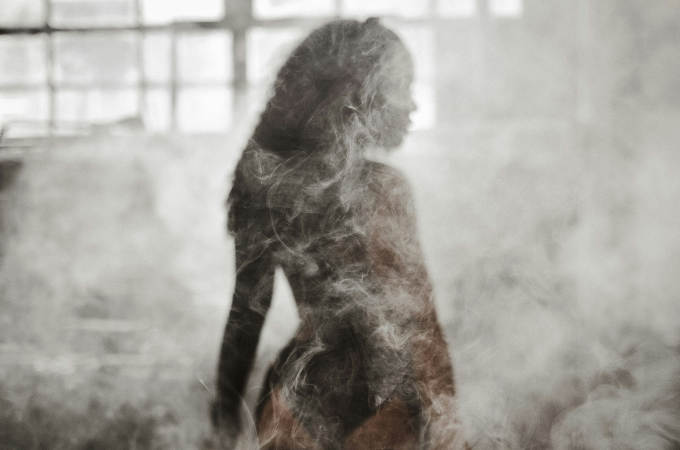
In the small town of KwaNobantu, South Africa, a place that no map recognises and no road ever seems to lead to, women turned to smoke.
At first, it was mistaken for ash-housework. The women gathered daily eziko (hearth or fireplace) to create love and community so no one would have batted an eye at the smoke. Their hands greyed, thinned and eventually vanished. When Ayanda’s husband struck her for thinking too loudly at dinner, her adult son laughed and pointed to her dissolving knuckles. Phumelele, her husband said it was a trick of God in heaven. When she reported it to the police, Officer Thabo blew smoke from his half-consumed cigarette into her swollen, black and blue face and chuckled, “Must be your hormones, dear. I live with this exact smoke in my house, I know how this goes. Women provoke us men every time they get on to that thing they get on. The “monthlies” they call it. It is all nonsense. Dog’s bollocks if you ask me.”
Each silencing word sped up the transformation. From fingertips to wrists, elbows to shoulders, until her whole body thinned into a careless whisper of self. By the time her daughter spoke up and said, “Mama is missing,” Ayanda was a mere mumble, weaving unwillingly through the hallway windows. She did not vanish. That would have been a mercy, a blessing. Instead, she lingered.
Soon, the whole town was covered in smoke. Bruised, battered and broken women moved like forgotten lullabies through homes, classrooms, and churches. Women who were once loved babies were now forgotten and discarded. They hovered over sleeping infants, whispering secret protection spells in hopes that they could shield them from the fate they faced. “Baleka mntana. Baleka ude uyofika emlanjeni. Baleka ude uyofika apho kungenje.” They brushed past old wedding photographs, where love once lived and curled around sacred texts and expired, tattered passports. They could whisper, and they did. Long, looping phrases in isiXhosa, “Sikhona, sikhona,sijongeni” then silence but no one listened. Only other women who had turned to smoke could feel the tremor of their breath and the sorrow in their exhale.
The murderous men walked right through them, offering absentminded shrugs and negligent nods when chilled by their presence. “The weather really is changing,” they’d say, rubbing their arms. “This winter is going to be brutal.”
It wasn’t the weather.
It was Ayanda Moko who’d been gaslit into embers, into smoke. It was Aunt Nomhle, pressed into silence beneath church hymns and her husband’s fists. It was little Poonkie, age seven, who said her uncle, “touched her wrong” and was told that lying about adults was a grave sin. That children who lie about adults upset God and are sent to hell. It was Lusapho who had been punished for living her truth. Who had been told, “Maybe if I do this you will stop trying to be a man and remember what women are supposed to act like.” It was Uyinene Mrwetyana. It was Karabo Mokoena, Tshegofatso Pule, Joshlin Smith, it was all the women and children who had been harmed by a man. For these women, no graveyards were needed. Just high ceilings and sharp corners.
Then one day, The House arrived.
It did not appear. It unfurled. It grew, not on land but from it like a boil or a buried organ. One morning, there it was, flesh-coloured, wet-walled and sighing. The House unfurled with a wet crack, like cartilage splitting under tremendous pressure. It rose screaming, wailing and yelling from the dirt. A tangle of timbers and bone-coloured plaster slapping outward in sporadic spasms. Its floorboards shrieked as they bent in and out of place, groaning with splinters, shutters snapped open like the jaws of caged sharks. The nails which kept The House together sang high, metallic wails as they flew into sockets that were not meant for them. The ground bubbled with a mucous gurgle, like that of a sick baby. It birthed walls that thudded into being with the dull impact of fresh, bloody meat against clean marble. Pipes wept and moaned and gnashed in the walls like cracked teeth grinding against old enamel bowls. Windows vomited panes that cracked and shattered in a stuttering, dissonant chorus of glass-like ululation. It was not built, no, it erupted, a herniation in the landscape, a cystic citadel clawing itself into architecture.
Located in the centre of KwaNobantu, where a playground once danced, it moaned continuously. A low and ancient dirge that smelled like burnt milk and bloody daisies. The House had no doors, only open, pulsing wounds. Inside it were pulsating walls. The walls murmured and whispered names that had not been heard or spoken in years. Each time a woman turned to smoke, The House cried out a long, gelatinous scream that made dogs run backwards and birds of prey fly in loops. It sounded like the weeping and the moaning and the gnashing of teeth.
The men spoke of it in circles. Their eyes averted and mouths full of silence, they insisted nothing had grown there and nothing had ever stirred. The men spat lies through cracked, blackened teeth. They swore no such thing writhed beneath the soil, no disgusting mass and no birthing smell filled the air. The men denied its existence. They laughed loud with wide eyes and slick tongues. They claimed daily that nothing throbbed beneath the floorboards, though their feet trembled when they walked. They were afraid yet they claimed no house grew and no wound sang. They called it heresy. Said it was a vile deception whispered by the damned women. “No house had grown there,” they said with arrogance. “No sacred rupture in the earth could come from that soil,” they sang in gross harmony. They charged it to the madness of femininity. Every day their prayers grew frantic, but their eyes flickered. They feared what pulsed beneath, for The House was not built by hands but by hunger, pain and hymn.
Mayor Thabo Thabethe called it “an emotional rumour fuelled by the delusions of women.” Reverend Wright called it “Satan’s satire.” Ordinary men slapped and struck women for daring to mention or whisper of The House, that throbbing mass, that incorrect geometry clawing from the soil. Their denial came with bruises as if violence could silence the scary architecture of madness. More smoke slithered from unseen fissures curling upward in dark, thick and choking ribbons that sang of death and betrayal. The sky soured. Entire households loosened from their foundations and lifted like drifting bones, weightless. Floors creaked and cried as they rose. The windows wept dark ash, and the furniture hung in the dark air like sacrificial offerings to a God no longer known.
Still the men swore nothing had changed.
One woman, only known as The Grave floated above the courthouse daily, singing the names of missing women. Despite the sweet but ominous noise no one looked up. Eyes remained fixed on neon screens and newspaper articles on what the who’s who of Hollywood were wearing or having affairs with. Curiosity about what was going on around them found no home in their eyes. Their attention was consumed elsewhere. The world shifted but no one looked up.
Soon, every boy child in town had a smoke mother and sister. Schools smelled of cloves, cinnamon and absence. Whenever teachers stepped to the front of the classrooms with chalk in hand and began to write on the smooth black surface, words appeared clearly, glowing faintly white, only to vanish seconds later. They vanished as if the boards had minds of their own. No erasers were needed. Each equation, each sentence disappeared just as quickly as it came, making room for the next lesson to be learned. Students watched with intrigue trying to catch each fleeting phrase before it dissolved into thin air. Into nothingness. The blackboards seemed to have come alive, and they only responded to the rhythm of the cries of women and children. They seemed to constantly clear themselves like waves on the beach washing away footprints in the sand.
In the one and only hospital in town, girls were born with smoke in their brittle bones. Their tiny translucent fists unable to be held or to hold.
A man named Logic tried to bring order.
He held town meetings in his sleep and gathered crowds of his imaginary friends in the dim glow of unconsciousness. There, with magnificent ceremony and self-importance, he rose to speak from a podium made of vapour. He stood only to accuse the women of KwaNobantu. Silent figures that hovered at the edge of stolen dreams. He said, “They’re too sensitive. Too magical” and worst of all, “not real.” His voice shook with conviction as he handed out hand-drawn, made-up charts and dubious graphs which had the task of disproving the existence of “whatever these women seem to moan about.” The diagrams were covered in arrows and equations that the men in attendance pretended to understand.
But Logic, as he called himself, was an unreliable narrator. He wore seven watches strapped to his arms and one around his neck. Strangely, none of them told the same time. Sometimes, they ticked in opposite directions. He claimed this was evidence of a grand conspiracy against clocks. He had large and unimaginable conspiracies, yet people still came to listen to him speak. They all claimed to use him. His nonsense felt familiar to them. It felt like the truth.
His friend, idealism, now sits in prison. Locked away in a concrete cell of consequence and compromise. She once stood boldly in the town square with chivalry and innocence, who died weeping. They preached of hope, justice and change with hands wide open. They believed in the better angels of our nature, in progress through bold passion, and they believed in the triumph of good intentions. Unfortunately, over time, idealism was deemed inconvenient, chivalry self-destructive, and innocence too naïve. All three questioned the way things were and for that they were punished. Shackled by Realism, laughed at by Pragmatism and convicted by Power and now, idealism sits in solitude, chivalry died by its sword, and innocence lies six feet under.
In the shade of The House, things warped. Time curled like dried prunes. Birds nested in The House’s sobbing and leaking eaves, and sang lullabies backwards. A woman named Memory lived inside the chimney and silently sang visions into the ash:
The House is the laceration.
The Smoke is the truth. The blood. The proof.
And Denial is the spell.
But she burned dry, and no one noticed. No one cared.
Then, a woman came. A woman with no name and no past. She was made entirely of smoke with solid, big eyes. She stood in the throbbing doorway of The House and said, “We are not gone. We are here and we are waiting.”
The House responded with a cry that folded the sky in three.
An old man named Reason collapsed. His ears bled petals from the graves. He kept asking what language the smoke spoke and why the world was suddenly unrecognizable.
No one answered. No one had an answer. No one could answer. There were no answers.
Eventually, the men stopped speaking altogether. Their words hung in the air like wet laundry but never dried. They continued their lives. They carried on eating from invisible plates, unable to live without the women they claimed were useless. They carried on with life, embracing women who were no longer there and dancing to music that only repeated the sound of screaming.
Still, The House grew.
It is said that if you walk backwards into KwaNobantu with your eyes closed and your heart open to contradiction, you might hear them. Hear them weep for their children. Hear them moan for their mothers, and it is said you can hear their teeth gnashing in pain for their sisters.
The Smoke Women laughing loudly through lament.
The House, groaning in grief.
The truth, too large for your ears to hold.
And if you open your mouth too wide, you might inhale someone you once loved. And then what will you say?
Baleka mntana. Baleka bhabha. Baleka ude uyofika emlanjeni. Baleka ude uyofika apho kungenje.
Run my child. Run my baby. Run until you get to the river. Run until you get to where it is not like this.
Sikhona, sikhona,sijongeni
We are here. We are here, look at us.





Phokela November 12, 2025 06:49
What a hauntingly beautiful way to bring awareness to the current reality eating away at our country. Brava!