

Jamarcus Ward crossed into Halcyon five minutes before sundown. The sign stood at the county line, half-rusted but carefully maintained, its letters glowing faintly as if lit from beneath the skin of the metal.
WELCOME TO HALCYON
DAYLIGHT IS FOR EVERYONE
No mention of what happened after.
Jamarcus slowed his truck, hands tightening on the wheel. His retinal implant flickered—an involuntary response to unfamiliar surveillance fields. Halcyon hummed, a low electrical vibration that settled into his bones the way desert rotors once had. The sound carried memory. It always did.
He exhaled, counted four beats in, six beats out. The VA therapist had called it grounding. The Army had called it “failure to adapt.”
The truck rolled forward.
Halcyon looked preserved rather than old—white houses in symmetrical rows, porches swept clean, flags arranged with careful neutrality. No people. No children. No movement except the soft pivot of surveillance cameras embedded in lampposts and rooflines. Even the mailboxes had eyes.
Jamarcus had survived Kandahar, Basra, and the coastal reclamation zones after the floods. He had survived smart bombs and dumb politics. But towns like this—quiet, watchful—had always unsettled him more than war.
The engine coughed.
“Don’t do this now,” he muttered.
The truck sputtered and steadied, as if reconsidering.
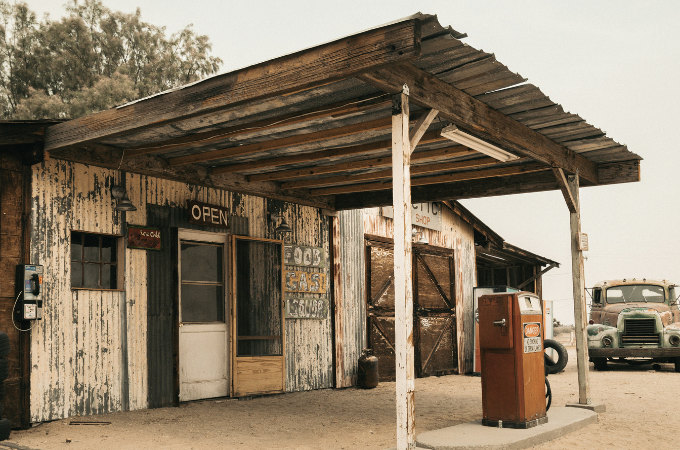
Jamarcus turned into the only gas station still lit, its canopy glowing sterile white against the dimming sky. A drone hovered near the pumps, black and oval, projecting prices in midair.
The moment Jamarcus stepped out, the drone chimed, “IDENTITY VERIFICATION REQUIRED.”
He froze. His right hand twitched toward a sidearm that wasn’t there. He curled his fingers into his palm until the reflex passed.
“Just getting gas,” he said evenly.
The drone adjusted its angle.
His implant buzzed behind his left eye. WARNING: ELEVATED CORTISOL LEVELS DETECTED.
“Yeah,” Jamarcus muttered. “No kidding.”
The station door slid open. A man stepped out wearing a pressed uniform the color of bone. Sheriff’s badge. Clean boots. Too clean.
“You passing through?” the sheriff asked. His voice was polite. His eyes were not. Data scrolled faintly across his augmented irises.
“Looking for my grandmother’s house,” Jamarcus said. “Etta Mae Ward. She lived here in the forties.”
The sheriff smiled, thin as a paper cut. “We don’t keep records that far back.”
The pressure began then—the tightening behind Jamarcus’s temples, the warning tremor before memory bled through. Sand. Heat. A child screaming in a language he hadn’t known.
Focus.
“She died here,” Jamarcus said. “Didn’t she?”
The smile didn’t change. “Sir, it’s almost sundown.”
The drone chimed again, “CURFEW IN TEN MINUTES.”
Jamarcus turned back to the pump, “Then I’ll be quick.”
As the fuel flowed, his implant betrayed him. The present flickered, replaced by an overlay of the same station decades earlier. No drones. No lights. Men in rolled-up sleeves. Rope coiled like a promise.
Jamarcus staggered and braced himself against the truck.
“You alright?” the sheriff asked.
“Fine,” Jamarcus said. The lie tasted old.
The pump clicked off. Jamarcus replaced the nozzle and climbed back into the truck. As he pulled away, the sheriff raised two fingers—not a wave. A signal. The drone followed.
Doors closed as the sun sank. Lights went dark in careful succession, like a town rehearsed in disappearance. Jamarcus drove deeper into Halcyon, guided by addresses scavenged from his grandmother’s letters—burned pages recovered after her death, edges blackened but legible.
She hadn’t left Halcyon alive. The official record said relocated. The truth had always lived in the silence afterward.
His implant pulsed again, involuntary. He saw Etta Mae as a young woman standing on a porch, clutching a bundle to her chest. Fear radiated from her in waves. A baby cried.
Not him, he told himself. The vision fractured.
WARNING: MEMORY BLEED DETECTED.
“Shut up,” Jamarcus whispered.
The drone dipped lower, “CURFEW IN TWO MINUTES.”
He turned sharply down a side street, then another, heart pounding. The house appeared at the end of the block—smaller, sagging, paint peeling like sunburned skin. Unlit. Unwatched. Or pretending to be.
Jamarcus parked and ran. The door opened with a groan. Inside, the air smelled of dust and old fear. His implant adjusted, mapping heat signatures.
None.
He moved through the house slowly, every step deliberate. The walls flickered—past and present colliding. Whispers threaded through the hum of distant machinery.
In the back room, he found it. A machine sat against the wall beneath a tarp, its silhouette unmistakable. Military-grade neural echo capture.
“What were you doing, Grandma?” he whispered.
The Army had abandoned the program decades ago after ethics boards declared it psychological warfare against civilians. The machines recorded emotional imprints from trauma-saturated environments and replayed them, amplified. Used to break resistance. Used to erase will.
Etta Mae Ward had one.
Jamarcus pulled the tarp free. The machine powered on.
Halcyon, 1942.
The street was crowded. White faces blurred together, mouths open, voices sharp with anticipation. Jamarcus felt Etta Mae’s terror slam into him, raw and overwhelming.
“Don’t look. Don’t run.”
A shout split the air. The rope snapped taut.
Jamarcus collapsed to his knees. His PTSD surged, war memories folding into lynching memories until there was no distinction between battlefield and hometown. His implant screamed warnings as it overloaded.
“Stop,” he begged. “Please—stop.”
The machine did not stop. It showed him everything.
Halcyon had learned to feed on fear. To capture it. To store it. The town’s calm wasn’t nostalgia—it was preservation. Surveillance wasn’t for safety. It was harvesting.
That was why the curfew mattered.
Jamarcus tore cables from the wall. The vision stuttered, then surged harder. The machine adapted.
Sirens wailed outside, “CURFEW VIOLATION DETECTED.”
Jamarcus slammed the machine’s core against the floor. Sparks exploded. The house shuddered as if waking from a long sleep.
The vision shattered.
For a moment, there was silence.
Then the walls screamed.
Halcyon erupted.
Lights flared across the town. Drones swarmed the sky like metal insects. Jamarcus burst from the house, clutching his head as pain tore through him.
The sheriff’s voice boomed from every speaker, “Jamarcus Ward. You are destabilizing municipal harmony. Surrender.”
Harmony.
Jamarcus laughed, ragged and unsteady. “You built this place on ghosts.”
A drone fired. Brick scorched inches from his shoulder. Training took over—movement sharp, efficient. He ducked into an alley, breath controlled, body remembering what the mind wanted to forget.
But this wasn’t a war he could win with bullets.
He reached into his jacket and pulled free a signal spike—illegal, unstable. He jammed it into the port behind his ear, bypassing implant safeguards.
Pain detonated. Jamarcus screamed as memory, fear, and history tore loose. And then he broadcast.
Everything. Etta Mae’s terror. The rope. The crowd. The decades of harvested silence.
The signal flooded Halcyon’s network.
Cameras burst. Drones fell, smoking from the sky. Houses flickered, projecting images they had hidden for generations. The town convulsed under the weight of its own memory.
Jamarcus collapsed to the pavement, blood streaming from his nose.
The sheriff staggered toward him, implant glitching. “You don’t understand,” he hissed. “This is how we survived.”
Jamarcus looked up at him. “No,” he said. “This is how you hid.”
The sheriff raised his baton—
—and froze.
Dropships thundered overhead, descending in columns of light. Federal insignia gleamed on their hulls. Loudspeakers crackled, “HALCYON MUNICIPALITY, POWER DOWN AND COMPLY.”
The sheriff looked around, lost. Jamarcus closed his eyes.
They found him at dawn. Wrapped in a thermal blanket. Shaking. Alive.
An agent knelt beside him, her voice gentle, “You did something important.”
Jamarcus stared at the horizon where Halcyon smouldered. “I just listened.”
She nodded. “Your grandmother didn’t build a weapon,” she said. “She built a witness.”
For the first time in years, the hum in Jamarcus’s head softened.
The sun rose fully, washing Halcyon in light that did not discriminate.
Daylight, at last, was for everyone.
Photo by Jakob Owens on Unsplash







COMMENTS -
Reader Interactions