

I.
I recall that it was sometime in August, during one of the long school breaks. We were lean teenagers, sprawled on the brown sunbaked soccer pitch, exhausted from play. Eleven boys in all, chattering about a young man who lived close to the village high school and owned a BlackBerry. His name was Echezona, but we called him fineboi because he was handsome, with a rugged, laid-back zing. Fineboi, too, because he let us touch his BlackBerry – which was all the rage then – running our fingers over its fragile sleekness. We admired his stylish baggy jeans and liked the way he greeted us with a tender fist bump. Fineboi was cool in the same way we talked about Chris Brown, until one of the boys that afternoon in August, serious-faced, said fineboi was an okpontu.
He said he had seen videos on the BlackBerry of men being with each other in ways a man should be with a woman. Bizarre recordings of men grunting, men kissing, men fondling, men sucking. Okpontu. His voice was low. As he spoke, I could tell, in the way his face twisted in a grimace of disgust, in the way he evaded our eyes, in the way he said okpontu in a tone so casually lukewarm, in the way our shock was disbelievingly loud, that we would never look at Fineboi the same way again.
Hate begins with a naming — the summation of a person into a singular character, complete in its condemnation. In Igbo, Okpontu is a colloquialism used to refer to homosexuals. It loosely translates to ‘one who nails in;’ a person with the capacity to forcefully or violently rupture. I sat with this translation for a very long time, worried about the word’s insistence on not seeing me as a person with a particular tenderness, or a boy who felt things with excess and confusion, or even a sinner in the relatively dignified biblical tradition, but as an act of pure, monstrous violence. In my worry, at twelve, I felt in a way I could not have articulated then, betrayed.
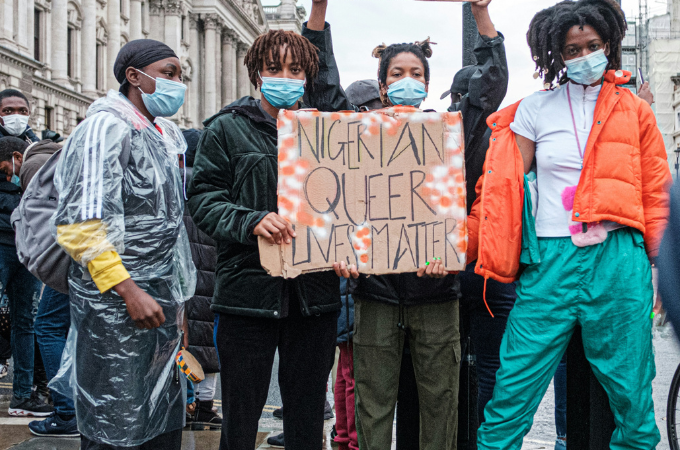
I read somewhere that language isn’t neutral; it is how power tells you who to ignore. So, this is where we must begin: with betrayal. Because the conversation Nigerians are presently having about queer people in media is not, despite its passionate volume, actually about media. It is about the ancient, carefully maintained comfort of not having to see us.
II.
Let us address the choking directly. You are, I understand, by your own dramatic account as heterosexuals of this British-assembled, colonial-christened entity called Nigeria, being force-fed homosexuality through television screens, streaming platforms, and social media timelines.
A gay character appears in a series and the comment sections fill with the vocabulary of assault. They are pushing this on us. Who asked for this? This is propaganda. A nation amalgamated with the administrative casualness of someone rearranging furniture, a nation whose legislative house is a gathering of docile zombies, a nation of people with the lowest life expectancy rate, people who cheerfully navigate 80% unemployment, people with sustained theft of their oil wealth, people with musical talent that attends to the woman’s body as muse in the most objectifying form, and Nollywood’s inexplicable commitment to four-hour films celebrating crass materialism. And it is the presence of a gay character in a Netflix drama, an optionally negligible foreign franchise, that is pushing Nigerians to the absolute limit of their endurance.
The satirist’s task is, often, simply to arrange the facts in the correct order. So, I will be precise about what is actually happening when a queer character appears in your media. What is happening – and I appreciate that this is its own kind of violence for those unaccustomed to it – is that you are being asked to briefly, temporarily, share the narrative space with a person whose life is unlike yours. You are being asked to extend the same imaginative generosity that you extend automatically when you watch a film about a Yoruba man if you are Igbo, or a film about a wealthy family if you are not, or a film about a woman navigating love if you are a man. You are being asked, in short, to be a reader. And it is a terrible irony that a nation of people who endured the profound violence of having their story colonized, erased and rewritten by strangers should be so resistant to the project of any group telling their story.
We might make this argument less embarrassingly local and look, for a moment, to the way media reshaped racial imagination elsewhere. In the United States, for instance, it was visibility that reframed black lives from caricature to complexity. Think of the way television shows, documentary films, and novels pierced the blandness of stereotype and replaced it with the dignified complexities of black lives. Did racism end? Obviously not. But it softened the polarities. It made certain racial anxieties less comfortable. The same thing happens when there is a humanizing representation of queer people in any art form. Visibility is not propaganda. Visibility is the antidote to propaganda. Invisibility is propaganda – it is the sustained, deliberate lie that certain people do not fully exist.
Okpontu is a reductive propaganda. The word a culture reaches for when it names a thing reveals what the culture believes about that thing. So, in reducing the intimate human relations or feelings between same-sex to a word as okpontu, a word guarded in a cold repulsion, we cruelly strip queerness of personhood, extracting it from all context and rendering it as pure aggression. This is precisely what queer representation in media, in any artform, refuses. It refuses the reduction. It insists on showing you the full person, which most times, in this democratic crisscross of social, legal, and religious hostilities, is often a sad, sad person.
Sometime in 2022, a Nigerian online magazine, Isele, made a call for submissions on creative works centering queer joy. As a creative, I was eager to write, eager to send in a submission. I began creating stories, inventing characters, structuring plots that explored the joy in queer existence. I turned to my life, to the lives of my queer friends, sifting through the restrained agency of our living, overwhelmed with and saddened by how little of it held the possibility for joy, for happiness. I began to think of Uche, an impressive fashion designer in central Aba, who when disowned by family for being gay, left home in search of home elsewhere. I wrote briefly about Kene in Calabar, who on a random Friday called over the phone to say he was physically assaulted on the street by total strangers for walking ‘a certain way.’ I thought of writing about Dave, camera shy and melancholic, then remembered he visited a man’s house one September and has never been found again. There was Nkechi, sad Nkechi, who over a bowl of hurriedly made Abacha confessed she still tries to pray the gay away every night, and each night, she cried and she choked and God was always silent.
In this quiet distrust of what it means to be gay and happy, I am beginning to believe that maybe happiness in its vulgar nature is an indulgence of possible sorrow. As James Baldwin, the gay American writer, says, “I know that I and the people I love may perish in the morning. I know that. But there is light on our faces now.”
III.
There is a particular species of Nigerian argument I want to address because it will certainly be deployed against this letter. It goes: This is not our culture. Homosexuality is Un-African.
The anthropological record disagrees, comprehensively and without ambiguity, but let us set that aside. Let us instead note that the argument is being made in English, on the internet, by people whose current relationship to their culture is otherwise – and this is being said with genuine love – quite selective. The Nigerian who eats jollof at Christmas, drives a Japanese car, worships at a Pentecostal church established by an American televangelist, wears a suit to the office in the irate sun, holds an iPhone, watches American films on a Korean television, and uses British law to prosecute his neighbors is making a very particular choice when he decides that the one thing he will defend with absolute cultural fidelity is the exclusion of queer people.
Culture, in Nigeria as everywhere else, is constantly negotiated, constantly hybridized, constantly in conversation with the wider world. The question is never whether we will be influenced. The question is what do we become in the face of this influence? What do we become when our response to benign difference is the overt inclination to violence?
We become homophobic, threatened by the unfamiliarity of a social phenomenon rooted in nature. Unlike any other form of fear, homophobia, in its most curious state of appeal, is logically handicapped. It promises a reason for prejudicial discrimination but comfortably fails at the feet of plausibility. When questioned over and over again, homophobia becomes a circus of utter absurdity, the homophobe an eager clown.
We become murderers. Armed with the religious delusion of cleansing the society of sodomites, we throw queer people from story buildings to their death, their bodies a shattering of innocence. Desperate for social applause, we brutally club effeminate gay men in the silence of the dark and leave their bodies, nude and soulless, by the roadside. We visit queer homes under the pretense of endearment, then stab them in the chest and watch their bodies become blood and more blood. A body is only a body because it can bleed.
We become oppressors like the errant heterosexuals in the streets of Lagos and Abuja who in the wake of the SSMPA, took up arms to hunt down gay men like wild rodents. Or like a close relative of mine, a catholic priest, who admonished my cousins to be physically aggressive towards me, and that their indifference was a tactful encouragement of my sexual lifestyle.
We become apathetically irrational; it doesn’t affect us, so it is not of our concern. We redefine humanity as graceless individualistic living, and the concept of neighborhood as a redundant idea, rife with drama.
Above all, we become monsters, virtuously in self-denial.
IV.
I want us to be better than this. I am asking for this plainly, without the satire, which I will now, for a moment, set down.
Last year, while I was in law school, a friend dubbed me ‘Dodo,’ which is Yoruba for plantains. He said it was because he could not get his eyes off me, alluding to the careful attention needed to fry plantains to a golden deliciousness, lest it burns. At first, I thought the name silly, the allusion a little too dramatic, too brashly sentimental. Now, when I think of the word ‘love’ and its Igbo variant, ‘Ifunanya’ – to truly see a person, I am beginning to consider the eyes as the most privileged body part for its capacity to behold, to have at its will, perspective. And this is the premise of empathy.
Empathy is the ability to love even in the absence of understanding. It is a permission of dignity. And it is no surprise how little empathy we have in the face of divisive social, political, and religious constructs. Nigeria is a country of extraordinary intelligence, creativity, warmth, and potential, shackled by a profound difficulty in extending its famous communal generosity to those who fall outside the circle of the recognizable. We are good at loving our own. We are less practiced in the larger love, the love that does not require the beloved to be familiar.
The nation that learns to sit with its discomfort long enough to discover the person on the other side of it, is a nation building something worth building. The nation that cannot manage it remains exactly what colonialism made it: a collection of people sorted by power, where those at the bottom are kept invisible for the comfort of those above. This is, simply, the oldest trick in the book. And some of us are done maintaining the illusion.
The writer is a gay Nigerian man. He is also, in case it needs saying, a person – extravagantly, inconveniently, specifically.
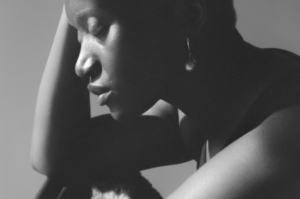
Photo by Ehimetalor Akhere Unuabona on Unsplash



George Essien May 27, 2026 17:14
reading this tonite and it has been a mix of emotions. The homophobe being an eager clown is so hilarious and the idea of the legislative house being a gathering of docile zombies. Yo sabi write. Loved the part about the eyes and empathy, very beautiful. P.s can I call u Dodo if and whenever I get to see you?