
Here is a fact that sticks out in my mind like a sore thumb. Almost all bronze statues of women around the world (most of them built in their good memory) have been rubbed down countlessly on one particular area. Their breasts.
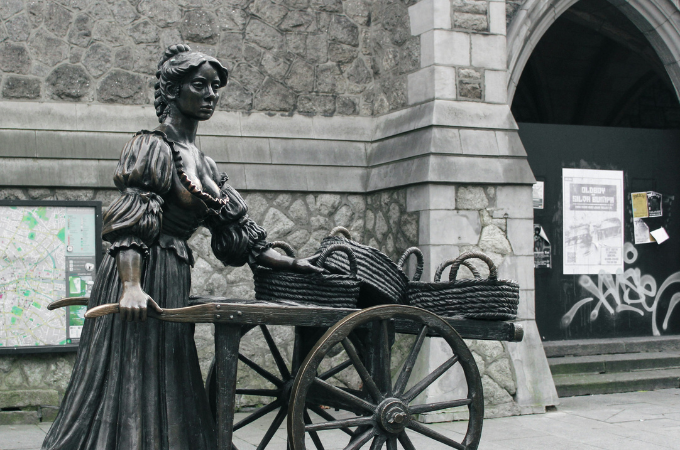
Take the famous Molly Malone bronze statue in Dublin, raised off her mysterious legend. There she stands, her face impassive, her gait strangely beautiful, holding her wheelbarrow with both hands. She seems to me a person determined to go about her business in the city. On her bronze body, the testament to years of touching shows, discoloured from constant use. Her breasts are fondled, grabbed and kissed every day. Every time I see pictures or videos of Molly Malone, a chill starts down my spine. I feel oddly connected to her, for I know that if I were to freeze into a bronze statue at this very moment, I would be subjected to the same fate as Molly Malone.
Recently, a woman was kicked out of a Virgin Australia business lounge for pumping breast milk. She was told that she was making other people uncomfortable, despite the fact that breastfeeding is protected under the Sex Discrimination Act of 1984 in Australia. As I watched her angry rant on social media, this breastfeeding mother wronged and embarrassed for doing one of the most natural things ever, I again felt oddly connected to her. I imagined myself sitting in that lounge, the soft flesh of my child in hand, cheeks hot with shame as a staff member pointed to the door, telling me to leave.
I was on my usual social media prowl when I came across a video that gave me a horrified pause. It was a Japanese billboard advertising some game or product. I am grasping at straws trying to conjure a picture of this billboard to you, but I’ll try. On the billboard was an animated girl with gigantic breasts. Every five seconds, she giggled childishly and leaned forward, her freakishly oversized breasts spilling out of her shirt. It is a weird, illogical video, one that keeps playing in my mind like an eternal reel. I could not believe that an ad would choose to create a large-chested girl and have her lean to draw attention to her chest, mumbling something in an intentional baby-girl robot voice just to sell a product. If I had forgotten it, that video was a rude reminder that busty women face a level of unimaginable sexualisation. I came away from that video cheeks stinging, as though I had been slapped across the face by a ringed hand.
I see myself in Molly Malone, in the Australian woman who was kicked out of the business lounge. I feel acute pain and anger at that disgusting Japanese video. I see and I feel, because in a strange way, I am them and they are me. We share something peculiar; our breasts sometimes make an entrance before we do.
Breasts are everywhere. This statement in and of itself sounds like a truism, but it bears repeating. Breasts are everywhere. Apart from their place on women’s bodies and their functions as tools of mothering, breasts have come to occupy a strange place in popular culture. Objectification, sexualisation, the obsession with purity. The bust is always on our minds. Popular culture cannot decide whether they hate breasts or they love them. Every day is an oscillation between disgust and plastic appreciation. The same people who would cheer at the grotesque Japanese advertisement would turn their noses up in disgust because a woman dares to breastfeed in public. Over the decades, women with big breasts have been represented in the media as dumb chicks with a taste for licentiousness. Breast enlargement surgeries took the world by storm at some point in time. Skits make busty women the butt of their jokes. The racialisation of breasts today is another kettle of pungent fish. The bust is always on our minds, to an alarming degree.
No matter how much I try to ignore their place on my body, my breasts stand out. Since they started to peek out of my chest as a girl, they have been larger than average. My first memory surrounding my breasts come in the vision of a friend of my mother’s, a woman who had a daughter my age. She looked at my eight-year-old body and claimed disdainfully that I was “too fat” for my age. “You shouldn’t have breasts like those,” she said, pointing to my chest. “You cannot have breasts at such a young age. Cut down on what you eat.” She said it like it was an accusation, like I had something to do with it. It was then that I started to notice them, my breasts that kept growing and growing like a stubborn weed, often not matching my then-thin frame. Her words birthed new anxiety for me, pitting me against a body I had no control over. As my breasts grew, I began to realise that a girl stopped being a girl in the eyes of the world once her body started to curve in this place and that. Susan Brownmiller says it best: “from the moment they [breasts] begin to show, a female discovers that her breasts are claimed by others.”
There comes an age when a girl gets to where she realises that her body isn’t hers anymore. Her body is for others. For others to look at, to criticise, to feel entitled to. The jokes start trickling in, the side comments, the hushed warnings to be careful. The everyday reminder that you cannot be comfortable in your skin anymore because you have this alien object taking over your body. It’s natural, yet everyone around you talks about it like it’s an invasion. It’s a thief who’s come to rob you of your whimsy. No running, no sports, no playing of any sort. Nothing to draw attention to them. You’re a woman now, or at least you’re becoming one. Once your breasts start growing, the world will start to treat you differently.
The reactions to my breasts have stayed the same. I am constantly warned against gaining weight, lest my breasts grow even larger than they are. A few months ago, I was assaulted over the phone by a respected figure. “I dream of holding your breasts in my hands,” he breathed heavily, on a call that was meant to be about discussing internship opportunities in the UN. I cringed and wept. I get the stares, the importunate glances at my chest. Adults in my life talk about my breasts so much that it has started to alarm me. And yet, in all of this, I grow determined by the day to never hate the body I have been moulded in.
To live every day, head held high in the face of virulent sexualisation, is to be victorious. It is not my fault that the world sees me only as a blank slate on which they can project their fantasies and ideas. It is not my fault that my body makes a statement sometimes before I can get a word in. In the past, my breasts used to feel heavy on my body, like a mill weighing me down. Now, my back is straighter with pride and defiance. I happen to the world. My body happens to the world as well. I won’t allow anyone to tell me otherwise. I believe my embodied experience is a result of transcendent divine machinations. It’s precious and wonderful and deserving of all the love it can get.
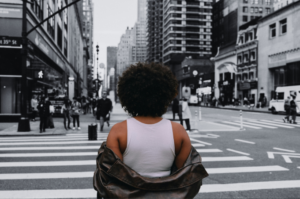
Photo by Sophie Popplewell on Unsplash

E December 05, 2025 07:07
strong and imposing as always