


The Census of the Unregistered
Field Report — Form 4B Series, Ref: KDG/LGA/URP/2024/031
Reporting Officer: Gwamna, S. (Staff No. KDG-1187)
The assignment comes attached to a rubber band. Sandyep removes it before reading, rolls it onto his left wrist with the others already there, a green, a brown, and now this pale yellow one from around the folder. His supervisor, Mallam Shafi’u, watches without comment. Eleven years of watching, and he stopped registering it somewhere around year four.
“Kabala West, then toward Kawo railway side,” Mallam Shafi’u says. “The new list. People who didn’t appear in the digitization.”
The folder holds fourteen names: a spreadsheet printed and paper-clipped, each line carrying a name, an approximate address, and a column marked “Physical Presence Confirmed” that is blank for all fourteen. That blank column is Sandyep’s job. He takes a keke napep to Kabala West junction and walks from there. His bag holds Form 4B pads, three ballpoint pens, a bottle of Eva water, and the lunch his wife Yetunde packed, fried yam in foil, which he will not eat because he never eats in the field. He has told Yetunde this fourteen times in fourteen years. She packs the yam anyway.
The rubber bands on his wrist: thirty-seven. He had counted them.
——-
Subject 1
Malam Tsoho
Approx. 67
Male
Residence: Plot 7B, Ungwan Dosa extension
The compound is a low wall enclosing three structures. A woman drawing water from a plastic drum points without speaking to the left doorway. Inside, an old man sits on a prayer mat, a television behind him showing a muted Kannywood film.
Sandyep presents his identification, explains the purpose of the visit. The old man nods. No birth certificate. No NIN. A son in Zaria registered a SIM card using his father’s name, which put the name in the database: present, then not, then an anomaly requiring investigation. The old man produces a voter’s card from 1999, laminated, the photograph inside sharing only his cheekbones with the man on the mat.
Sandyep writes: Subject present. Documents non-standard. Verbal attestation provided. Recommend secondary verification. The form has a field for distinguishing marks. The old man’s right hand: three fingers missing to the second knuckle, a farm injury in Zonkwa. They speak briefly in Tyap, which surprises the man. Sandyep writes: Right hand, partial amputation, fingers 2-4. He caps his pen. He clicks it open. He caps it again. The form is complete.
——-
Subject 2
Hajiya Rakiya Umar Gwamna
Approx. 54
Female
Residence: Kawo Quarters B, near the railway embankment
This part of Kawo carries groundnut husks and charcoal, the railway embankment rising brown and grassy behind the houses. In the compound Sandyep is directed to, four women sort dried peppers in the yard. None of them are Hajiya Rakiya. A girl of about twelve leads him to a room at the back. Hajiya Rakiya sits upright in a chair, dressed for visitors in a pale green wrapper, a cup of tea at her elbow. Her face is handsome, organized. When she speaks, she uses the particular Hausa of Kaduna women who have negotiated markets and households and disputes for three decades: efficient, exact, with silences that carry instructions.
Her documents burned during the 2000 crisis. Her first husband burned them. She has said this to four different government officers in twenty-four years.
“What will this form do?” she asks.
Sandyep explains: physical presence confirmed, forwarded to the NIN office, secondary registration initiated.
“And if I am not here next time someone comes?”
“The process continues regardless.”
She extends her wrist for the vaccination scar, per the form’s requirement for distinguishing marks. When Sandyep looks at it, the wrist takes a moment to resolve, the scar is there, present, and then continuously present, as though he had expected otherwise. He writes it down.
In the yard, the women sorting peppers do not look up.
——-
Subject 7
Falmata B. (surname unclear)
Residence: Informal settlement, railway embankment east face
This is where the official map ends. The embankment’s east face has no street names. The path was shown to him by a boy selling pure water who pointed and left without waiting for a tip. The structures here are corrugated iron and UNHCR plastic sheeting faded to a translucence that predates the sheeting’s supposed expiry.
Falmata B. is somewhere in her thirties. Seated in the shade of her structure’s overhang, braiding a child’s hair. The child sits with the patience of children accustomed to endurance.
Sandyep presents his identification. Falmata B. reads it carefully. Most people do not.
“Eleven years,” she says, returning the card. “The form has been coming eleven years.”
“This is my first visit to this area.”
“Not you. The form.”
He asks the standard questions. She answers without evasion or urgency. Born in this settlement. Her mother displaced from north of Birnin Gwari in 1992 and again in 2011. No NIN. No documents. The address she gives matches the coordinates he was provided, which means someone else came before, or tried to.
At the field for distinguishing marks, he looks up. The afternoon sun is full on the embankment. No shade where Falmata B. sits, only the overhang above her, which she has positioned herself just beyond. The ground around her feet catches the light. The ground under her feet catches it too. Sandyep writes in the distinguishing marks field: Scar, left forearm, origin unknown. He had not looked at her left forearm. He writes it because the field requires something.
In the field marked “Physical Condition (Reporting Officer’s Observation),” he writes: Within normal parameters. He has never written anything in that field before.
——-
Subject 9
Name: [See notes]
Residence: Informal settlement, embankment east face
There is no Subject 9 on the original list.
She sits twenty meters from Falmata B.’s structure, and she is the only person in the settlement who does not turn to watch him pass. In a settlement where strangers are notable, this registers as its own category.
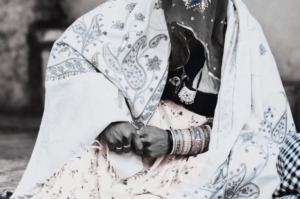
Seventy, perhaps more. A faded red wrapper and a blouse in a fabric Sandyep knows, printed in Kano, popular in the late nineties, rough-weave polyester with a geometric border. His mother owned this pattern. The woman feeds sticks into a small fire, patiently, and the fire takes, the smoke rising straight in the still air.
Subject 10 was on the list. This woman was not. The form had no field for not.
He walks toward her. She looks up when he is close. Her face is deeply lined, the particular work of Kaduna sun across decades. She does not look surprised, more like someone watching a door that has always been in the same place.
“Good afternoon,” he says, in Hausa. “I am from the LGA office.”
“I know what you are,” she says. Gbagyi-accented Hausa, slow, deliberate. “Sit.”
There is no place to sit. Sandyep squats, which is not professional. His form pad rests on his knee.
She tells him her son registered in Minna in 1989. Registered again in Kaduna in 2003. The two registrations cancelled each other, duplication, they said, and removed both. She had been under his registration. When they removed his, they removed her. He writes her name as she gives it: Mama Rikiya Ungwan Gwari. A locational name, a how-people-know-you name. It fills both lines of the name field without abbreviation. He asks her age. She does not know precisely.
Down the embankment, a train moves, the sound arriving before the vibration.
“The fire,” he says. “What are you cooking?”
“Nothing.” She looks at it. “It is a good fire. I like to finish a thing.”
He stops writing.
The smoke rises and, at a height where there is apparently wind, spreads. The woman feeds another stick to the fire. For a moment, the length of a blink, the stick passes through her hand before she adjusts her grip and it is solid again, and the fire takes it, and the smoke rises straight.
Sandyep does not write what he saw. He looks at the form. The field for physical condition is blank. He writes: Within normal parameters. He writes her approximate age as a range. He completes the address field, the NIN status field. Three boxes: Not Registered. Not Previously Registered. Not Registerable Under Current Framework. He ticks the third, which he has never ticked before, which requires a supervisor’s countersignature he does not have, which he will deal with when he deals with it. He attaches this form to the authorized stack with the pale yellow rubber band, the one from the folder, moved now from his wrist to the forms.
She is still feeding the fire when he stands.
“It will go somewhere,” he tells her. “The form.”
She nods in acknowledgment.
——-
End of Field Activity — 16:43
The fluorescent tubes in the LGA office hum their familiar chord, one tube a third above the other. Mallam Shafi’u is at his desk, as two other officers type. The ceiling fan turns at its single speed, as it always has, as it will tomorrow.
Sandyep sits. His bag goes on the floor. He removes the form pad and aligns the completed forms on the desk: fourteen authorized subjects, paper-clipped and ordered by subject number, with the additional form at the bottom, its edges squared with the others.
His standard-issue pen is in his right hand.
He sets it down.
The blue pen is in the outer pocket of his bag.
He takes it out. Clicks it once, twice.
The ink is the same blue. The line it makes is the same width.
He carries the stack to Mallam Shafi’u’s in-tray. Sets it down without a word.
Mallam Shafi’u does not look up.
Back at his desk, Sandyep takes the rubber bands from his wrist and counts them. His lips do not move.
Thirty-eight.
End of record.
Image from Patricia Botezatu from Canva



COMMENTS -
Reader Interactions