

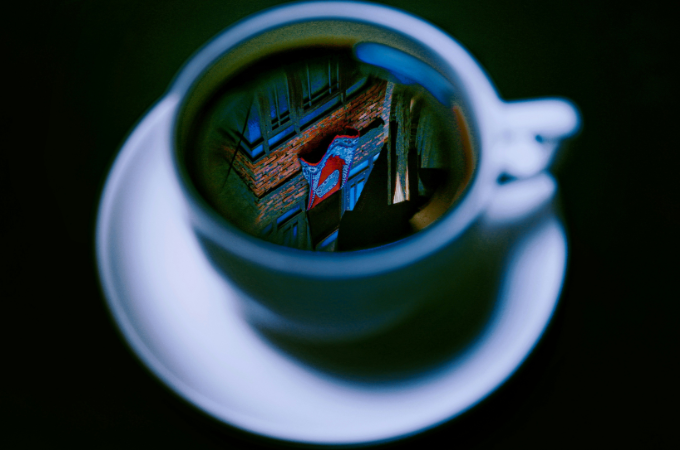
“Love, calm down. It’s not worth it.”
He looked at her—at those empty eyes. The furniture behind her was a blur, as hazy as the love they had once shared. He had been cooking dinner while she did nothing, staring vacantly at the world outside the dim room, the bed standing as a silent witness.
He kept looking, but she remained empty, eyes darker than usual, skin paler than usual, her beauty slightly dimmed.
“You are the reason,” she finally replied.
The reason for what? With her words, a million memories flooded his mind. The night walks, the jacket he lent her to ward off the cold, her smile, the grass ring he had woven for her finger, the way he had knelt before the world just to tie her shoelaces. She had settled in his heart without warning, claiming the land he had inherited from life, only to burn down the olive tree he had spent years tending to for her sake. She had tasted the olives and the oil, she had rested in the shade of their leaves, but in a single moment, it was all forgotten—just as the world forgets suffering, as the callous forget to seek solace, as he had forgotten to take care of himself.
“The reason for what, love?” he asked again, his voice thick with the fear of where this was leading.
“Everything,” she said.
Everything meant the bad. The degree she struggled to earn, the games she played, even the scorching of a pan on a random Tuesday. He fell silent and turned back to his cooking. He knew that arguing would solve nothing. He understood then that this wasn’t about the flaming oil in the pan. He simply knew. And so, he cooked.
The blurriness slowly cleared as the meat tightened in the pan. He turned down the flames and set the meal aside. He dressed in silence, her voice fading into a blur in the background. All he could hear was a receding, “You’re always doing this.”
He knelt down, but this time it was to tie his own shoes. He grabbed only what truly belonged to him—his mind, his thoughts, his phone, and his wallet. He closed the door slowly, feeling the coastal breeze on the back of his neck.
With each step, he counted. One, two, three, four, five. He stopped. He counted again, only to stop at five. Again, and again, and again.
It’s been five months, he thought. Five months since my happiness was pure, since my joy didn’t end with the taste of defeat. Five months since I laughed out of a love for life, rather than to escape the ocean of sadness I was drowning in. Five months—not enough time for a fetus to become a baby, but long enough for a tragedy to mature.
He walked past the same alleyway, past the same stationed cars. The same colors: black, white, gray, blue, and a darker blue—the palette of his last five months. He remembered how they had once hugged and promised forever and beyond. He realized now that “forever” had already passed. He was in the beyond now. The abyss. The Ouroboros of emotions that can never be told and will never be heard.
One, two, three, four… Again, he forgot how to count past five.
He walked past everything. The street was kind of empty, kind of full, but with a strange smell in the air—not the exhaust emitted by cars, nor the scent of the small restaurants nearby, but the smell of a burning desire to feel free. He wanted to feel loved by the one he truly loved, haunted by the scent of her vanilla perfume still trapped in the molecules of every piece of clothing he wore.
“Life, it’s life,” he thought. And just as he couldn’t count past five, the thoughts he had couldn’t contain more than five words. He counted again. Life, one. It, two. Is, three. Life, four. Ironically, he had walked for five kilometers to calm down, searching for the calmness inside of him.
He sat down at his usual coffee shop—not his favorite, nor the best in town. It was a mediocre café on the street, with mediocre service and mediocre coffee, served by a mediocre-looking man in a similarly mediocre cup.
Balancing a cheap cigarette between his lips, he spoke aloud, “One coffee.”
The waiter, surprised by him not saying “please” nor asking about his well-being as usual, looked at him with a bizarre expression and asked, “Are you good? You look sick.”
He looked back at him and answered in three words, “Yes, slightly sick.”
The server silently went to the counter to get the order, no further questions asked, no more words said.
Here, he thought, bodies lose their way here. But souls yearn for home. And just as much as souls yearn for home, the server yearned for a “thank you” after the warm coffee was served, or at least a “please.”
“This book you’re reading is weird,” the server said. “The cover is a bit twisted.”
“Why?”
The waiter, in a bit of shock, replied, “What do you mean, why?”
The man asked again, “Why?”
The waiter, not expecting the answer, threw the tray away and shouted, “There’s no chance at all… we are all trapped… by a singular fate…”
Or, at least, that is what he imagined in the silence between their words.
“You look put together,” the server said, this time not only in the man’s head. “The cover, I assume it’s just the cover, and the book is on philosophy or politics. You are too smart to read about broken love stories.”
The man, sipping his coffee, nodded a yes, and went back to staring into the brown crema on the top of the coffee, and straight through it. He simply wondered, why?
Why do people judge? Why do they assume? He didn’t mean generally, but particularly in the mundane situations we encounter in life. And since he could find no answer looking deep into the coffee’s blackish soul, he sipped. He tasted the sour, sweet notes on his tastebuds. As the warmth slid down his throat, he sensed once again that, for a brief moment in time, he could feel something. He felt that a thing, a soul, a whatever it is, could make the cold breeze inside his chest warm up, giving the cancer trees in his lungs the spring they had long longed for to flourish. He felt the darkness of his thoughts and of his own feelings, but he carried on with small things, like sipping a cup of coffee and smoking a light Camel cigarette. And just as birds decide to hatch, he decided to go back and talk to her.
He texted her randomly, Let’s talk. She ignored it. He called, and she hung up. He went down to the street, grabbing a ride with the last of the money in his pocket, and bought her favorite chocolate and ice cream. He hoped it would soften her a bit, make her talk a bit, make her the way she used to be. But she ignored the calls and the texts. When she finally picked up, she said, “Don’t look for me. I ain’t home.” Hearing that, he thought of his parents randomly.
He recalled the days when he was a kid, how long he would lie awake dreaming in bed. He thought of the games he made with cardboard and glue, and of the rooster he adored playing with—the rooster that adored him back with small gestures of protection, speaking a physical, avian language he barely understood but deeply felt.
He wandered the streets, the alleys, and the places she might be, calling and recalling. He saw nothing but the golden sunlight reflecting off the weirdly sophisticated architecture of the city. He knew one thing: she was not home, and she was not walking. She must be by the sea.
He knew, even through the emptiness and blurriness, that she adored the sea, the breeze, and the vast openness of it. He walked there, his internal compass pointing directly to her. And he found her. She was sitting alone on a high wall, eyes to the sea, her ears blocked by a chaos of thoughts. Sensing his presence, she turned.
He walked slowly, stopping on the count of five. She looked him up and down with each step he took.
“Don’t look for me,” she whispered, standing up.
He walked again, faster this time, moving in a confused blur.
And as he closed the distance between them, she said, “I’m sick, I know, this is the only way to give you the peace you want.”
He couldn’t understand the why—the reason someone could forget, could love, could do the right thing. He just couldn’t understand it. He couldn’t find the right words to express that he felt the same, that he felt pity for her. He wanted to say that he was here, just as he had promised, to make life easier. But he had forgotten that she was the one keeping him stuck, and with that routine came hardship.
So, he simply replied, “Love, calm down. It’s not worth it.”





COMMENTS -
Reader Interactions