

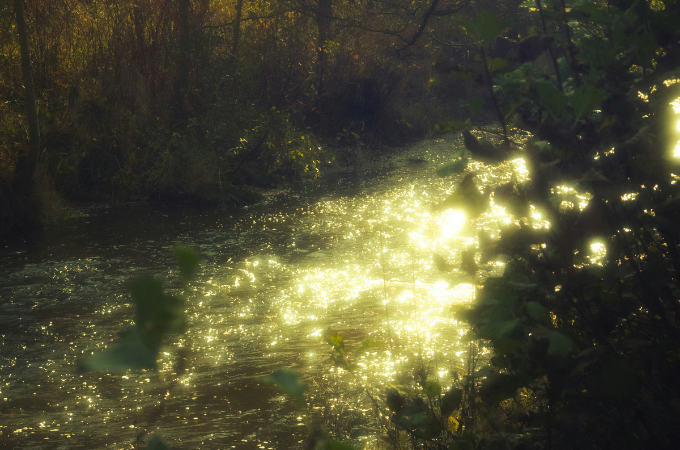
This has been our way for generations. Our fathers did it, as did their mothers’ fathers. When a pain strikes too deep for the body to hold, you bring it here. You stand where the earth meets the rush and you speak it aloud—or you don’t; some things are too heavy for words, anyway. You cast whatever you have into the water: a paring of nail, a braid of hair. Sometimes you offer nothing but the salt of your own eyes, and still, the river takes it all. That is the agreement; that is how it works.
The pain goes in, the river holds it, the person walks away lighter. Nobody asks if it flows east or north or what becomes of it in the west; you don’t ask those kinds of questions about things that… work. We have our fathers’ lightness as proof. We have watched women arrive here bent double in the shape of a bracket and leave standing straight as poles. The water takes; we are unburdened. That has always been enough.
The river is patient. It has claimed the pain of droughts and floods, of famines, of wars that swept through and left the town completely gutted. It has embraced the grief of women whose husbands came back from those wars mentally rearranged, and of men who didn’t come back at all. Postpartum grief, widower pain, collective agony, you name it. The river has seen every single one of these.
It isn’t always smooth. There was the year of the meningitis, when so many children were thrown as tears into the river in a single season that the water went a queer color for three whole weeks: neither red nor brown; something between the two. We waded in anyway. You learn not to look too closely when you are doing something that simply needs to be done.
There is one amongst us who has never brought anything. Ma Bimbo. She comes to the bank with us, stands at the water’s edge, watches. When we ask what she has brought she says: nothing today. We have always found her a little cold, a little withholding. We have said, among ourselves, that she does not trust the river, or does not trust us, which is the same thing. We have not considered that she might simply have nothing she needs to put down; we do not think it’s possible.
Everyone carries something. That is why we have never been profligate with what we bring. We drop only what we cannot hold. We do not bring small things: the odd irritation at a neighbor’s generator, the boredom of a doleful afternoon, the low-level dissatisfaction that is just the tax of being alive. We bring only what has weight, only what bends us, only what, if kept inside long enough, would curdle into illness. We are responsible in this way.
The trouble began the year Mrs Hadeola brought her pain. Not pain as grief. Pain as guilt. Guilt as blood. The pain arrived first in the shape of grief, yes, dressed in the same depthless cloth, standing at the water’s edge the same way. However, what mattered was the core of things, not their appearance. Grief is clean, natural as rain: it falls like tears, soaks into the earth, becomes something else. Pain as guilt is a different chemistry. Guilt has blood in it. And blood, when dropped into water, does not mingle. It suspends. We did not know this.
Mrs Hadeola had kept her daughter from the man who would have been good to her, engineering instead a marriage to a man with prospects, a man who turned out to have only prospects and nothing else—no softness, no hands that knew how to touch without leaving scalding prints. The daughter had been dead three years by the time Mrs Hadeola came to the river. She threw in her nails, all twenty of them. The crimson sat at the bottom, preserved in the cold dark, its teeth sharp, pressing against everything else the river carried.
More came after Mrs Hadeola, once she began to speak of her lightness. A woman brought her shame over an abortion she had needed but had been made to feel ashamed of. Another brought a childhood cruelty she had committed and never confessed, a small thing, a thing so small she had told herself for decades it didn’t matter, and the river absorbed that too, the smallness and all. A man brought the unutterable memory of a deliberate murder, another a quieter betrayal. A mother brought a favoritism so invisible to herself that one child had grown broken and the other never knew they were built on rubble.
These are not griefs; they are the opposite. Grief asks nothing of the person who holds it. Guilt asks for accountability. The river has no mouth for confrontation—it can hold but it cannot judge, cannot absolve, cannot say: yes, you should have done otherwise. Only the people you wronged can say that. And the wronged people were not here.
The river filled.
We did not see it happening. We were too busy arriving with our bundles, too grateful for the relief, our shoulders lifting as we walked home. We told our daughters about the river. Our daughters told their sons.
The rains came.
The water rose. With everything inside it. When it breached its banks, it spread across our compound walls, our farmlands, our children’s playing fields, and it began to leave things behind.
A finger, dried but warm, and when Mrs Hadeola’s grandson picked it up, he put it in his mouth before anyone could stop him. When they found him, he was crying and chewing, muttering that the blood was bitter, even though there was no blood and the finger was really a branch of wood. He cried for three days. He is seven years old, and Mrs Hadeola thinks he sometimes looks at her with a bizarre expression she has never thought of seeing on a child’s face.
A piece of paper, folded. In it, a thick wad of hair Deborah recognized as her own before she realized that she had never cut this much, before her body reacted as if it wasn’t hers, although it smelled exactly like her. She hasn’t shown it to anyone. At night she spreads it open under the lantern and searches relentlessly for the version of herself who might have done this, but she never finds her.
Ma Bimbo walked through all of that mess. She moved through the flooded compound in the early morning when the rest of us were still inside, looking at what the river had left. We watched her crouch to examine things, touch them sometimes, leave them where they lay. When she came inside, she smelled of the river, and she looked at each of us with an attention that made us want to look away, and we did, and she let us. Later, when we went out ourselves, we found a small thing near where she had crouched: an eye, or a living seed—we couldn’t agree—that had not been there before. She has not mentioned it. We have not asked.
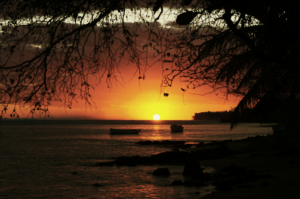
The river is still out there. Wide, full of everything we gave it and everything it wants to give us in return, and sometimes in the early morning when the light comes at a low angle across the water we can see something moving below the surface, something that looks, that sees, that has blood but no blood, something that smells of pain as guilt.
We don’t go to the bank alone anymore.
Ma Bimbo goes alone. We watch her from a distance and tell ourselves she will soon stumble upon whatever she thinks she’s looking for, ending up just like the rest of us. So far, she hasn’t.
Photo by Leonardo Scharm on Unsplash


COMMENTS -
Reader Interactions